
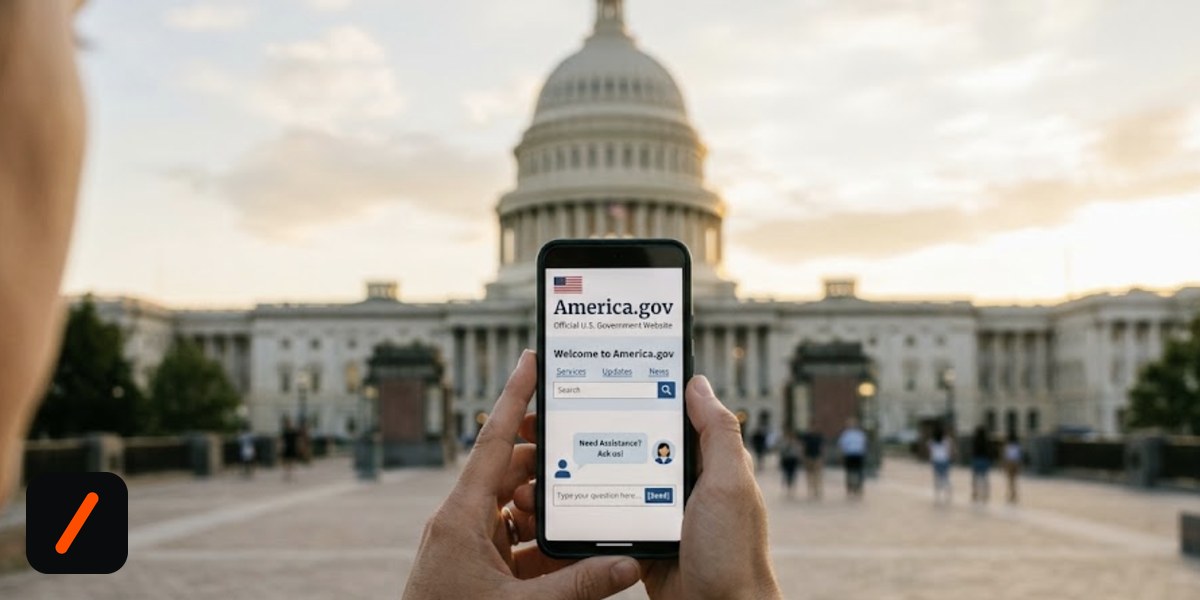
America.gov is now live: a chatbot that answers questions about federal services by reading roughly 29,000 government websites, and it needs no account. The Trump administration launched it on September 29, 2026, and it runs on Google's Gemini and xAI's Grok. Today it only answers. By early 2027 it is supposed to file things for you, and that is the part worth watching.
- America.gov is a single chat box over about 29,000 federal sites, built to give answers from official government sources only, with no sign-in.
- Per US Chief Design Officer Joe Gebbia, it runs on Gemini and Grok. The privacy notice says AI providers do not retain prompts or responses, and answers are cached for up to two hours using hashed prompts.
- Planned for early 2027: completing forms, applications and renewals on the site, including Medicare enrollment and passport applications, with Login.gov handling identity.
- Still unexplained: the contracts with Google and xAI, the procurement details and how the privacy protections actually work.
What is America.gov, exactly?
It is a front door. Instead of knowing which agency owns a task and hunting through its site, you type or speak a question into a chat interface and the system finds the answer across federal websites. Gebbia, the Airbnb co-founder now serving as US Chief Design Officer, described it as users asking for what they need while the system scans tens of thousands of sites on the back end. When an agency changes a page, that change becomes available in real time. Engadget summarized the design goal as using AI to get simple answers only from official government sources.
RelatedGoogle Tests a Flipkart Buy Button Inside Gemini in India
The launch examples are ordinary on purpose: replacing a Social Security card, registering to vote, comparing Medicare plans, registering a business. It goes live with an identity hook already in place, since it integrates with Login.gov for verification. The team behind it includes Peter Arnell as Chief Brand Architect and lead engineer Edward Coristine, a DOGE member. Elon Musk is credited for the initial vision and for recruiting, and FedScoop reports the work began almost on day one of the administration.
How does it differ from USA.gov and a search engine?
The federal government already has a portal, USA.gov, run by GSA. It is a directory: you browse, it points. A plain web search gives you links ranked by an outside company, some of them from sites that only look official. America.gov tries to collapse both steps into one answer with official sourcing.
| Question | America.gov | USA.gov | Plain web search |
|---|---|---|---|
| Interface | AI chat, type or voice | Directory and site search | Ranked links |
| Sources | About 29,000 federal sites | Federal pages and agency links | Whole web, mixed quality |
| Account needed | No | No | No |
| Identity check | Login.gov integration | Not disclosed | None |
| Handles forms | Planned by early 2027 | Links out to agencies | No |
| Contracts and model terms | Not disclosed | Not applicable | Not applicable |
How does it probably work under the hood?
This section is our analysis, not something the government has published. A system that answers only from a defined set of pages is almost certainly retrieval-augmented generation, or RAG: a search step finds relevant passages on federal sites, then a language model writes a plain-English answer grounded in them. The real-time update claim fits that design, because retrieval reads the live pages instead of relying on what a model memorized during training.
RAG fixes a lot, and it does not fix the failure that matters most here: the confident wrong answer. Eligibility rules and deadlines are exactly where a model can blend two agency pages, pick a stale one, or flatten a caveat into a clean yes. A wrong answer about a filing date is worse than a search result you have to read yourself, because the tidy tone discourages a second look. The cache adds one more property. Because answers are stored for up to two hours against a hashed prompt, identical questions get identical answers, which is good for consistency and means one bad answer repeats until it expires.
The two-vendor setup is also a design choice with tradeoffs. Running Gemini and Grok gives the service a fallback and lets it compare behavior, but two models can phrase the same rule differently, and the public has no detail on how the two are routed. Engadget noted Grok's role had not been officially announced when it published, so the routing question is still open.
Is your data safe when you use it?
The privacy notice makes specific promises. It says AI providers do not retain your prompts or responses. Cached responses are keyed on hashed prompts, not raw text. It does not collect precise GPS and approximates your location. It tells users to share minimal information and says it tries to stop people from submitting personal details in the first place.
RelatedCalifornia's AB 1709 Would Strip Under-16 Feeds of Algorithms
Those are reasonable statements for a question-answering tool. FedScoop's point is that the mechanisms behind them were not detailed, and the contracts with Google and xAI are undisclosed. Engadget flagged the tension: the 2027 plans, like Medicare enrollment and passport applications, need extensive personal data, which sits awkwardly beside a tool built to discourage sharing it. The launch also lands in a rough year for AI security. We covered OpenAI apologizing to the Australian government over a breach and Meta's Muse AI reading private messages, and both are a reminder that "we don't retain it" is a claim to verify, not a guarantee.
What changes between 2026 and 2027?
- Early 2025Work begins. FedScoop reports it started almost on day one of the administration.
- Sep 29, 2026America.gov goes live. Around 10 a.m. ET, no account required, Gemini and Grok behind the chat.
- Early 2027Transactions arrive. Forms, applications and renewals on-site, plus progress tracking such as a name change after marriage.
The jump from answers to transactions is where the risk profile changes. A wrong answer costs you time. A wrong submission can cost you a benefit or a deadline, and a system holding your identity and application data becomes a far more attractive target than one that only reads public pages. The government also already has tools for the plumbing: GSA's OneGov negotiates low-cost AI deals for agencies, and USAi is a multi-model platform for agencies. How America.gov relates to them has not been spelled out.
- Accuracy on deadlines. Test it on date-sensitive and eligibility questions and check the cited source page every time.
- Published contracts. Whether the Google and xAI terms, and the retention terms behind the privacy notice, become public.
- Model routing. How Gemini and Grok are used, and whether the site says which one answered.
- The 2027 handoff. What data the form-filling step stores, for how long, and how Login.gov limits it.
Our take
Federal services are hard to navigate, and a single searchable front door is a legitimate fix. Grounding answers in official pages is the right architecture, and skipping the account requirement lowers the barrier for the people who need help most. That said, the launch is ahead of its own paperwork. A tool that speaks for the government should show its sources on every answer, publish how it is evaluated for accuracy, and put the privacy mechanisms in writing before it starts touching passport and Medicare data. Judge America.gov on the 2027 version, and until then treat every answer as a pointer to the official page, not a replacement for it.
- OfficialAmerica.gov the portal and its privacy notice
- ReportingFedScoop launch, team and unanswered procurement questions
- ReportingEngadget privacy tension and the 2027 plans
- ReportingCNBC Gemini and Grok details
- ReferenceLogin.gov the federal identity verification service
Original analysis by GenZTech, based on FedScoop and launch coverage.