
Velaura AI, the chip startup formerly known as Auradine, announced on August 18, 2026 that it closed a $110 million Series A, a round that pushed its valuation past $1 billion. The money is chasing a specific bet: that power, not raw transistor count, is now the thing actually limiting how much AI compute the world can deploy.
- Seligman Ventures led the round, joined by new investors Capricorn Investment Group and Prosperity7 Ventures, alongside existing backers Mayfield, Maverick Silicon, MARA, Premji Invest, Samsung Catalyst Fund, and StepStone Group.
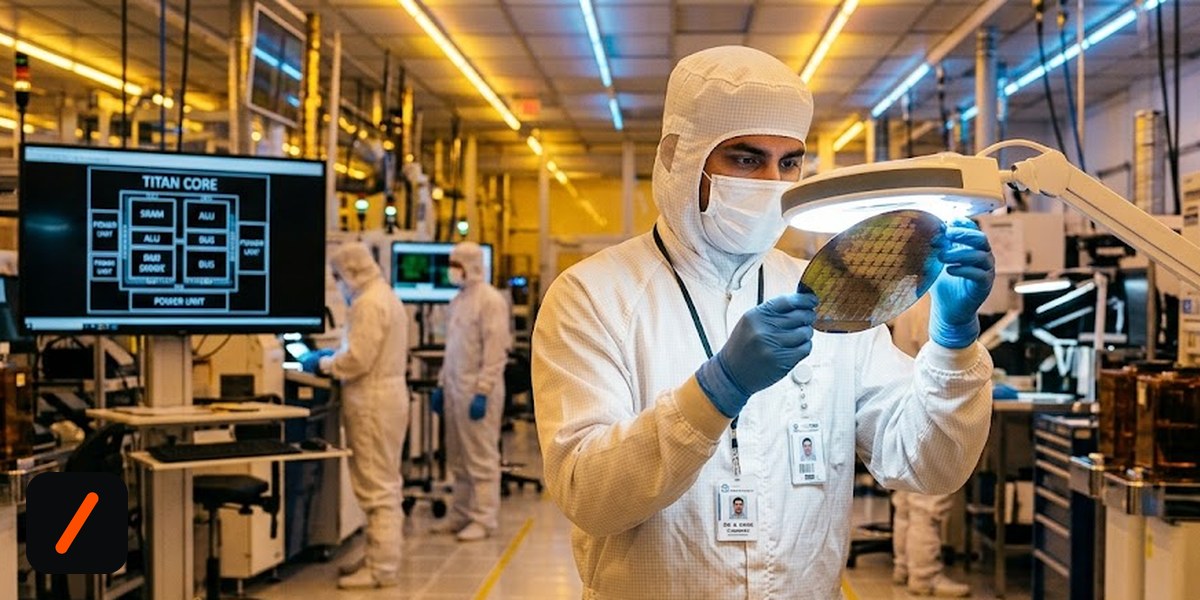
- Velaura's flagship product, Titan Core, is a silicon design and IP platform that targets up to 2x lower overall power for AI accelerators, which the company says can free up roughly 500W on a typical 1000W GPU or XPU.
- The underlying low-power techniques are not new lab work. They're already running in production across more than 30 million ASICs on leading process nodes.
- Co-founder and CEO Rajiv Khemani and co-founder and Chief Development Officer Manu Gulati lead a team stacked with veterans from Apple, Nvidia, Google, Qualcomm, and Marvell.
Titan Core is the pitch. Here's roughly how Velaura frames where that power goes on a typical accelerator, and how much of it the platform claims to reclaim.
RelatedSnorkel AI Hits $3.5B Valuation in $350M Series E
Why is power suddenly the bottleneck in AI data centers?
For most of the last decade, the AI infrastructure story was about buying more chips. That story is running into a wall that has nothing to do with silicon supply. Hyperscalers are increasingly capped by how much electricity they can pull into a building and how much heat they can pull back out of it. Grid interconnects take years to build. Cooling capacity is finite and expensive to expand. When a data center campus is power-constrained rather than chip-constrained, the fastest way to add useful compute isn't ordering more GPUs, it's making the GPUs you already have (or plan to buy) draw less power per unit of work. That's the gap Velaura is stepping into, and it's a genuinely different problem than the one Nvidia, AMD, and the custom-silicon teams at Google and Amazon have spent most of their effort on.
What does Titan Core actually change at the silicon level?
Titan Core isn't a chip. It's a design and IP platform that other silicon teams can license and build into their own AI accelerators. Velaura says it targets up to 2x lower overall power for a given chip, which the company translates into as much as 500W of savings on a typical 1000W GPU or XPU. The company's own messaging frames that as a 2-4x jump in performance-per-watt rather than a straight 2x cut, since some of the reclaimed power headroom can be redirected into running the chip harder instead of just running it cooler. Either framing points at the same lever: squeeze waste out of the parts of a chip that draw current without doing useful math, and you get more AI work per watt without waiting on a new process node.
Why do 30 million already-shipped ASICs matter more than a lab demo?
Plenty of power-efficiency startups show a slide with a simulated power curve and call it proof. Velaura's argument is different: the low-power techniques inside Titan Core are already deployed in production across more than 30 million ASICs on leading process nodes. That's a meaningfully different claim than "we modeled this in simulation." Production silicon at that volume has been through real yield, real thermal behavior, and real customer qualification cycles, which is exactly the kind of evidence a hyperscaler's silicon team would want before betting a next-generation accelerator design on someone else's IP block.
Titan Core's pitch beyond the data center
Velaura isn't stopping at racks. The company is positioning Titan Core for what it calls Physical AI: robotics, drones, and other autonomous systems where battery life and thermal budget matter just as much as raw compute. A humanoid robot or a delivery drone doesn't have a data center's cooling infrastructure to lean on, so a chip that does the same AI inference work at half the power is arguably a bigger unlock outside the data center than inside it. It's a natural adjacency for a power-efficiency IP company, and it broadens Velaura's addressable market well past the hyperscaler GPU conversation that's driving most of the funding headlines this cycle.
Who's actually running Velaura, and does the pedigree matter?
CEO Rajiv Khemani and Chief Development Officer Manu Gulati co-founded the company, and the leadership bench around them is drawn from Apple, Nvidia, Google, Qualcomm, and Marvell. In a category this technical, that resume list functions as a credibility signal in its own right. Power-efficient silicon design is a narrow, hard-won discipline, and investors writing nine-figure checks into a company that rebranded from Auradine are, in part, betting on the people who've already shipped chips at that scale elsewhere rather than on a first-time team promising to figure it out.
RelatedTemporal Raises $550M Series E at $12.55B, 2.5x in 7 Months
What the valuation says about where investors think the money goes next
Crossing a $1 billion valuation on a Series A is unusual even by 2026 AI-funding standards, and it's worth reading as a signal rather than just a number. The signal for investors tracking AI infrastructure spending is that power efficiency, not additional raw compute, is increasingly seen as the next bottleneck worth funding. Velaura says it's already engaged with multiple hyperscalers, and for those customers, tens to hundreds of millions of dollars in electricity, cooling, and infrastructure savings at data-center scale is the kind of number that justifies paying for licensed IP rather than building the equivalent in-house. None of this is investment advice, and a single funding round doesn't confirm a market. But readers tracking where capital is flowing in AI infrastructure can compare this round against other recent deals on GenZTech's live funding tracker and see how it stacks up on the site's ranked list of the biggest AI funding rounds.
Our take
The rebrand from Auradine to Velaura AI could read as a red flag, a change of identity right as the company crosses a headline valuation. But the underlying story holds up better than most: this isn't a startup promising a power breakthrough from a whiteboard, it's one pointing at 30 million shipped ASICs as evidence the core technology already works in the field. That's a stronger foundation than most Series A pitches get to stand on. The bigger question is whether "power efficiency IP" can scale as a standalone business the way Arm scaled CPU IP licensing, or whether hyperscalers with the resources to do so eventually just build equivalent techniques into their own custom silicon and cut Velaura out. For now, the investor list, particularly Samsung Catalyst Fund and MARA sitting alongside data-center-focused firms, reads like a bet that the licensing model wins before that happens.
- OfficialVelaura AI Series A announcement Aug 18, 2026
- AnalysisMoor Insights & Strategy research note on Titan Core
- FundingPulse2 coverage of the raise and valuation
- OfficialPR Newswire: Titan Core product announcement
Original analysis by GenZTech. Sources: Velaura AI, Moor Insights & Strategy, HPCwire.