
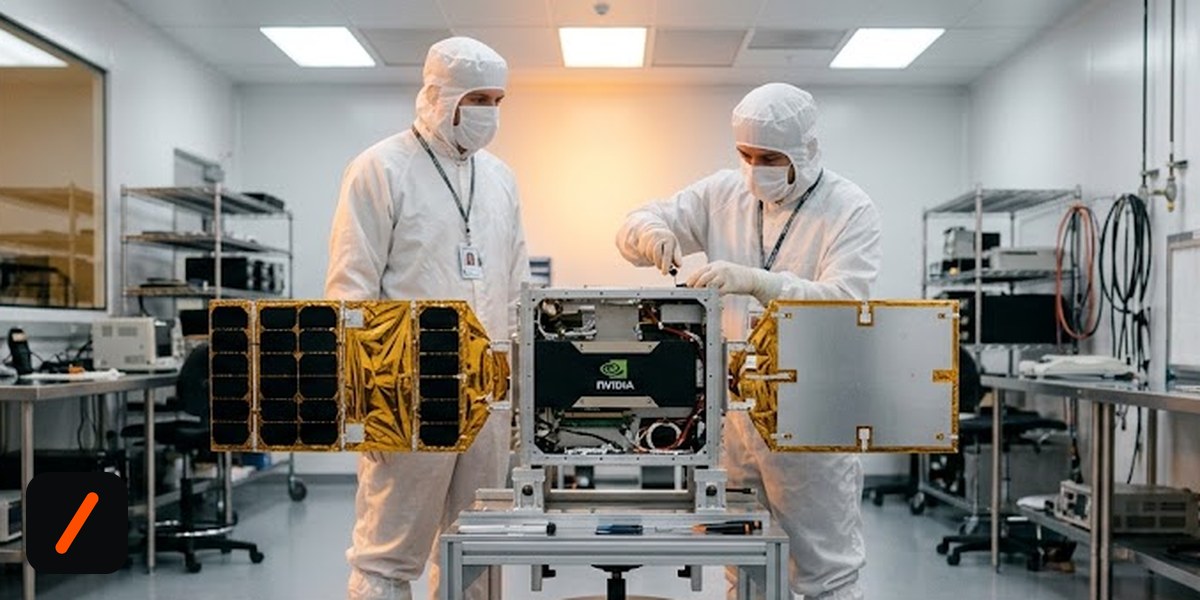
Starcloud, a Redmond, Washington startup building data centers meant to orbit Earth, raised $250 million on August 21, 2026, at a $2.3 billion valuation. Investors are betting orbit fixes AI's power problem. Run the numbers honestly, and the real constraint is getting enough mass off the ground.
- Manhattan West led the $250M round. Nvidia, Cisco Investments, Cedar Capital, Goanna Capital and Standard Capital joined as new investors, alongside returning backers Benchmark, EQT, Soma, NFX and 776.
- The valuation more than doubled in five months, from $1.1 billion in March 2026 to $2.3 billion now, on one satellite in orbit.
- Starcloud's long-term goal is 88,000 satellites and 20 gigawatts of orbital compute, far bigger than anything the rocket industry flies today.
- A new 100,000 square foot Woodinville, Washington facility will build the next-generation Starcloud-3 spacecraft.
What Starcloud just announced
Manhattan West led the round. Existing backers Benchmark, EQT, Soma, NFX and 776 returned, and Nvidia, Cisco Investments, Cedar Capital, Goanna Capital and Standard Capital joined for the first time. That brings Starcloud's total raised to $450 million in two years since its 2024 founding, fast for a company that builds spacecraft rather than software.
RelatedLovable raises $400M at $13.3B, doubling in eight months
Starcloud has one satellite to show for it. Starcloud-1 launched in November 2025 carrying the first data-center-grade GPU flown in orbit, roughly 100 times more GPU compute than had previously existed in space, and trained the first AI model there. Starcloud-3 production now moves into a new 100,000 square foot Woodinville facility near Redmond.
Why is orbit suddenly pitched as the fix for AI's power problem?
The pitch is simple. A satellite in the right orbit sees the sun almost constantly, versus the 25 to 30 percent daily uptime a ground solar farm gets, with no interconnection queue and no permitting fight. Space also offers a near-free cold sink: radiate heat outward and it's gone, no chillers, no cooling towers.
Nvidia's presence on the cap table is the detail worth sitting with. It already sells the GPUs and invests in the clouds renting them out, and now it's backing a different place to put them. A day before this round closed, Nvidia signed a roughly $6 billion licensing deal with Poolside, two very different bets inside 48 hours. That reads like hedging across the compute stack, not one layer.
What would 20 gigawatts in orbit actually take?
Starcloud's stated long-term vision is 88,000 satellites and 20 gigawatts of orbital compute. That figure is Starcloud's own. Everything from here is our own back-of-envelope estimate built on public industry figures, not a Starcloud number, worth walking through since most coverage skipped it.
A modern rack like Nvidia's GB200 NVL72 draws around 120 kilowatts and weighs about 1.4 metric tons including cooling. Swap ground cooling for radiators and you need similar mass just for the compute. Twenty gigawatts divided by 120 kilowatts is roughly 167,000 racks; at 1.4 tons each, that's on the order of 230,000 metric tons before solar panels or radiators are even added.
Heat is the other half. In vacuum there's no air to convect into, so waste heat leaves only as radiated infrared. Spacecraft radiators typically manage a few hundred watts per square meter. Run that against 20 gigawatts and you land on tens of millions of square meters, tens of square kilometers unfolded in orbit. That's not impossible, but the constraint was never capital or GPU supply. It's how much mass and radiator area fits in a fairing.
Is launch capacity really the bottleneck?
TechCrunch framed this round bluntly: Starcloud is raising money "as launch options dry up." That's a real supply problem. Launch cadence has grown fast, mostly on SpaceX's own Starlink buildout, but a heavy-lift rocket still carries roughly 20 to 60 metric tons to low Earth orbit, and only a handful of vehicles fly that class regularly. Scaling to hundreds of thousands of tons means years of dedicated launches, or heavy-lift capacity that doesn't exist yet.
The counterarguments deserve equal weight. Radiation degrades electronics faster in orbit, and with no technician to swap a failed GPU, failures are closer to permanent. Round-trip latency runs to hundreds of milliseconds, ruling out entire workloads no matter how cheap the compute gets. None of that kills the idea. It makes orbital compute a bet on a narrower slice of AI work than "data center" usually implies, for now.
RelatedSnorkel AI Hits $3.5B Valuation in $350M Series E
| Orbital | Terrestrial | |
|---|---|---|
| Power source | Continuous solar in the right orbit | Grid interconnection, gas or nuclear backed |
| Cooling mechanism | Radiative panels into vacuum, no air to convect into | Water or air cooling, chillers, towers |
| Latency | Hundreds of ms round trip, orbit dependent | Single to low double-digit ms |
| Servicing | No technician, failures near-permanent | Technician swaps hardware same day |
| Binding constraint | Launch capacity, cost per kg to orbit | Grid capacity, permitting timelines |
- 2024Starcloud is founded Redmond, Washington
- Nov 2025Starcloud-1 launches first data-center GPU in orbit, first AI model trained in space
- Mar 2026$170M raised at $1.1B first major valuation marker
- Aug 21 2026$250M extension at $2.3B led by Manhattan West, Nvidia joins
- AheadStarcloud-3 and the 88,000-satellite goal 20 gigawatts of orbital compute, years from proof
What it means for the market
A $1.1 billion valuation in March becoming $2.3 billion in August, on one satellite and an unbuilt constellation, shows how aggressively investors are pricing the AI power bottleneck. Grid interconnection queues stretch years in parts of the U.S., and that scarcity is pulling capital toward any credible alternative. See how this round compares in our Funding Tracker.
The signal for investors watching Nvidia is that it's no longer just selling into the buildout, it's placing bets across the whole supply chain: GPUs, cloud investments, an inference deal with Poolside, and now equity betting compute eventually leaves the ground. Cisco Investments joining is a smaller, related signal, since Cisco's business also depends on enterprises needing capacity somewhere. None of this is investment advice about Nvidia, Cisco, or anything named here, it's a read on where two companies with real demand visibility are placing bets.
- Launch manifests. Slots actually booked for Starcloud-3, not cash on hand.
- Thermal data. Real radiator performance from Starcloud-1, not simulations.
- Nvidia's next move. One-off bet, or a pattern across future rounds.
- Rival entrants. Whether other orbital-compute startups clear a second launch.
Our take
The physics is harder than the pitch admits. Continuous solar power and a free radiative sink are real advantages, and Starcloud already proved the idea by training a model in orbit. But going from one satellite to 88,000, and from proof of concept to 20 gigawatts, runs into a launch industry nowhere near sized for that cargo, on an undisclosed timeline.
We'd rather see real numbers next: radiator performance from Starcloud-1 after months in orbit, actual Starcloud-3 manifests, a per-kilogram cost target that closes the math above. Until then, this valuation bets on a power problem Starcloud has solved for one small piece of what it says it eventually needs.
- FundingStarcloud Raises $250 Million at $2.3 Billion Valuation : Business Wire
- ReportingStarcloud raises $250M as launch options dry up : TechCrunch
- ReportingNvidia joins Starcloud's $250 million round : SpaceNews
- ReportingStarcloud adds $250M to Series A at $2.3B : Via Satellite
- GENZ TECHFunding Tracker : every AI round we've covered
- GENZ TECHBiggest AI Funding Rounds : our ranked largest AI raises
Original analysis by GenZTech, with reporting from TechCrunch.