
Alphabet reported second quarter results after the US market close on July 22, and the headline number is the wrong one to look at. Net income rose 298% and earnings per share hit $9.11, but almost three quarters of that came from an unrealized paper gain on equity holdings. The two figures that actually describe the business: Google Cloud revenue grew 82% to $24.8 billion, and Alphabet's own free cash flow went negative for the quarter, at minus $5.9 billion, because capital spending doubled to $44.9 billion.
- Cloud is the story. Google Cloud revenue rose 82% year over year to $24.8 billion, well past the roughly $22.4 billion analysts modelled, and its operating income more than tripled to $8.8 billion.
- The profit explosion is mostly paper. A $99.0 billion net gain on equity securities added $77.1 billion to net income and $6.26 to diluted EPS. Excluding it, EPS was about $2.85 against $2.31 a year ago.
- Free cash flow turned negative. Operating cash flow of $39.1 billion did not cover $44.9 billion of capex, producing negative $5.9 billion, Alphabet's first negative quarter in the four-quarter series it published.
- Alphabet funded the gap externally. It raised $49.6 billion of equity and $20.3 billion of notes in the quarter, doubled long-term debt to $98.2 billion, and repurchased no stock at all, against $13.2 billion of buybacks a year ago.
What did Alphabet actually report?
Consolidated revenue was $119.8 billion, up 24% and up 23% in constant currency, against a consensus near $116.9 billion. Google Services revenue rose 15% to $94.5 billion. Inside that, Google Search and other grew 17% to $63.3 billion, subscriptions, platforms and devices grew 15% to $12.9 billion, and YouTube ads grew 13% to $11.1 billion. Google Network, the third-party ad business, was the one line that shrank, slipping to $7.30 billion from $7.35 billion.
RelatedGoogle Is Quietly Killing Gemini's Free Gems for Paid Skills
Operating income rose 30% to $40.8 billion and operating margin expanded two points to 34%. That is the clean read on the operating business, and it is genuinely strong. Evercore had set the bar at 17% or better Search growth and 70% or better Cloud growth for the quarter to count as a beat. Alphabet cleared both. Shares still traded roughly flat immediately after the release, which tells you the market had already priced the growth and was reading the spending line instead.
Why is the 298% profit jump misleading?
Other income, net came in at $98.0 billion against $2.7 billion a year ago. Alphabet breaks the driver out on page nine of its release: a $99.0 billion net gain on equity securities, which it states includes unrealized as well as realized gains. The company also does the reader's arithmetic, disclosing that the gain increased the tax provision by $21.9 billion, net income by $77.1 billion, and diluted EPS by $6.26.
Back that out and the picture is ordinary in the best sense: roughly $2.85 of underlying EPS against $2.31, growth in the low twenties, in line with revenue and operating income. The balance sheet shows where the mark came from. Non-marketable securities went from $68.7 billion at the end of December to $131.5 billion at the end of June. These are stakes in private companies, revalued upward, not cash that arrived. Alphabet warns in the same footnote that these swings "could significantly contribute to the volatility" of the line in future periods, which is a polite way of saying a down round somewhere reverses it.
How did Google Cloud grow 82%?
Cloud is now 20.7% of Alphabet's revenue, up from 14.1% a year ago, and it grew faster than it did when it was a fifth of the size. Alphabet credits enterprise AI infrastructure and enterprise AI solutions on top of core Google Cloud Platform services. Sundar Pichai said nearly 90% of the Fortune 100 now use Gemini Enterprise, that Gemini models process 22 billion API tokens per minute, and that the Gemini app has 950 million monthly active users. CNBC reported cloud backlog of $514 billion, which is the number that turns one quarter into a multi-year revenue schedule.
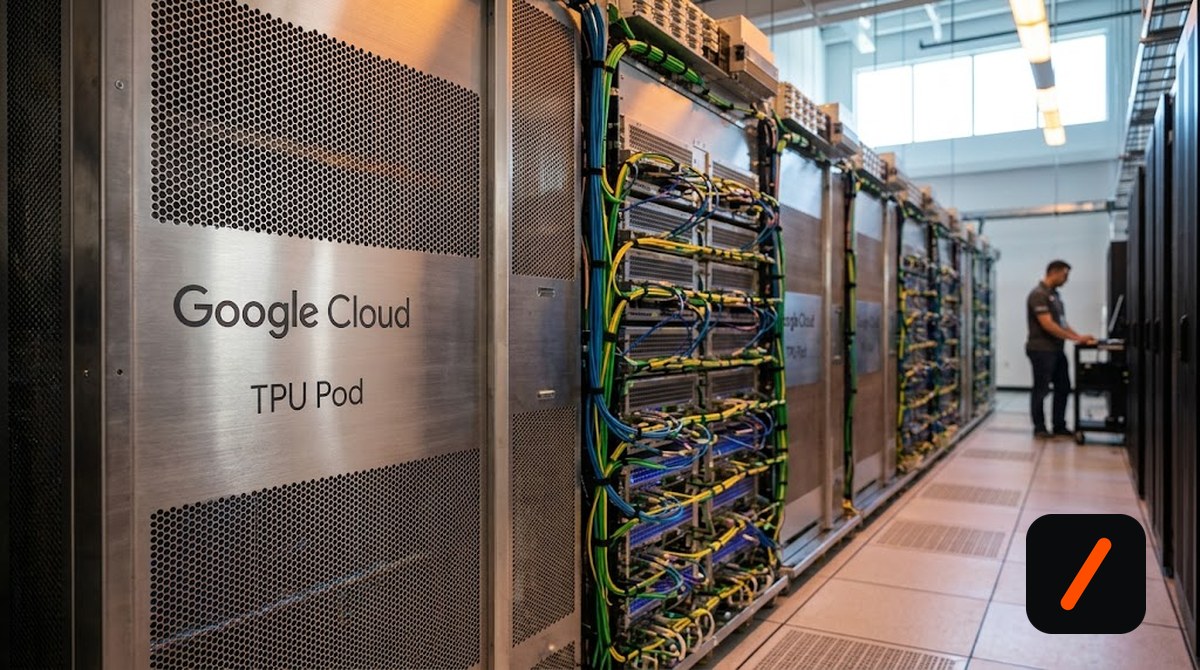
The mechanism most coverage will skip is in the segment definition. Alphabet states that Google Cloud "generates product revenues primarily from the sale of TPU systems." Google is not only renting AI compute, it is selling the silicon systems. Inventory backs that up: it went from $2.4 billion at year end to $10.0 billion at the end of June, a fourfold build that is very hard to explain with Pixel phones alone. Selling hardware is lower margin than renting it, yet Cloud's operating margin still went from 20.7% to 35.6%, and its operating income tripled from $2.8 billion to $8.8 billion. That combination is the single most impressive thing in the release.
| Line, quarter ended June 30 | 2025 | 2026 | Change |
|---|---|---|---|
| Total revenues | $96.4B | $119.8B | +24% |
| Google Search & other | $54.2B | $63.3B | +17% |
| YouTube ads | $9.8B | $11.1B | +13% |
| Google Network | $7.35B | $7.30B | -1% |
| Google Cloud | $13.6B | $24.8B | +82% |
| Cloud operating income | $2.8B | $8.8B | +212% |
| Capital expenditures | $22.4B | $44.9B | +100% |
| Free cash flow | $5.3B | -$5.9B | negative |
| Stock repurchases | $13.2B | $0 | halted |
What does negative free cash flow mean for Alphabet?
It does not mean Alphabet is short of money. The company closed the quarter with $242.5 billion in cash, equivalents and marketable securities, up from $126.8 billion at year end. What it means is that the AI build is now larger than the cash the business throws off, and Alphabet has switched to funding it from the capital markets rather than from operations.
RelatedGoogle DeepMind Maps All 9 Billion Human DNA Mutations
The evidence is stacked through the filing. In June it issued Class A and Class C stock plus mandatory convertible preferred for $49.6 billion of net proceeds, explicitly earmarked in part for "capital expenditures to scale AI infrastructure and global compute," and set up an at-the-market program for up to $40 billion more. It issued senior unsecured notes for another $20.3 billion. Long-term debt went from $46.5 billion to $98.2 billion in six months, and quarterly interest expense went from $261 million to $1.28 billion. Buybacks, which ran at $13.2 billion in the year-ago quarter, were zero. Depreciation is already following the capex curve, up 42% to $7.1 billion, and that is the charge that will compress margins for years after the servers land.
- Q2 2025Capex $22.4B free cash flow positive $5.3B
- Q3 2025Capex $24.0B free cash flow $24.5B
- Q4 2025Capex $27.9B free cash flow $24.6B
- Q1 2026Capex $35.7B free cash flow falls to $10.1B
- Q2 2026Capex $44.9B free cash flow negative $5.9B, buybacks halted
- H2 2026Trailing capex already $132.4B watch the guidance on the earnings call
What it means for the market
The signal for investors is that Alphabet has moved from an ad company that happened to own a cloud into an infrastructure company financing a build cycle. That reprices the risk rather than removing it. Three exposures are worth watching. First, the suppliers: $44.9 billion of quarterly capex, doubling year over year, lands on Nvidia, Broadcom and the networking and power supply chain, and Alphabet's own TPU systems sales make it a competitor to some of them at the same time. Second, the cloud comparison set: 82% growth at a $99 billion annualized run rate raises the bar Microsoft Azure and Amazon Web Services will be measured against when they report. Third, Alphabet itself: the equity gain flatters every trailing valuation ratio built on GAAP earnings, so screens keyed to reported EPS will show a company that suddenly looks far cheaper than the operating business justifies. None of this is a recommendation, and the earnings call is where the forward capex number gets set.
Our take
This is a strong quarter wrapped in a misleading headline. Strip the accounting noise and Alphabet grew revenue 24%, expanded operating margin two points, tripled cloud profit, and did it while absorbing a $5.8 billion drag from unallocated AI research at the corporate level. That is a company executing.
The honest concern is not demand, it is duration. A $514 billion backlog and 82% growth say the revenue is contracted. But a business that funds its build with $70 billion of fresh capital in one quarter, halts buybacks, and books negative free cash flow has taken on the risk profile of a utility construction project. It works if AI demand holds for the eight to ten years those assets depreciate over. Watch the capex guidance rather than the EPS print.
- Forward capex. The number set on the call matters more than anything in the release. Another step up above $45 billion a quarter keeps free cash flow negative into 2027.
- Cloud margin durability. 35.6% operating margin while selling TPU hardware is the claim to test next quarter. If hardware mix grows, margin should give some of that back.
- Buyback restart. Zero repurchases is the loudest capital-allocation signal in this filing. A restart would say management thinks the peak spend is behind it.
- The equity mark reversing. A $99.0 billion unrealized gain can swing the other way. Expect volatile GAAP earnings for as long as the private-company stakes stay this large.
- OfficialAlphabet Investor Relations, Q2 2026 results , the earnings release, segment tables, cash flow statement and free cash flow reconciliation used throughout this piece
- FilingAlphabet SEC filings, EDGAR , the Form 10-Q for the quarter ended June 30, 2026 carries the full detail on the equity securities gain
- ReferenceGENZ TECH AI coding leaderboard , independent SWE-bench Verified scores for the Gemini models this cloud growth is selling
Original analysis by GenZTech, built from Alphabet's Q2 2026 earnings release and consolidated financial statements. Reported figures cross-checked against CNBC's earnings coverage. Nothing here is investment advice.