
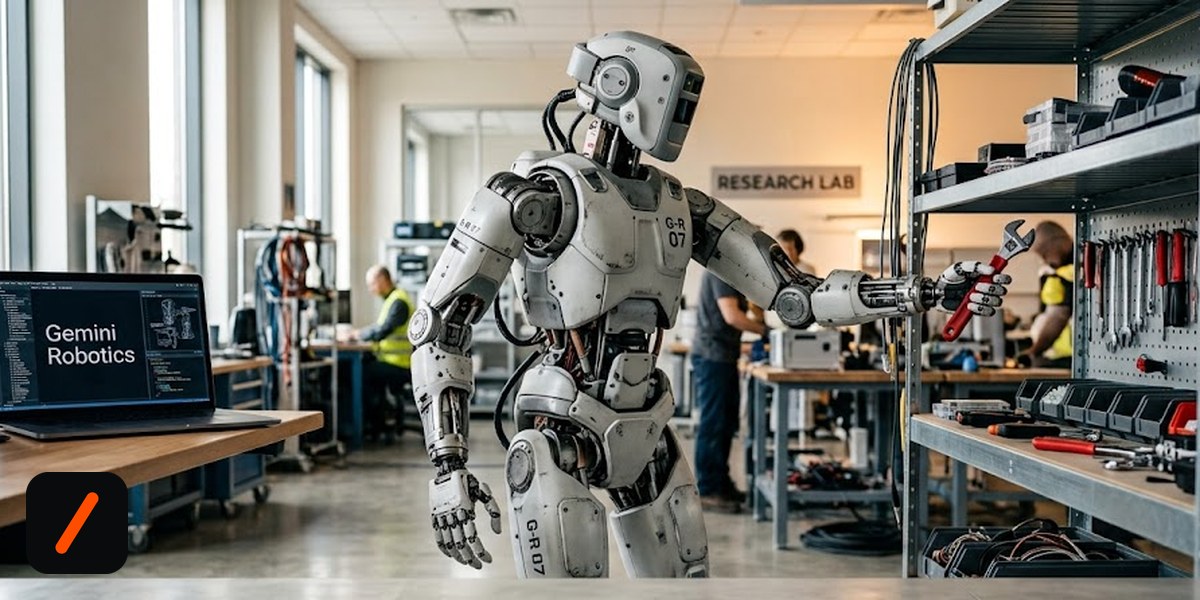
Google DeepMind published Gemini Robotics 2 this morning, and the change is anatomical. The model now drives a humanoid's legs, torso, arms and hands inside one control loop, instead of running a pair of arms bolted to a table. Three models shipped together: Gemini Robotics ER 2 does the reasoning, Gemini Robotics 2 turns that reasoning into motion, and Gemini Robotics On-Device 2 runs the whole thing on the robot with no network in the path.
DeepMind also published its own task success rates, which is the part worth slowing down for. They are real numbers on real hardware, and several of them are nowhere near solved.
RelatedApple Opens Its On-Device AI to Claude and Gemini
What actually shipped?
One release, three distinct models, each aimed at a different layer of the problem:
- Gemini Robotics ER 2 is a vision-language model that acts as the high-level planner. It sequences multi-step jobs, holds a conversation about what it is doing, and coordinates more than one robot at a time. Available now in Google AI Studio as a preview, and in the Gemini Enterprise Agent Platform under private preview.
- Gemini Robotics 2 is the vision-language-action model. It controls full humanoid bodies and bi-arm setups, across both five-fingered hands and simple grippers. Early access only, through a trusted tester program.
- Gemini Robotics On-Device 2 is the efficient variant that runs locally. DeepMind says it adapts to a new robot body in a few hours from fewer than 200 demonstrations.
- Supported platforms named in the announcement include Apptronik's Apollo 2 humanoid, Franka Duo, Dexmate, Trossen and SO101, with Boston Dynamics and Agile Robots also in the partner list.
What does whole-body control actually buy you?
Gemini Robotics 1.5, from September 2025, was an upper-body model. It reasoned well and manipulated well, but the base stayed put. That is a bigger constraint than it sounds, because an arm's reachable workspace is a function of where the torso is standing. A tabletop model cannot pick something off the floor, because the answer to "reach lower" is not an arm command. It is a crouch.
Version 2 folds locomotion into the same policy. Walking, crouching and stretching are now actions the model can take in service of a manipulation goal, alongside the finger movements. On top of that, DeepMind is claiming task sequences that run for several minutes and jobs split across two robots working together, which is a different failure surface entirely: a model that can chain twenty actions has twenty chances to compound a small error into a dropped object.
How good is it, really?
DeepMind reported per-task success rates on named hardware, and the spread across them says more than any single figure.
On an Apollo fitted with Inspire hands, general whole-body manipulation lands at 76.3% picking from a shelf, 68.4% from a table, and 45.7% from the floor. Multi-finger dexterity with SharpaWave hands hits 92% unscrewing a bulb, 44% tying a trash bag, and 36% screwing a bulb back in. Gripper work on a Franka Duo does considerably better: 89.6% precise insertion, 78.9% tool kitting, 74.2% general pick-and-place.
Two patterns fall out of that. First, the gripper numbers beat the humanoid numbers by a wide margin, which points at where the hard part actually lives. A fixed-base arm with a two-finger gripper is a well-understood control problem, and the model is close to production-grade on it. Put the same intelligence on legs and ask it to squat down to a concrete floor, and it fails more than half the time. The bottleneck is the body, not the reasoning.
Second, unscrew at 92% against screw-in at 36% is a physics tell, not a model failure. Removal is forgiving: grip anywhere on the glass, rotate, and slop in your alignment does not matter much. Insertion demands the thread to line up within a millimetre or so before torque is applied, and every degree of wrist error compounds. That gap is the same reason assembly automation is expensive and disassembly is not, and it will not close because the next checkpoint has more parameters.
Who can use it today?
The access split is deliberate. ER 2, the planning brain, is the piece anyone can touch right now through AI Studio, because a reasoning model that outputs plans cannot break your ankles. The models that emit joint commands stay behind the trusted tester gate, with documentation on Google's developer blog for those admitted.
RelatedGoogle DeepMind Maps All 9 Billion Human DNA Mutations
The number that matters for everyone outside the named partner list is under 200 demonstrations. If adapting a frontier VLA to an unfamiliar robot body genuinely takes an afternoon of teleoperation rather than a research program, that resets what a small robotics company has to build in-house. DeepMind also introduced an ASIMOV-Agentic benchmark alongside the models, measuring agentic safety and whether a robot resolves its own uncertainty instead of guessing, with ER 2 reported as better at detecting nearby humans and holding to safety constraints than its predecessor.
- Sep 2025Gemini Robotics 1.5 ships upper-body, tabletop manipulation only
- Jun 2026Apptronik opens Robot Park 90,000 sq ft Austin facility feeding Apollo 2 teleop data to DeepMind
- Jul 30, 2026Gemini Robotics 2 announced whole-body control, on-device variant, ASIMOV-Agentic safety benchmark
- NextApollo 3 Apptronik's first fully commercial, scaled humanoid product
What it means for the market
The signal for investors is that value in humanoids is migrating toward the model layer, and Alphabet is the party doing the migrating. DeepMind is not selling robots. It is becoming the thing that makes other people's robots useful, and it is collecting the training data to keep that position: Apptronik's Robot Park generates Apollo 2 teleoperation data specifically to train Gemini Robotics, with collection workflows already running at customer sites including Mercedes-Benz and GXO.
The exposure worth watching is asymmetric. Alphabet (GOOGL) captures the platform position without carrying hardware margins. Hyundai-owned Boston Dynamics and privately held Apptronik and Franka gain a capability they were not going to train alone, but they also accept that their differentiation narrows toward chassis, actuators and reliability once the intelligence is a shared dependency. The thing to watch is licensing: whether the VLA opens up broadly or stays partner-gated determines whether this is a platform play or a vertical one. This is analysis, not investment advice.
- Floor-level picking. 45.7% is the number to track. If it clears 80% on a shipping checkpoint, whole-body manipulation stops being a demo.
- The under-200-demos claim. Watch for a third party outside the partner list reproducing an embodiment transfer in hours. That claim carries the whole on-device story.
- ASIMOV-Agentic adoption. A safety benchmark only matters if rivals report against it. If Figure, Tesla and 1X ignore it, it stays a Google artifact.
- VLA access. If the action model stays trusted-tester into 2027, DeepMind is building a closed stack, not a platform.
Our take
The demo reel is not the interesting part of this release. The interesting part is that DeepMind published numbers it did not have to publish, including a 36% and a 45.7%, next to a claim that a new robot body can be onboarded in an afternoon. Read together, those say the field has moved past "can a model control a humanoid at all" and into the unglamorous middle, where the remaining work is reliability on tasks a warehouse temp does without thinking. That middle is where robotics companies have historically gone to die, and it is also the only place a real product can come from. Whole-body control was the prerequisite. It was never going to be the finish line.
- OfficialGoogle DeepMind: Gemini Robotics 2 brings whole body intelligence to robots — the announcement, model list and reported success rates
- ReferenceGoogle AI Studio — where Gemini Robotics ER 2 is available in preview
- OfficialApptronik: Robot Park and Apollo 2 — the data pipeline feeding Gemini Robotics training
- BenchmarkGENZ TECH AI Coding Leaderboard — our independently sourced board for Gemini's language-model siblings
Original analysis by GenZTech, built from Google DeepMind's Gemini Robotics 2 announcement published July 30, 2026.