
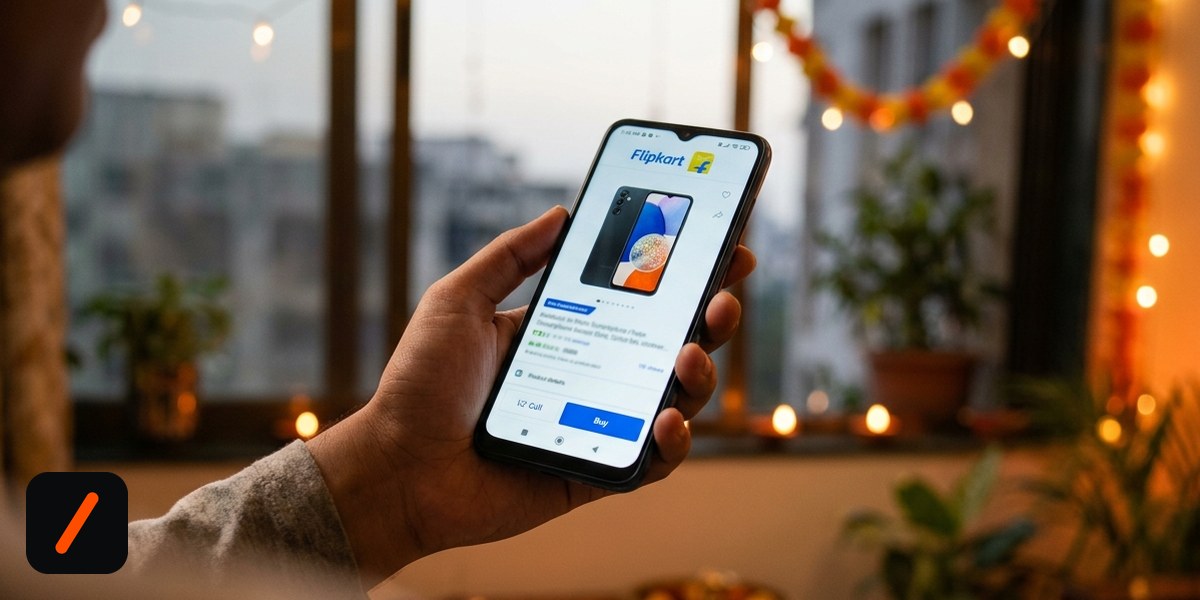
Google is running a live test in India where some Gemini and Google Search AI Mode users see a "Buy" button on select Flipkart product listings. Tap it, and a Flipkart-branded checkout opens inside the AI interface itself, no tab switch, no separate app. TechCrunch reported the test on September 26, 2026. Google is also a shareholder in Flipkart, which is what makes this worth a closer look rather than a shrug.
- The buy button currently appears only on a small set of listings in smartphones, electronics and mobile accessories, and only for some users.
- Amazon listings still show up in the same results, but without a direct buy option, only a link out.
- Google plans a broader rollout in October 2026, timed to land right before India's festive shopping season.
- The checkout flow is Flipkart-branded, not the Google-hosted checkout Google demoed earlier this year under its Universal Commerce Protocol.
Why is Flipkart the only merchant with a buy button?
Google put roughly $350 million into Flipkart in 2024 for a minority stake, and Flipkart itself is majority owned by Walmart. So when Gemini shows a Flipkart product with a one-tap buy button while an Amazon listing sits right next to it with no such option, the obvious question is whether Google is recommending the best product or the product it has equity in. Google's answer, when TechCrunch asked, was that it is "always testing new features and experiences to help people discover and connect with businesses more easily," which is the kind of line that answers the process question without touching the ownership one. Flipkart did not respond to TechCrunch's request for comment at all.
RelatedBrave Origin: A Paid Browser That Strips Out Crypto and AI
None of this proves the ranking is rigged. A test running on "a small set of products" for "some users" is exactly the shape of experiment that Google runs constantly and rarely turns into policy. But a shareholder relationship changes what a neutral-looking feature actually means, even if nobody touches the algorithm. India has more than a billion internet subscribers, and Flipkart and Amazon fight over that audience harder than almost anywhere else in the world. Handing one of them the only checkout button in an AI answer is a meaningful thumb on the scale, intentional or not.
| Assistant | Google Gemini / AI Mode | OpenAI ChatGPT | Amazon |
|---|---|---|---|
| Equity stake in a merchant shown | Yes – ~$350M in Flipkart (2024) | not disclosed | n/a, Amazon is the merchant |
| Buy button live in this India test | Yes, Flipkart listings only | not disclosed | No buy button in this test |
| Checkout host in this test | Flipkart-branded checkout | not disclosed | n/a |
| Open checkout standard | Universal Commerce Protocol (announced, not used for this test) | not disclosed | not disclosed |
| Planned wider rollout | October 2026, before festive season | not disclosed | n/a |
Who ends up holding the checkout, and the customer data?
This is the part that gets lost under the shareholder-conflict headline. Earlier in 2026, Google introduced the Universal Commerce Protocol, an open standard meant to let AI agents handle an entire shopping journey, discovery through checkout, with two possible endings: a Google-hosted checkout through Google Pay, or a handoff to the retailer's own checkout. The Flipkart test uses the second option. That matters because it decides who actually owns the transaction. A Google-hosted checkout keeps the payment, the order record and the customer relationship inside Google's stack. A Flipkart-branded handoff keeps that relationship with Flipkart, and Google is just the AI layer that pointed the user there.
So the Flipkart test is not really Google building a walled AI storefront. It is closer to Google testing whether it can become the default entry point to shopping while letting the retailer keep the parts of the business Google doesn't need, the fulfillment, the returns, the loyalty program, the Flipkart Plus subscription. Whether that's a stable arrangement or an early version of something Google eventually pulls in-house is unanswered. The UCP demo already shows Google knows how to host the checkout itself when it wants to.
RelatedGoogle Maps Renames Lake Ontario to Lake America for US Users
Why India, and why now?
India's festive season, the run of shopping tied to Diwali and the months around it, is when Flipkart and Amazon post their biggest numbers of the year. Testing a frictionless AI buy flow now, with a wider release planned for October, puts the feature in front of shoppers exactly when they're already primed to buy. It also means any lift Flipkart sees from an AI-native checkout will show up in a season Google, as a Flipkart shareholder, has direct financial interest in going well. OpenAI and other assistant makers are pushing into commerce too, but the timing here is specific to Flipkart's calendar, not a generic feature launch.
- Does the buy button reach Amazon listings too? If Google extends it evenhandedly across retailers later this year, the conflict-of-interest reading weakens considerably.
- Does the checkout stay Flipkart-branded? A later switch to Google-hosted checkout, under UCP, would be the moment Google starts capturing the transaction itself rather than just the referral.
- What happens in October? The promised wider rollout, timed to festive shopping, is the real test of scale, not this small pilot.
- Does Flipkart ever comment? Its silence to TechCrunch so far leaves the commercial terms of this arrangement entirely undisclosed.
Our take
The interesting story here isn't that Google is putting a buy button in Gemini, every AI assistant is racing to do that. It's that the first merchant to get one happens to be a company Google partly owns, in the one market where that company is fighting Amazon block by block. Google's statement about "testing new features" is true and also beside the point. The point is that a minority stake changes how a neutral-sounding product decision reads, and Google hasn't said anything that resolves that tension. Keep an eye on whether the button spreads to other retailers before October, because that single fact will tell you more about intent than any statement Google puts out.
- ReportTechCrunch original report, September 26, 2026
- ReferenceGoogle – Universal Commerce Protocol announcement the open checkout standard Google introduced earlier in 2026
Original analysis by GenZTech. Figures current as of September 2026.