
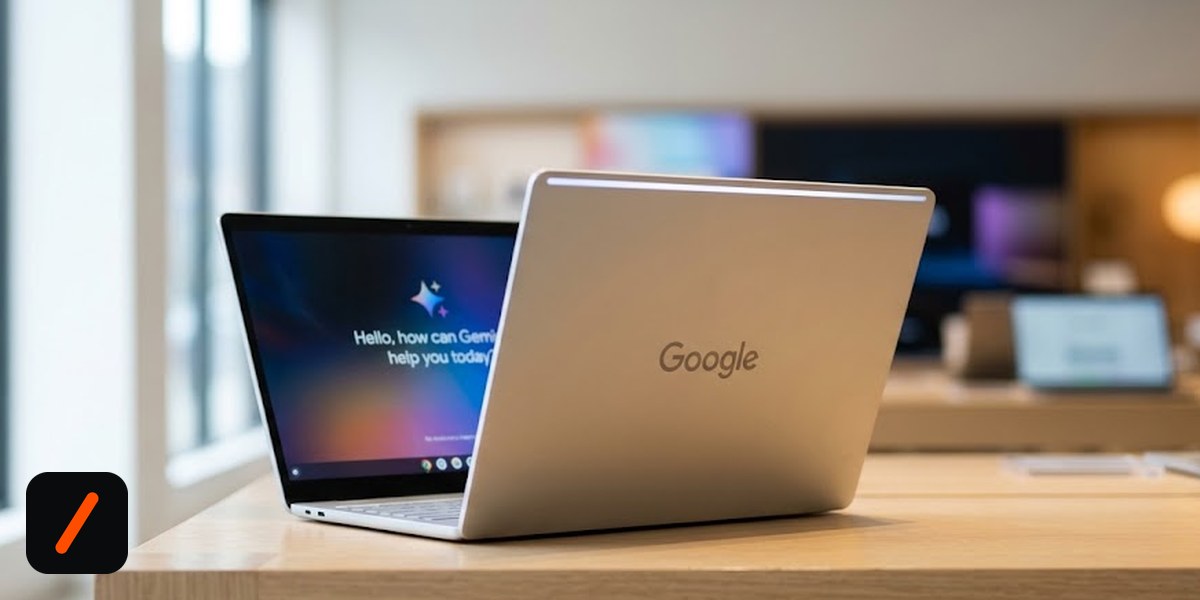
Google put a real price tag and a real ship date on Googlebook this morning: five laptops from Acer, Asus, Dell, HP and Lenovo, starting at $899, on shelves October 4 in the US and a day later across the UK, Ireland, France, Germany and Australia. Pre-orders opened at the Google Store and Best Buy within the hour.
The line has been an open secret since a Lenovo leak surfaced marketing renders back in August, but today is the first time Google has confirmed pricing, chip splits and a bundle. The pitch is blunt: an Android-like OS with Gemini built into the shell, aimed at the roughly 50 million people already running Chromebooks and anyone carrying an Android phone who never quite found a laptop that talked back to it.
RelatedPixel 11 Starts at $899 as Google Raises Every Price
- Five models ship October 4 (US) and October 5 (UK, Ireland, France, Germany, Australia), priced $899 to $1,299.
- Chips split between Intel Core Ultra Series 3 (Panther Lake) and Qualcomm Snapdragon X Elite, both with 40+ TOPS NPUs.
- Every unit ships with a Titan security chip, a Level 5-certified pKVM hypervisor, and 10 years of quarterly OS updates.
- Buyers get 12 months of Google AI Pro (5TB storage, Gemini Advanced) plus trial periods of YouTube Premium, Photoshop and CapCut.
What exactly is a Googlebook?
It runs what Google is calling an Android-like operating system rather than ChromeOS or a stock Android build: full desktop Chrome with extensions and vertical tabs, Android apps pulled straight from the Play Store and flagged for desktop use, and a Linux terminal with genuine root access underneath a pKVM hypervisor Google says is certified to Common Criteria Level 5. Sign in with an Android phone and the laptop pulls in your Wi-Fi passwords, messages and settings automatically, plus a "Continue On" handoff and a "Cast My Apps" mode for throwing a phone app onto the bigger screen.
Gemini sits in a permanent side panel rather than a bolt-on chatbot window. Two features do the heavy lifting: Magic Pointer, which lets you point at something on screen and ask Gemini about it, and Rambler, a dictation tool built to handle long, rambling voice input and clean it into usable text. There's also a "Create My Widget" tool that turns a plain-language request into a home-screen widget on the fly.
Why launch five laptops from five different OEMs on day one?
Because Google is trying to avoid the mistake it made with the original Pixelbook: a single first-party device that proved the concept but never got real retail distribution or accessory support. Spreading the launch across Acer, Asus, Dell, HP and Lenovo gets Googlebook onto shelves at Best Buy and into corporate refresh cycles simultaneously, the same playbook Google used for Chromebook and, before that, the one Google borrowed from Windows OEM launches generally. The tradeoff is a fragmented spec sheet: the $899 Acer is the only unit that hits Google's headline price, and RAM, storage and chip choice all move independently across the other four.
Who is this actually for?
Google is naming two audiences directly: the installed base of roughly 50 million Chromebook users who are candidates for a Gemini-native upgrade, and Android phone owners who've never had a laptop that syncs the way an iPhone syncs to a MacBook. The developer tooling is aimed at a third group. Antigravity, Google's native app-and-Linux-integration layer, ships with support for both Claude Code and OpenAI Codex out of the box, alongside direct Android app deployment from the laptop itself. That's Google explicitly courting developers who'd otherwise reach for a MacBook or a Linux box, by making its own hardware a first-class target for two competitors' coding agents rather than just its own.
What does it mean for the market?
This is Alphabet's most direct swing yet at the AI-PC category Apple and Microsoft have been building with Apple Intelligence Macs and Copilot+ PCs, and it does it through partners rather than in-house silicon, which is the more interesting signal. Qualcomm gets three of the five launch design wins for Snapdragon X Elite, reinforcing Arm-on-Windows-adjacent momentum even outside Windows itself, while Intel's Panther Lake lands its first major consumer wins in the Acer and Lenovo models. For Google, the bet is that a 10-year OS update commitment and a hardware-level Gemini integration differentiate Googlebook enough to pull share from Chromebook's own base without Google having to build or subsidize the hardware itself. Watch Best Buy's actual sell-through in the first two weeks after October 4 more than the pre-order numbers Google will inevitably tout; pre-orders on a brand-new SKU are a weak signal on their own.
RelatedApple Watch Series 12: Price, Specs, Health Features
| Spec | Googlebook (from $899) | MacBook Air M5 | Surface Laptop (Copilot+) |
|---|---|---|---|
| On-device AI assistant | Gemini, permanent side panel | Apple Intelligence, system-wide | Copilot, taskbar-anchored |
| OS update commitment | 10 years, quarterly drops | ~7 years typical | ~4-5 years typical |
| Mobile app bridge | Native Android apps + phone sync | iPhone Mirroring | Phone Link (limited) |
| Chip options at launch | Intel Panther Lake or Snapdragon X Elite | Apple M5 only | Snapdragon X or Intel Core Ultra |
| Entry price | $899 | $1,099 | $999 |
- Aug 1, 2026Lenovo Googlebook renders leak two clamshells and a 2-in-1, unconfirmed pricing
- Sep 21, 2026Official launch, pricing and pre-orders open five models across Acer, Asus, Dell, HP, Lenovo
- Oct 4, 2026US retail availability Google Store, Best Buy
- Oct 5, 2026UK, Ireland, France, Germany, Australia availability
What should buyers actually watch before Oct 4?
Battery claims of up to 14 hours of video and 16 hours of web browsing are Google's own numbers, not third-party review figures, so treat them as a ceiling rather than an expectation until independent reviewers get units. The bigger open question is software maturity: a side-panel Gemini assistant and a from-scratch Android-app-on-laptop story both have a real track record of shipping rough at launch and smoothing out over the following few quarterly updates. Anyone who needs day-one polish over long-term potential should wait for the first post-launch update cycle rather than buying in week one.
- Real battery and performance reviews. Independent benchmarks against the Snapdragon X Elite and Panther Lake configs will settle whether the price split is worth paying for.
- Developer uptake of Antigravity. Native Claude Code and Codex support is a genuine differentiator if it works well; if it's a checkbox feature, expect quiet criticism within weeks.
- Whether Acer's $899 unit sells out or the $1,299 tier does. That tells you whether Google's actual buyer is price-sensitive Chromebook upgraders or Android power users who'll pay more for the bigger screen.
Our take
Spreading a launch across five OEMs on day one is the correct lesson from the original Pixelbook's failure to get real shelf space, and locking in a 10-year update window is a genuinely strong commitment that undercuts both Chromebook's usual support window and Windows OEM laptops generally. What's unproven is the software: Gemini-as-a-permanent-panel and full desktop Android in one machine is a bigger swing than a spec bump, and Google has a mixed record shipping ambitious OS ideas cleanly on the first try. We'd call this a genuinely interesting hardware push handicapped by a fragmented launch lineup, worth watching closely rather than buying blind in week one.
- OfficialGoogle, "Googlebook: pre-order now" pricing, availability, bundle details
- OfficialGoogle, "Googlebook's built-in intelligence" Gemini features, Magic Pointer, Rambler
- ReferenceBloomberg, "Google Rolls Out $899-Plus Googlebooks" OEM and market context
Original analysis by GenZTech, based on Google's official Googlebook announcement and independent reporting.