
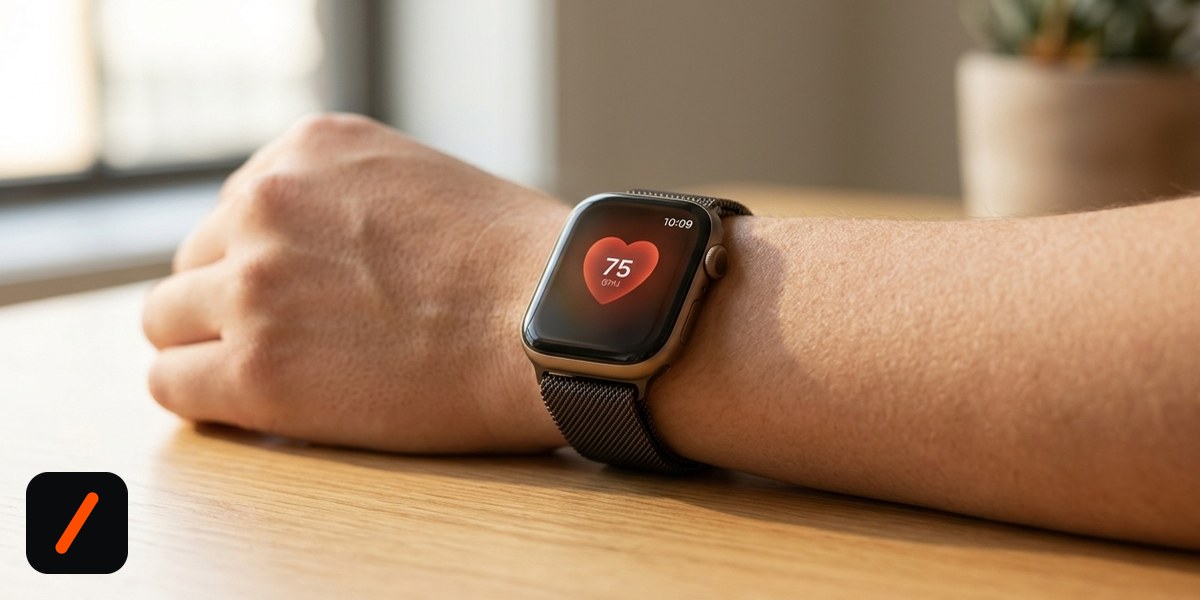
Apple Watch Series 12 arrived at today's "Surprise and Shine" keynote at the same $399 it has cost for years, and the money went somewhere useful. Apple rebuilt the sensing hardware: a larger ECG electrode surface, photodiodes rearranged into a ring, and bigger, more efficient green LEDs. The result is a heart rate reading every five seconds all day, which is roughly 60 times more often than the watch used to sample in the background. Pre-orders opened today and it ships on September 18.
- Still $399, in 42mm and 46mm, with aluminum, titanium and a new ceramic case in pearl white or night blue.
- Background heart rate every 5 seconds and heart rate variability sampled up to 24 times more often, from an all-new sensing stack.
- A daily Readiness score from 0 to 10, built on Apple Heart and Movement Study data, that tells you to recover, pace yourself, or go for it.
- Audio Intelligence arrives on the wrist: Sound Recognition, Live Rewind for the last 15 seconds of speech, Siri Recap notes and Shazam, all running on the S11's always-on processor.
What changed in the sensor?
Three things, and they are physical rather than algorithmic. The electrode surface grew, which improves skin contact when you take an ECG and is the difference between a clean trace and a retry. The photodiodes were rearranged into a ring so they collect more of the light that scatters back out of your wrist. And the green LEDs got larger and more power efficient, which is what lets Apple leave them running far more often without wrecking battery life.
RelatedApple Watch Ultra 4: $799 and 50 Hours of Battery
Apple claims this is the most accurate heart rate sensing in any wearable, and it cited a study of hundreds of participants running, cycling and doing HIIT with an ECG chest strap as the reference. That is the right comparison to make, and it is a stronger evidentiary claim than most wearable makers bother with, though the study is Apple's own.
What does the Readiness score actually do?
Every morning the watch scores you from 0 to 10 based on recent activity, overnight vitals and sleep, and labels it Recover, Pace Yourself, Ready or Go For It. Apple says the scoring algorithm came out of the Apple Heart and Movement Study, which is the largest dataset it has for this kind of thing.
Whoop, Oura and Garmin have sold readiness and recovery scores for years, so Apple is late here rather than first. What it brings is sampling density and the fact that most people already wear the thing. A recovery score built on a reading every five seconds has more to work with than one built on a handful of nightly samples.
What is Audio Intelligence?
This is the part that will divide people. The S11's always-on processor listens through the watch microphones to recognise sounds such as alarms, doorbells and a baby crying, which Apple framed around accessibility for deaf and hard of hearing users. Live Rewind shows a transcript of the previous 15 seconds of speech, so you can catch what you missed. Siri Recap turns daily conversations into titles, summaries and key points you can read later in the Siri app.
Apple was specific that these features do not create or store audio recordings. That claim is doing a lot of work, and it is the one worth watching, because a wrist device that continuously transcribes ambient speech is a meaningfully different privacy object than one that counts steps. The processing sits on the always-on processor with a secure enclave that has dedicated space for audio, which is at least a coherent architecture for the promise.
RelatediPhone 18 Pro: Price, Specs and Release Date
| Series 12 | Ultra 4 | |
|---|---|---|
| Price | $399 | $799 |
| Sizes | 42mm and 46mm | One size, titanium |
| Battery | Up to 24 hours | Up to 50 hours |
| Fast charge | 15 min for up to 12 hours | 15 min for up to 18 hours |
| Workout tracking | Up to 10 hours outdoors | Up to 25 hours, 45 in max mode |
| Satellite | No | Yes |
What does it mean for the market?
Holding $399 while adding a new sensor stack, a ceramic case option and a subscription-free readiness score is a direct shot at the wearables companies that charge monthly for exactly that analysis. Whoop has no display and a subscription. Oura sells a ring plus a subscription. Apple (AAPL) is bundling the same category of insight into hardware people already own, which is the move it has made in every accessory category it eventually took over.
The other thread is health services. A Health app rebuilt around Health Age, a Longevity tab and a $119 Quest blood panel in the United States is Apple stepping toward diagnostics rather than fitness. That is a much larger market with much heavier regulation, and it is worth watching how carefully Apple words the claims.
- Battery under real sampling. Apple rates 24 hours with the new sensing cadence. Independent testing on always-on displays with workouts will show whether that holds.
- The privacy question on Audio Intelligence. No stored recordings is the claim. Look for the security documentation, not just the keynote line.
- Whether Readiness beats the subscriptions. If Apple's score tracks close to Whoop and Oura output, the case for paying monthly gets thinner fast.
Our take
The Series 12 is the least flashy device Apple showed today and probably the most useful. A sensor that reads 60 times more often is the kind of change that compounds quietly: better trends, earlier flags, a recovery score that is not guessing between two data points. The ceramic case will get the attention, and Audio Intelligence will get the debate, but the reason to upgrade is the sensing stack. If you are on a Series 9 or older, this is the first Apple Watch in a while where the health hardware, not the software, is the reason.
- OfficialApple Newsroom: Introducing Apple Watch Series 12 specs, battery and pricing
- OfficialApple Newsroom: Health and fitness with Apple Intelligence Health app, Health Age, Readiness
- ReportingMacRumors: Apple Watch Series 12 and Ultra 4 Announced
Original analysis by GenZTech Team, based on Apple's September 9, 2026 keynote and its official announcement.