
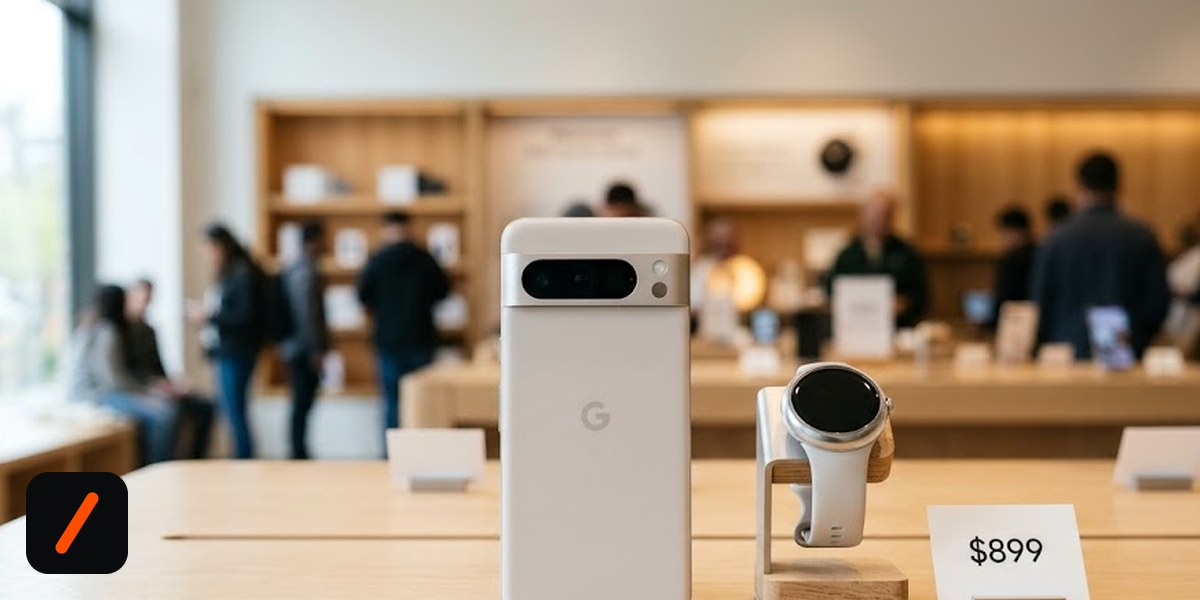
Google raised the price of every phone it announced this morning. The Pixel 11 starts at $899, a hundred dollars more than the Pixel 10 it replaces, and the Pixel 11 Pro moves from $999 to $1,099. Made by Google 2026 ran in New York and put four phones, a watch, and Google's first Bluetooth tracker on sale, but the number that will decide how this launch lands is the one on the price tag, not the one on the spec sheet.
What Google is asking buyers to accept is a straightforward trade: pay more, get double the base storage and a chip built almost entirely around running Gemini on the device instead of in a data center. Whether that trade is fair depends on how much of your phone use actually touches AI.
RelatedGoogle's Googlebook Laptops Debut at $899, Five OEMs Onboard
What did Google actually announce?
Four phones, and the pricing ladder is unusually wide this year.
- Pixel 11, $899. A 48MP wide sensor with 56% more light sensitivity, a camera bar that is more than 40% thinner and now all glass, 12GB of RAM, and 256GB of storage as the new floor. Rated for 30+ hours, 25W Qi2.2 wireless charging. Colors: Frost, Hibiscus, Pistachio, Obsidian.
- Pixel 11 Pro, $1,099. A 6.3-inch panel hitting 3,600 nits peak with a coating Google says is more than twice as scratch resistant, a 50MP wide and 48MP telephoto pair with 30% more light sensitivity, 12GB of RAM upgradeable to 16GB, and wired charging that reaches 75% in roughly half an hour. There is a new HiLight ring around the flash.
- Pixel 11 Pro XL, $1,299. The same package on a 6.8-inch display, in Canyon, Fog, Olive and a matte Obsidian.
- Pixel 11 Pro Fold, $1,899. Down to 258g, nearly 10% lighter and almost a millimeter thinner than last year, with a glass-fiber composite back Google rates as three times more durable. A 6.5-inch outer Super Actua display runs 20% brighter, the inner Super Actua Flex panel hits 3,600 nits, and there is a 48MP main camera with 30x Super Zoom, 16GB of RAM, and a 4,750 mAh battery rated for 24+ hours.
Preorders opened the same day across the Google Store, Amazon and Best Buy. Google did not commit to a retail ship date on stage.
Why is Google charging more this year?
The honest answer is silicon and storage. Doubling the base tier to 256GB across every model carries a real bill of materials cost, and Google is no longer selling a 128GB entry point to hold a headline price down. The louder answer, the one that ran through the whole keynote, is Tensor G6.
Google claims the G6 delivers 50% more TPU compute and twice the memory bandwidth of its predecessor, which it translates into on-device AI tasks running up to 3.5x faster while drawing 3.5x less energy. The gains outside AI are more modest and more honest: 15% faster app loading, 25% faster web browsing, an upgraded image signal processor for zoom and low light, and a new Titan M3 security chip.
That gap between the 3.5x bar and the 1.15x bar is the whole strategy in one picture. If you mostly send texts and take photos, a 15% faster app launch is what your extra hundred dollars bought. If you lean on the assistant, the case is much stronger.
What are the new Gemini features?
The most concrete one is task automation that reaches across apps: Gemini can now work through orders and bookings, and it will dial a business by phone to finish a job it cannot complete on the web. Live Translate extends to podcasts and YouTube videos. Live Transcribe added American Sign Language support. Gboard gained Rambler, which strips filler words out of rambling dictation so the transcription reads clean. Proactive Assistance surfaces contextual suggestions, At a Glance now pulls up loyalty cards and location-based prompts, and a set of Gemini commands for timers, alarms and workouts runs fully offline.
Offline commands matter more than they sound. Every voice request that stays on the handset is one that costs Google nothing to serve and one that works in a basement or on a plane. That is the payoff for spending the chip budget the way Google did.
| Model | Pixel 11 | Pixel 11 Pro | Pixel 11 Pro XL | Pixel 11 Pro Fold |
|---|---|---|---|---|
| US price | $899 | $1,099 | $1,299 | $1,899 |
| Display | Standard | 6.3in, 3,600 nits | 6.8in, 3,600 nits | 6.5in outer, 3,600 nit inner |
| Main camera | 48MP wide | 50MP wide + 48MP tele | 50MP wide + 48MP tele | 48MP, 30x Super Zoom |
| RAM | 12GB | 12GB, to 16GB | 12GB, to 16GB | 16GB |
| Base storage | 256GB | 256GB | 256GB | 256GB |
| Battery rating | 30+ hours | Not stated | Not stated | 4,750 mAh, 24+ hours |
| Chip | Tensor G6 | Tensor G6 | Tensor G6 | Tensor G6 |
The Pixel Tag finally exists
Google shipped an AirTag competitor. The Pixel Tag is a pill-shaped tracker with a G logo and a user-replaceable coin cell, running on the Find Hub network, at $29 for one or $99 for a four-pack. It works with the Pixel Watch and responds to Gemini voice commands. It arrives November 11, which is the odd note in an otherwise same-day launch: three months after the announcement, and well after the holiday buying decision starts forming.
The pricing is a direct shot at Apple, and the four-pack is the aggressive part. Google is betting that the Find Hub network's Android install base, which is far larger than Apple's, closes the gap that kept previous Android trackers from mattering.
RelatedNintendo Switch 2 Hits $499.99 as AI Chip Demand Drains DRAM
What about the Pixel Watch 5?
Externally it is the same watch. Inside, Google moved to a Snapdragon W5 Gen 2 Accelerated part with a 12% CPU bump, raised RAM from 2GB to 3GB, doubled storage to 64GB, and claims 20% better overall performance. It is $399 for the 41mm and $429 for the 45mm, with cellular adding $100 and a Stephen Curry special edition at $579.
The health story is the interesting part: monthly blood pressure and insulin resistance summaries. Those are trend reports rather than clinical measurements, and the framing matters, but insulin resistance in particular is a metric no mainstream smartwatch has put in front of consumers before. Pixel Buds Pro 2 got an Olive color and a major software update slated for September.
- Jul 7, 2026Google confirms the August 12 date Earliest Pixel launch ever, a month ahead of Apple
- Aug 12, 2026Made by Google, preorders open Four phones, Watch 5, Pixel Tag, Tensor G6
- Sep 2026Pixel Buds Pro 2 software update Announced on stage, not detailed
- Nov 11, 2026Pixel Tag ships $29 single, $99 four-pack
What it means for the market
Alphabet is the obvious name, but Pixel has never moved the stock on unit volume. It is a rounding error against Search and Cloud. What this launch does test is whether Google can charge a hardware premium for AI features it is otherwise giving away inside Android, and that answer generalizes well beyond one phone line.
The timing is the sharper signal. Launching in August puts the Pixel 11 in front of buyers roughly a month before Apple's usual September window, which means Google gets a clean run at anyone shopping early. Qualcomm keeps the Pixel Watch socket with the W5 Gen 2, worth noting for a company whose Android handset business has steadily lost ground to in-house silicon. The read for investors is not about Pixel units, it is whether a $100 across-the-board increase survives contact with a market where the last several flagship cycles were fought on trade-in credits and carrier subsidies.
Our take
Google made a coherent bet and priced it honestly, which is rarer than it should be. There is no 128GB stripped-down tier propping up a fictional entry price, and the storage doubling is real value against the increase. The Pro Fold at $1,899 with a genuine 10% weight cut and a three-times-more-durable back is the most improved product of the day.
The risk is that most of what justifies the new price is measured in AI benchmarks Google supplied itself. A 3.5x on-device AI figure is a vendor claim until somebody independent runs it, and the numbers a normal buyer will actually feel, 15% faster app loading and 25% faster browsing, are ordinary generational gains attached to an extraordinary price move. The Pixel Tag's November date is the other unforced error. Google announced a $29 accessory in August that nobody can buy until the week before Black Friday, which hands Apple a full quarter to respond.
- Independent Tensor G6 benchmarks. The 3.5x on-device AI claim is Google's own. The first third-party numbers will decide whether the premium is earned.
- Whether the increase sticks. Watch carrier and trade-in promotions in the first six weeks. Heavy discounting means the $899 sticker was aspirational.
- Pixel Tag ship discipline. November 11 is a long runway. A slip past it lands the product after the holiday window closes.
- Apple's September answer. Google now launches first by design, which makes the next iPhone the first true response rather than the thing Pixel reacts to.
- OfficialMade by Google 2026, Google's announcement hub the full set of first-party product posts
- ReferenceGoogle Store live pricing, configurations and preorder terms
- CoverageTechCrunch, everything announced at Made by Google 2026 pricing and spec confirmations from the event
- ContextOur July 7 preview of the August 12 event what was expected going in, for comparison
Original analysis by GenZTech. Prices are US launch pricing as announced on August 12, 2026. Performance figures attributed to Google are vendor claims and have not been independently verified. Source: Google.