
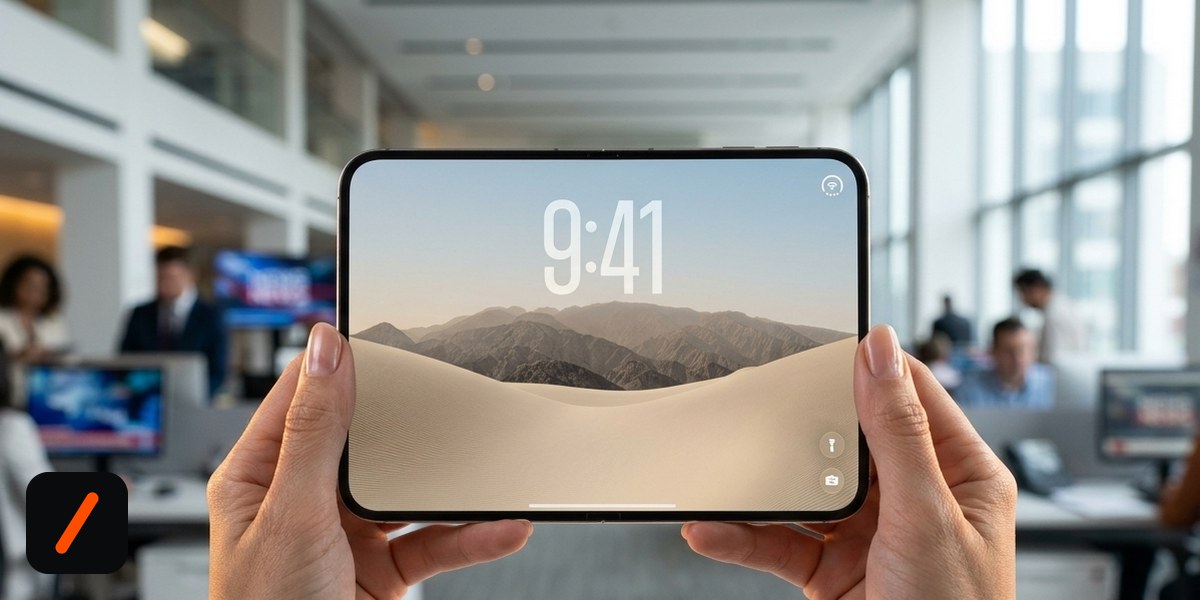
Apple closed its "Surprise and Shine" keynote with the thing everyone came for. The iPhone Duo is real: the first iPhone with two screens and the first Apple product of any kind with a folding display. It opens like a passport rather than a book, with a 7.6-inch inner display that Apple says is 50 percent larger than the iPhone 18 Pro Max screen, and a 5.4-inch screen on the outside for when it is shut. It starts at $1,999 for 256GB, runs up to 2TB, and it is the one product from today you cannot buy next week: pre-orders open October 16 and it ships October 23.
- A 7.6-inch Super Retina inner display and a 5.4-inch outer one, in a wide format Apple compares to a passport rather than the book shape Samsung popularised.
- Built on the A20 Pro with a display engine for driving two screens, a vapor chamber, and Apple's own C2 cellular modem.
- A structural stack aimed squarely at the crease problem: nano-texture display, stiff polymer layer with an Apple coating, titanium base plate and carbon fiber hinge supports.
- Two 48MP Fusion cameras, a main with 2x optical telephoto and an ultra wide, plus a FaceTime camera hidden under the inner display. Apple Pencil works on either screen.
- Grade 5 titanium with a mirror-polished finish, Ceramic Shield 2 front and Ceramic Shield back, in star white and night sky, with a hinge Apple says uses more than 100 components.
What makes the iPhone Duo different from a Galaxy Fold?
Shape, mostly. John Ternus took a direct shot at the competition on stage, saying other foldables "just feel like two phones stuck together" and that the resulting screen makes a larger display feel smaller. Apple went wide instead of tall. Folded, the Duo is a squat 5.4-inch slab; opened, it is a 7.6-inch landscape sheet closer to a small iPad than to a tall phone with a seam down the middle.
RelatediPhone 18 Pro: Price, Specs and Release Date
The second difference is the software, and this is where six generations of Samsung experience get challenged. iOS reflows around the fold: the dock runs vertically along the side on the outer screen, panels and buttons shift out of the crease zone when the device is partly folded, apps run side by side or as multiple instances of the same app, and app pairs relaunch together. Propped in a tent it becomes a bedside clock. Set at a laptop angle, the interface adapts to that posture.
Did Apple actually solve the crease?
Apple did not use the word much, but the engineering it described is entirely about the two complaints that have dogged foldables since 2019: the visible fold line and fragility. The display gets a nano-texture surface over a multilayer laminated stack, topped with a stiff polymer carrying an Apple-designed scratch-resistant coating. Underneath sits a titanium plate, and the hinge uses carbon fiber support plates with a custom variable torque profile plus a magnet array so it opens and closes with a controlled feel.
Whether that adds up to an invisible crease is the first thing every reviewer will check, and Apple's own demo units are the wrong sample. Ask again in six months, after these have lived in pockets.
What are the cameras and the chip?
The Duo runs the same A20 Pro as the iPhone 18 Pro, with its 6-core CPU, 7-core GPU and dual 16-core Neural Engine, plus a display engine capable of driving both panels, a vapor chamber for thermals and Apple's C2 modem. Cameras are two 48-megapixel Fusion units, a main that carries a 2x optical telephoto and an ultra wide, with zero shutter lag and sensor-shift stabilisation. Video goes to 4K at 120 frames per second for slow motion, and because the thing stands up on its own, 4K time lapse becomes a genuinely practical feature rather than a tripod exercise.
Selfies come from a Center Stage camera on the outside, while the inner display hides its FaceTime camera underneath the panel. Apple gave the resulting tricks names: Duo Preview shows your subject what the shot looks like on the outer screen, Kid Cue plays something on that screen to get a child to look up, Smart Take handles capture, and Duo FaceTime shows your face and your view at the same time. Batteries sit on both sides of the fold, rated at up to 31 hours of video on the inner display, 44 hours on the outer one, and 24 hours when you use both equally. Touch ID is built into the side button rather than Face ID under the screen.
Both panels are Super Retina XDR with ProMotion, Always On and 3000 nits of peak brightness, the inner one carrying the nano-texture finish. Split View and StandBy round out the software list.
What does the iPhone Duo cost and when can you buy it?
The Duo starts at $1,999 for the 256GB model, with storage tiers running up to 2TB. Pre-orders open on October 16 and it goes on sale October 23, more than a month after the iPhone 18 Pro reaches buyers on September 18. That gap is worth reading as a supply signal rather than a marketing one. Foldable display panels have been the hardest component in this category to make at scale, and shipping a first-generation folding iPhone five weeks behind the rest of the lineup is what a cautious ramp looks like.
RelatedApple Watch Series 12: Price, Specs, Health Features
At $1,999 it lands within a dollar of where Samsung has priced its top foldables, which means Apple is not trying to undercut anyone. Bloomberg's pre-event reporting had put the starting figure at roughly $2,000, so the number itself is no surprise. What it does mean is that the cheapest way into a folding iPhone costs more than a MacBook Air.
| iPhone Duo | iPhone 18 Pro Max | |
|---|---|---|
| Main display | 7.6 inch inner, 5.4 inch outer | 6.9 inch |
| Chip | A20 Pro with dual-display engine | A20 Pro |
| Rear cameras | 48MP Fusion main with 2x tele, 48MP ultra wide | 48MP Fusion with variable aperture |
| Battery | Up to 44 hours, outer display | Up to 45 hours video |
| Finish | Grade 5 titanium, star white or night sky | Aluminum, four colors |
| Biometrics | Touch ID in the side button | Face ID |
| Stylus | Apple Pencil on both screens | Not supported |
| Modem | Apple C2 | Apple C2 |
What does it mean for the market?
Samsung has sold foldables for seven years and has never had to defend the category against Apple. That changes today. The immediate pressure lands on the Galaxy Z Fold line, which has priced around $2,000 for years on the assumption that nobody else was selling a premium foldable in the United States. Apple entering does not automatically take that market, but it does two things reliably: it validates the format for buyers who were waiting, and it drags the accessory and app ecosystem toward folding layouts, which has been the category's real weakness.
For Apple (AAPL), this is the first genuinely new iPhone form factor since the iPhone X, in a year when memory prices are climbing. Watch the supply commentary rather than the launch-week queues. Foldable panels have historically been yield-constrained, and Apple's first year here is likely to be supply-shaped rather than demand-shaped.
- The crease, in person. Every foldable looks flawless on stage. The first hands-on videos from Apple Park will tell you more than any spec sheet.
- Durability over months. Titanium plate and carbon fiber hinge supports are the right materials. Hinges still fail on dust and time.
- App support. Two apps side by side is only useful when the apps cooperate. Watch how quickly the big iPad-style layouts arrive on the Duo.
Our take
Apple showed up seven years late with the least Samsung-like foldable it could design. Going wide instead of tall is a real decision, not a cosmetic one: it puts a small screen in your pocket and a nearly iPad-sized one in your hands, and it makes the software problem different rather than merely harder. The camera set is the compromise, one lens short of the Pro and with a telephoto that stops at 2x, which tells you Apple prioritised thinness and the display stack over optics. The crease and the hinge are the two things that will decide whether this is remembered as Apple's foldable or Apple's first foldable.
- OfficialApple Newsroom: Apple unveils iPhone Duo official specs, battery figures, pricing and dates
- ReportingMacRumors: Apple Announces Foldable iPhone Duo
- ReferenceGenZTech: iPhone 18 Pro price, specs and release date the A20 Pro sibling it shares silicon with
Original analysis by GenZTech Team, based on Apple's September 9, 2026 keynote and its official announcement.