
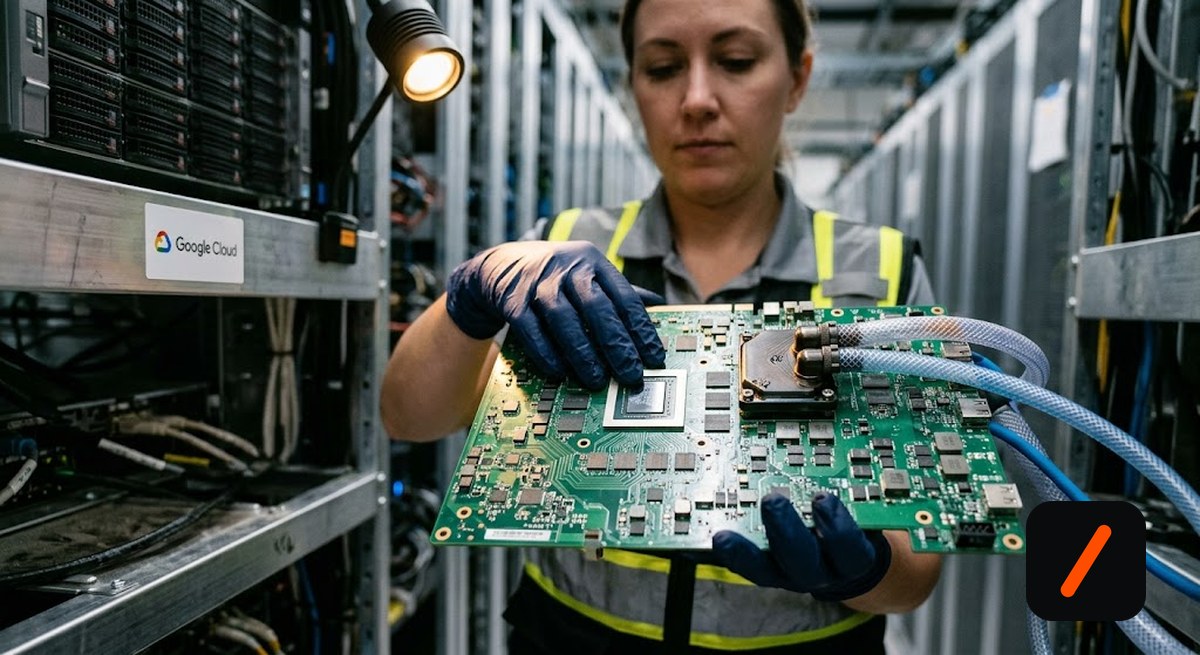
Google has moved its seventh-generation TPU, Ironwood, into general availability, and it is the most direct swing the company has taken at Nvidia's data-center dominance yet. Ironwood is purpose-built for the age of inference: 192GB of HBM3E per chip, 7.2 terabytes per second of memory bandwidth, and a superpod that ties 9,216 liquid-cooled chips into a single 42.5 FP8-exaflop machine. Google claims the total cost of ownership per Ironwood chip runs roughly 44% below a comparable Nvidia GB200 server from its own procurement view. Translation: the biggest threat to Nvidia is no longer another GPU, it is a custom chip that hyperscalers can build for themselves.
- Ironwood delivers about 10x the peak performance of TPU v5p and more than 4x per-chip gains over last year's Trillium (v6e).
- A full superpod links 9,216 chips for 42.5 FP8 exaflops, aimed squarely at large-scale training and high-volume, low-latency inference.
- Anthropic is the anchor customer, with access to up to 1 million TPUs and more than a gigawatt of capacity in 2026.
- Broadcom designs Ironwood; the next split of Sunfish (training) and Zebrafish (inference) targets TSMC's 2nm node in late 2027.
What makes Ironwood different?
Earlier TPUs were general accelerators. Ironwood is tuned for the workload that now dominates AI spend: serving models to millions of users at low latency, plus reinforcement learning and large-scale training. The memory story is the headline. At 192GB of HBM3E and 7.2TB/s per chip, Ironwood can hold and stream the giant weight matrices that inference chokes on. Google's pitch is not that any single chip beats Blackwell on paper, but that TPUs sustain roughly 90% model FLOP utilization on transformers versus 70 to 80% for GPUs, and cost far less to run per unit of useful work.
RelatedNvidia Bets $3.5 Billion on MediaTek to Ride the Custom-Chip Wave
Why is Anthropic the anchor customer?
Anthropic has committed to up to 1 million TPUs and more than a gigawatt of capacity in 2026, with the first phase covering 400,000 Ironwood units worth an estimated $10 billion in finished racks from Broadcom, and another 600,000 rented through Google Cloud. The deal has already stretched to 3.5 gigawatts coming online in 2027, positioning Anthropic as the anchor for the eighth-generation TPUs too. That is the validation Google needed: a frontier lab betting its serving infrastructure on TPUs instead of Nvidia.
What does it mean for the market?
The clearest read is for Broadcom (AVGO). Broadcom designs Ironwood and the coming training chip under an agreement running to 2031, and analysts peg its AI revenue from the Google and Anthropic relationships near $21 billion in 2026, rising to $42 billion in 2027. Custom-silicon sales are projected to grow 45% in 2026 against 16% for GPU shipments. The signal for investors is not that Nvidia collapses, its GPUs remain the flexible default, but that the highest-volume inference workloads are migrating to in-house ASICs, and the value is pooling around the design and supply chain, Broadcom, MediaTek, and TSMC, rather than any one merchant GPU.
- 2025Ironwood previewed at Cloud Next First inference-first TPU announced
- 2026General availability plus Axion CPUs Anthropic commits to up to 1M chips
- Late 2027Sunfish and Zebrafish on TSMC 2nm Training and inference split into two chips
- 2028Shipments projected past 35M TPUs From ~4.3M in 2026
How does this reshape the GPU-versus-ASIC balance?
For years the received wisdom was that custom AI chips made sense only for a handful of internal Google workloads, while everyone else rented Nvidia GPUs because CUDA and the software ecosystem were too far ahead to abandon. Ironwood does not overturn that overnight, but it changes the math for the largest buyers. When a workload is stable and enormous, serving one model to millions of users, the flexibility of a general GPU stops being worth the premium, and a purpose-built chip with higher utilization and lower cost wins on total spend. That is precisely the segment migrating first. The knock-on effect is that Nvidia's growth increasingly leans on training and on smaller customers who cannot design their own silicon, while the hyperscalers who can, Google, Amazon with Trainium, Microsoft with Maia, Meta with MTIA, carve their highest-volume inference out of the merchant market. Ironwood is the most credible version of that pattern yet, because it comes with a marquee external customer rather than being a purely captive chip, and that external validation is the part Nvidia should watch most closely.
RelatedGoogle's Frozen v2 Chip Bakes Gemini Into the Silicon
Our take
Ironwood is the moment custom silicon stopped being a science experiment and became a credible second supplier for the whole industry. Nvidia still wins on flexibility and software, and researchers will keep reaching for CUDA. But inference is where the money is, it runs the same shapes over and over, and that is exactly the workload an ASIC eats for lunch. When the customer paying for a gigawatt of it is a frontier lab, the argument is settled. The interesting question is no longer whether hyperscalers build their own chips, it is how much of Nvidia's inference share is already spoken for by 2028.
- OfficialIronwood: the first Google TPU for the age of inference Google
- OfficialIronwood TPUs and Axion VMs Google Cloud
- BenchmarkIronwood pods and the AI Hypercomputer model Tom's Hardware
Original analysis by GenZTech. Reporting via Google.