
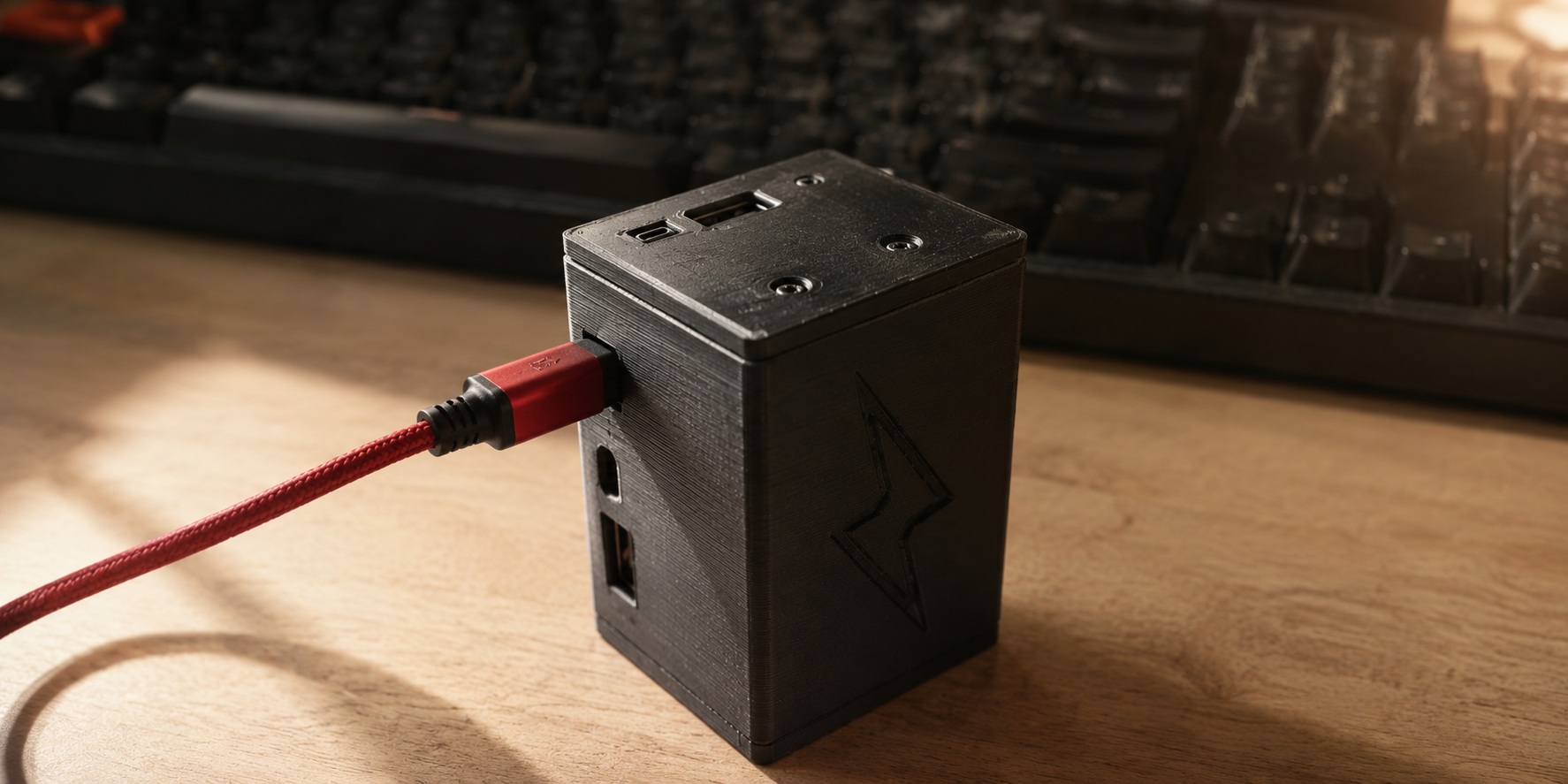
Most powerbanks are disposable by design: once one of the cells inside dies, the whole thing goes in the bin, because the batteries are welded straight to the circuit board. Panos Koutsoumanis, a student at the University of Patras in Greece, got tired of throwing away otherwise-fine electronics for exactly that reason, so he built Juicebox, a small, fast-charging powerbank with a 3D-printed enclosure he designed himself, where a dead cell is a five-minute swap instead of a trip to e-waste.
What Juicebox actually is
"It's a small, fast charging powerbank made with off-the-shelf parts and a 3d printed enclosure I designed myself in Fusion360," Panos told us. Nothing about the electronics is exotic, which is the point: the driver board and cells are parts anyone could source, and the enclosure is the part he actually engineered.
RelatedAMD Launches Budget Ryzen 5500F and 7500 to Dodge RAM Prices
Built because a spot weld once ended a perfectly good powerbank
"I used to have a similar size powerbank whose batteries died and I had to throw the whole thing away because the cells were spot welded to the board, so I made one with spring contacts so the batteries are now easy to replace," he said. That single design decision, spring contacts instead of spot welds, is the entire reason Juicebox exists. The tradeoff came in the enclosure: "The hardest part in making this project was getting everything to fit together in the tightest package possible which involved sandwiching the driver board and the battery holder against each other. Overall it was pretty easy to do and probably even easier to replicate provided you can source the same parts," Panos said, which is also a genuinely useful thing to hear from someone showing you a finished build: he's telling you it's replicable, not just admiring his own work.
Built during a summer of shipping, not a semester project
Juicebox wasn't coursework. "This project was made during a summer making event called Arcade by Hack Club (hackclub.com), a non-profit organisation empowering teens around the world to learn coding and engineering by making projects they actually want to build," Panos told us. "If you're under 19 years old and interested in learning how to make similar projects or meet new people with similar interests, you should absolutely check them out," he added, which we're passing along exactly as he said it.
| Trait | Juicebox | Typical off-the-shelf powerbank |
|---|---|---|
| Battery connection | Spring contacts, swappable | Cells spot-welded directly to the board |
| When a cell dies | Replace the cell | Throw away the whole unit |
| Enclosure | Custom 3D-printed in Fusion360, sandwiched tight around the parts | Sealed injection-molded shell, not meant to be opened |
| Origin | Built solo during Hack Club's Arcade summer program | Mass-manufactured |
Our take
The clever part of Juicebox isn't the powerbank itself, plenty of people have built DIY power banks. It's that Panos designed backward from a specific failure he'd personally experienced, and picked the one component decision, spring contacts over spot welds, that actually fixes it, rather than just building a nicer-looking box around the same disposable core. That's a repair-first mindset most consumer electronics, let alone hackathon projects, don't bother with. And he's upfront that it's meant to be copied: the parts are off-the-shelf and the design files are public.
RelatedSamsung's LPDDR5X-PIM Crams a Processor Into Every DRAM Bank
Juicebox was built by Panos Koutsoumanis, an Electrical and Computer Engineering student at the University of Patras, Greece, during Hack Club's Arcade summer program. The project is open: GitHub.
- Built something? Doesn't need to be finished or fancy: a side project, a hackathon build, or a class project you're proud of counts.
- Email hello@genztech.blog with what you built, why you built it, a link, and your name plus college.
- See every spotlight so far at genztech.blog/campus-radar.
Reporting based on a direct interview with Panos Koutsoumanis. GenZTech has not independently tested the device's charging performance or battery life.