
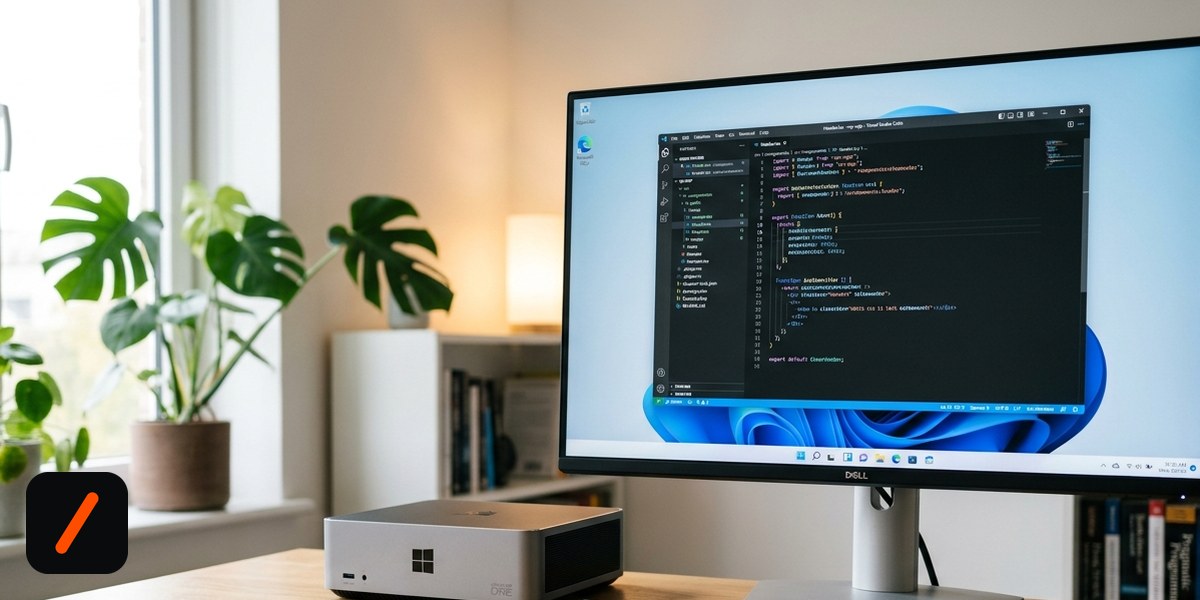
Microsoft just announced Project Zenith, a stripped-down Windows configuration built for developers, and the post went up on the Windows Developer Blog within the past half hour. The pitch is simple: buy a machine with enough memory, and Windows arrives already set up to code, with the clutter that normally ships on a fresh install turned off by default and the tools a working developer actually opens turned on.
Logan Iyer, Microsoft's corporate vice president for Windows Platform and Developer, wrote the announcement himself, which is usually a signal this is a platform bet rather than a one-off feature. The catch, and it's a real one, is the hardware gate: Zenith needs a machine with at least 64GB of unified memory and better than 250GB/s of memory bandwidth. That rules out almost every Windows laptop sold today. The first machine that qualifies is AMD's Ryzen AI Halo mini-desktop, a device we covered on this site the same day AMD showed its bigger sibling, the Threadripper Halo Station, at IFA Berlin.
RelatedWindows Server 2025 Memory Change Is Crashing SQL Server
- Zenith requires 64GB+ of unified memory and 250+ GB/s of memory bandwidth, a bar only a handful of current devices clear.
- It debuts on AMD's Ryzen AI Halo mini-desktop, with more OEM and silicon-partner machines promised in the coming months.
- File Explorer, Search, and Start all get developer-first defaults out of the box: extensions and hidden files visible, recently-used-file nagging off, WSL wired in with container support.
- Qualifying hardware can run local AI models above 30 billion parameters, unmetered, with no cloud token limits.
What did Microsoft actually change?
Nothing here is a new Windows build. Zenith is a configuration profile Microsoft applies to qualifying hardware at setup, and most of the changes are things developers have been manually undoing on every fresh Windows install for years. File Explorer now shows file extensions and hidden files, puts the full path in the title bar, and enables long-path support so a deeply nested node_modules folder stops throwing errors. Recently-used-files tracking and OneDrive sync-provider tips get switched off. Start menu tips and account notification nagging disappear. PowerToys' Command Palette is on by default, and Windows Terminal plus VS Code get pinned to the taskbar out of the gate. WSL ships pre-integrated with container support, so a developer who wants a Linux userland with Docker doesn't have to run three setup commands before writing a line of code.
Why gate a software feature behind 64GB of RAM?
Because the software feature that matters most here, running a real coding-capable model without hitting a token meter, only works if the model actually fits in memory. A 30-billion-parameter model at reasonable quantization needs on the order of 20 to 40GB just to load, before accounting for context window and the rest of the OS. Microsoft could have shipped the File Explorer and taskbar changes to every Windows 11 machine for free; gating the whole package behind a RAM floor high enough to guarantee local inference actually works is a deliberate choice, not an accident of engineering. It also means Zenith reads less like a Windows feature and more like Microsoft defining a new hardware tier, developer workstation, sitting between a laptop and a workstation-class rig, the same way AMD's own Ryzen AI Halo and Threadripper Halo lines carve out tiers by memory capacity rather than raw clock speed.
| Typical dev laptop | macOS + Homebrew | Project Zenith | |
|---|---|---|---|
| Out-of-box setup | manual: extensions, WSL, tool install | manual: Homebrew, dotfiles, Rosetta if needed | applied automatically at first boot |
| Minimum memory | 8-16GB typical | 8GB base config | 64GB+ required |
| Local model ceiling | ~7B at 16GB, often cloud-only | ~30-70B depending on config | 30B+ guaranteed by spec floor |
| Terminal + Linux layer | optional install | native Unix shell | WSL + containers pre-wired |
How does the memory floor compare across AMD's own lineup?
AMD's Ryzen AI Halo line, the exact hardware Zenith launches on, tops out at 192GB of unified memory and is pitched by AMD itself at roughly 300-billion-parameter models. Zenith's 64GB minimum sits at the entry end of that same lineup. The bigger Threadripper Halo Station AMD unveiled at IFA the same day pushes past a trillion parameters on up to 576GB of HBM3E, a machine built for labs rather than individual developers. Seen together, the two announcements describe one memory-tiered product line: a $50,000-class workstation at the top, a sub-$2,000 mini-desktop at the entry point, and Windows now configuring itself differently depending on which tier it's running on.
Who is this actually for, and what's next?
Not the average Windows user, and Microsoft isn't pretending otherwise. This is aimed at developers running local coding agents and fine-tuned models who are tired of either paying per-token for cloud inference or hand-configuring a fresh Windows box every time. It's also a direct answer to the pull toward macOS and Linux among AI-focused developers, where a clean, extension-visible, terminal-first environment has been table stakes for years. Whether Zenith closes that gap depends less on the config profile than on the OEM devices that show up to run it: right now, exactly one machine qualifies, and Microsoft's own post is vague on which additional silicon and OEM partners are actually shipping compatible hardware, or when.
RelatedMicrosoft Pauses Windows 11 Update Over Dell Shutdowns
- Which OEMs ship qualifying hardware next. Microsoft named no partners beyond AMD's Ryzen AI Halo. Intel and Nvidia both have unified-memory ambitions that could produce a second qualifying device.
- Whether the 64GB floor moves. Memory prices have climbed through 2026 on AI-driven demand; a requirement this steep on brand-new silicon is a real adoption tax, and Microsoft may face pressure to support a lower tier with reduced local-model guarantees.
- Whether Zenith's defaults migrate to standard Windows 11. Several of the File Explorer and Start menu changes have nothing to do with the RAM floor and could plausibly ship broadly if developer feedback is loud enough.
- GitHub Copilot's role. Local 30B+ inference and a cloud Copilot subscription solve overlapping problems; how Microsoft positions the two against each other on a Zenith machine is unresolved in the announcement.
Our take
The interesting move isn't the File Explorer defaults, developers have been flipping those settings by hand since Windows XP. It's that Microsoft is willing to make a Windows SKU that most Windows PCs can't run. That's a genuine break from three decades of shipping one Windows experience across whatever hardware happens to be plugged in, and it only makes sense in a world where local model inference has become a real workload developers plan hardware purchases around, not a hobbyist curiosity. Whether that world is here yet for the average developer, versus the subset already running local agents daily, is the actual open question, and it's one a blog post can't settle on its own.
Pairing Zenith with AMD's hardware launch the same day is also not a coincidence worth glossing over. Microsoft picked a debut partner with a memory-tiered product line built to match Zenith's own thresholds almost exactly, which suggests more coordination between the two companies than either announcement admits outright.
- OfficialWindows Developer Blog: Announcing Project Zenith : Logan Iyer's original announcement
- ReferenceEngadget on Project Zenith's hardware requirements and critique : RAM-cost context
- ReferenceNeowin on the default configuration changes : File Explorer and Start menu specifics
- RelatedGenZTech: AMD's Threadripper Halo Station targets trillion-parameter AI : the same-day AMD hardware lineup Zenith launches on
Original analysis by GenZTech. Sources: Windows Developer Blog.