
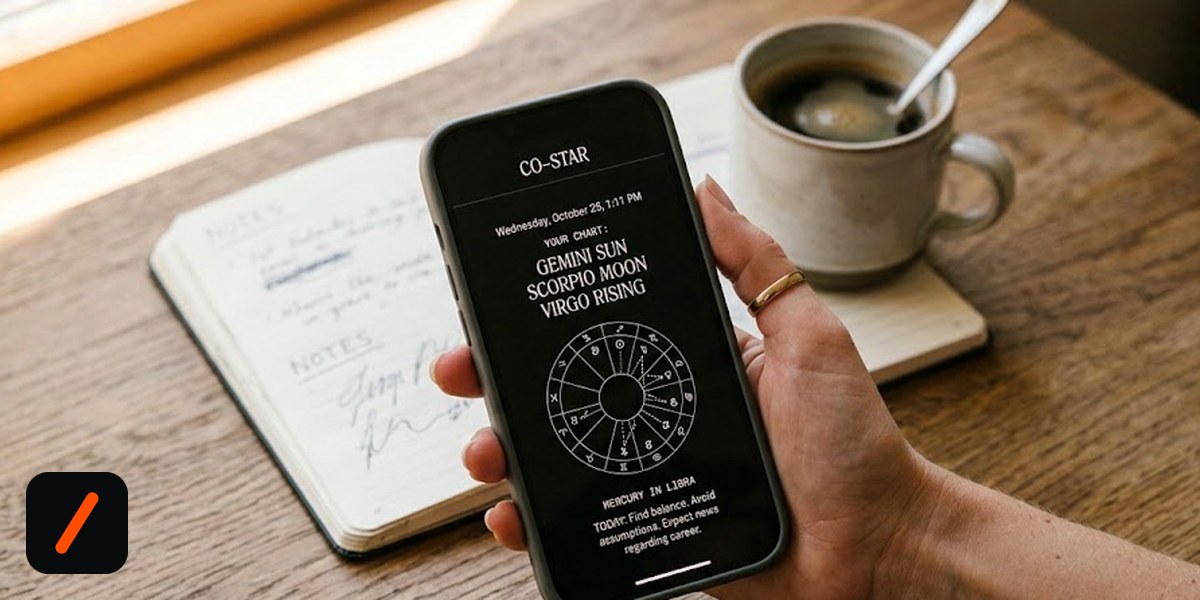
Midjourney, the AI image lab that has never taken venture money and still runs much of its product through a Discord server, has bought Co-Star, the astrology app. Bloomberg reported the deal on Friday. It closed quietly in spring 2026, terms were not disclosed, and Co-Star's roughly two dozen employees have joined Midjourney. Founder Banu Guler is now Midjourney's Chief Design Officer.
The joke writes itself, and most coverage let it. The more useful reading is that Midjourney did not buy astrology. It bought a consumer product team with 4.3 million monthly users and nine years of practice shipping something people open every morning. Midjourney has neither of those things.
RelatedAMD Buys Fei-Fei Li's World Labs for $8.2 Billion
What did Midjourney actually acquire?
Co-Star was founded in 2017 by Banu Guler, Anna Kopp and Ben Weitzman. It raised about $21 million across three rounds: a $750,000 pre-seed, a $5.2 million seed in 2019, and a $15 million Series A led by Spark Capital in April 2021, with Maveron and Female Founders Fund participating.
What it built is more relevant than what it raised. Co-Star generates horoscopes, compatibility readings and daily advice using a mix of machine generation and human writers. That is not a novelty detail. It means Co-Star has already solved, at scale and for years, the exact problem Midjourney is walking into: shipping generated text to millions of consumers every single day, with an editorial layer on top, without it reading as slop. Very few consumer companies have that muscle. Almost no AI labs do.
Guler keeps control of Co-Star, and the app continues to operate.
Why does an image lab need a design organization?
Because the model stopped being the bottleneck.
Midjourney's output has been competitive since 2022 and remains so. Its distribution has not kept pace. Running a paid product inside a Discord server was a genuinely clever growth hack four years ago, when the community was the product and the friction filtered for enthusiasts. In 2026, with every competitor shipping a polished mobile app, it is a tax. Midjourney still has no standalone consumer app. Co-Star's team has shipped and maintained one continuously since 2017.
David Holz framed it in exactly those terms, saying he was excited to have Guler and her team "join Midjourney to help build a broader organization around Product and Design." Guler's own framing was more pointed: "We're at a crazy moment in history. At a time when it feels like many labs are pushing toward replacing humans with computers, David and I are taking a different approach."
| Midjourney | Before the deal | After |
|---|---|---|
| Primary surface | Discord and web | Discord, web, plus Co-Star |
| Standalone mobile app | None | One, and a team who ships them |
| Design leadership | No named CDO | Banu Guler, Chief Design Officer |
| Consumer users on a daily habit | Not the model | 4.3M monthly on Co-Star |
| Outside funding | None | Still none |
Is Midjourney turning into a consumer company?
The medical hardware is the tell. Midjourney has been experimenting with a scanning device it describes as a cheaper alternative to an MRI, and Bloomberg reports ambitions stretching into healthcare and even spa services. None of that is an image model. All of it is consumer product, and all of it fails without designers.
This is also the kind of move only a bootstrapped company can make. Midjourney has never raised outside capital, so there is no board pressing it to defend market share in image generation, a category that is commoditizing quickly and where the marginal buyer increasingly cannot tell the outputs apart. Instead of spending its cash on more compute to hold a lead that is narrowing anyway, Midjourney spent it on a design team and a scanner.
RelatedGoogle Is Quietly Killing Gemini's Free Gems for Paid Skills
- 2017Co-Star founded Guler, Kopp and Weitzman
- Apr 2019$5.2M seed Android launch
- Apr 2021$15M Series A led by Spark Capital
- Spring 2026Midjourney acquisition closes unreported at the time, terms undisclosed
- Jul 24, 2026Bloomberg reports the deal Guler named Chief Design Officer
- NextMidjourney's first standalone app no announced date
What it means for consumer app valuations
Both companies are private and terms were not disclosed, so there is no clean valuation read here. The signal sits elsewhere. Co-Star raised $21 million into a category that has been out of favor with investors for years, and the acquirer was not a social app or a media company. It was an AI lab with cash and no product surface.
For anyone holding equity in a mid-sized consumer app with real daily engagement, that is worth noting: the buyers with the most cash right now are model companies, and what they are short of is not technology. It is habit, interface and the people who know how to build both. Expect more of these, and expect them to look similarly odd on the surface. This is analysis, not investment advice.
- Whether the standalone app actually ships. Midjourney has been rumored to be building one for years. Guler's arrival is the first concrete reason to expect it.
- Co-Star's product direction. If Midjourney's models start writing the horoscopes outright, retention will show whether users liked the humans in the loop.
- The scanner. A consumer medical device from an image-generation company is either the most interesting thing Midjourney does or a very expensive detour.
- Copycat deals. The next AI lab to buy a beloved mid-size consumer app confirms the pattern rather than the punchline.
Our take
Everyone got the headline they wanted out of this: AI company buys horoscope app, insert joke about prompting the stars. The deal is more legible than that.
Frontier labs spent four years competing on model quality because model quality was the scarce thing. It is getting less scarce every quarter. What remains scarce is a product people open without being asked, and the small number of designers who know how to build one. Midjourney, uniquely among the labs in that it answers to nobody, looked at that and bought the team instead of the GPUs. Guler's line about not wanting to replace humans with computers reads like a values statement. It is also a fairly precise description of what Midjourney just paid for.
- ReportBloomberg: Midjourney Buys Astrology App Co-Star broke the deal, 4.3M monthly users
- ReportTechCrunch: Midjourney acquired the astrology app Co-Star team size, standalone app ambitions
- QuotesGizmodo: 'We're at a Crazy Moment in History' Holz and Guler statements, spring close
- FundingAxios: Co-Star raises $15 million Series A led by Spark Capital, April 2021
- OfficialCo-Star the app continues under Guler
Original analysis by GenZTech. Deal first reported by Bloomberg.