
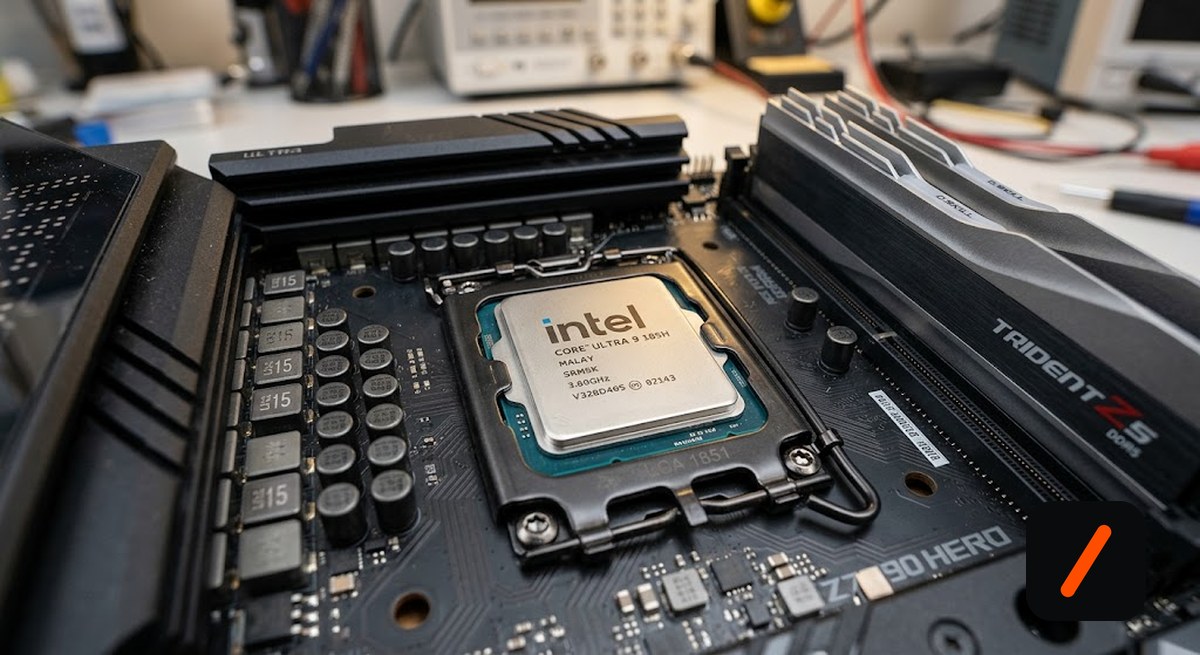
Intel has fixed the yield problems that were holding back its 18A manufacturing process and is now ramping production, according to BlueFin Research, with combined output across two sites projected to reach roughly 30,000 wafers per month. That is the single most important thing that can happen to Intel right now. 18A is the process behind Panther Lake, Intel's first chip on the node, and a working, high-yield 18A is what turns Intel Foundry from a promise into a business that can credibly compete with TSMC and Samsung.
- BlueFin Research reports Intel has resolved 18A yield issues and laid out a ramp for both 18A and its next node, 14A.
- Combined production across two fabs could reach around 30,000 wafers per month, which directly means more Panther Lake chips reaching the market.
- Panther Lake, the Core Ultra 300 series, is Intel's first 18A part, launched at CES 2026 with claims of roughly 50% faster CPU and GPU performance over the prior generation.
- 18A is Intel Foundry's proving ground: shipping it at acceptable yield is how Intel wins external foundry customers who currently depend on Taiwan-based TSMC.
What actually changed?
Yield is the percentage of usable chips you get from a wafer, and on a brand-new process it starts low and climbs as engineers hunt down defects. Low yield on 18A meant Intel could make Panther Lake but not enough of it, and every bad die is money burned. BlueFin's read is that Intel has now pushed 18A yields to a level that supports volume production, and that it is preparing to ramp 14A behind it. A separate improvement landed for owners too: Panther Lake systems with Arc Pro graphics can now use up to 93% of shared system memory, squeezing more performance out of the same silicon.
Related$1B of iPhone 18 Pro Chips Are Stuck Waiting on DRAM
Why is 18A the whole ballgame for Intel?
Because Intel bet its comeback on being a foundry, not just a chip designer. To win customers away from TSMC, Intel Foundry has to prove it can manufacture a leading-edge node at competitive yield and cost. Panther Lake is the demonstration unit. If Intel can ship it on schedule, at good yield, with competitive performance, then Intel Foundry gains the credibility it needs to land external orders. A large share of that production runs out of Fab 52 in Arizona, which doubles as a geopolitics story: domestic manufacturing, backed by billions in CHIPS Act money, appeals to customers nervous about concentrating leading-edge supply in Taiwan.
| Factor | Intel 18A | TSMC N2 | Samsung SF2 |
|---|---|---|---|
| Status | Ramping, yield fixed | High-volume leader | Ramping |
| Flagship use | Panther Lake | Broad customer base | Internal + external |
| Key edge | US fabs, CHIPS Act | Yield and ecosystem | Pricing |
| Open question | External customers | Capacity | Yield track record |
What it means for the stock
For Intel (INTC), a confirmed 18A yield fix is the most bullish operational data point the company can produce, because the entire foundry thesis hinges on it. A ramp toward 30,000 wafers a month signals the process is manufacturable at scale, which is the prerequisite for landing the external foundry customers that would justify Intel's capital spending. The signal for investors is not the Panther Lake performance numbers, which were already known at CES; it is the yield and volume, because those determine gross margin and whether Intel Foundry has a real path to third-party revenue. What to watch is any named external customer committing to 18A or 14A, since that, not internal chips, is the proof the turnaround is working. Treat this as analysis, not advice.
Our take
Intel has had more false dawns than most companies get, so healthy skepticism is warranted until the wafer numbers show up in shipments and financials. But this is a genuinely important milestone if it holds. Fixing 18A yield is the difference between Intel Foundry being a strategy deck and being a business. The performance story for Panther Lake was never really in doubt; supply and yield were. If BlueFin's read is right and 14A follows cleanly, Intel finally has a manufacturing story that competes on the merits rather than on patriotism. The next proof point is a customer logo, not a chip.
RelatedIntel puts its next CPU core on desktop before the data center
How does 18A change the foundry balance of power?
For a decade, leading-edge chip manufacturing has been effectively a TSMC monopoly, with Samsung a distant second and Intel absent as a merchant foundry. A high-yield 18A is the first credible crack in that structure in years. It gives large customers a third option for their most advanced silicon, and crucially a US-based one at a moment when supply-chain geography is a boardroom concern. That optionality has value even before Intel wins a single external deal, because it gives buyers leverage in negotiations with TSMC. The catch is that foundry relationships are sticky and trust is earned over multiple nodes, not one. A customer does not move a flagship product to a new foundry on the strength of a single good yield report; it runs test chips, validates the process design kit, and watches whether the second and third nodes ship on time. 18A gets Intel into the conversation. Staying in it is a multi-year proof.
- ReportingIntel solves 18A yield issues, Panther Lake shared memory The FPS Review
- OfficialIntroducing Panther Lake: by the numbers Intel Newsroom
- ReferenceUpcoming hardware launches 2026 TechPowerUp
Original analysis by GenZTech. Reporting via The FPS Review.