
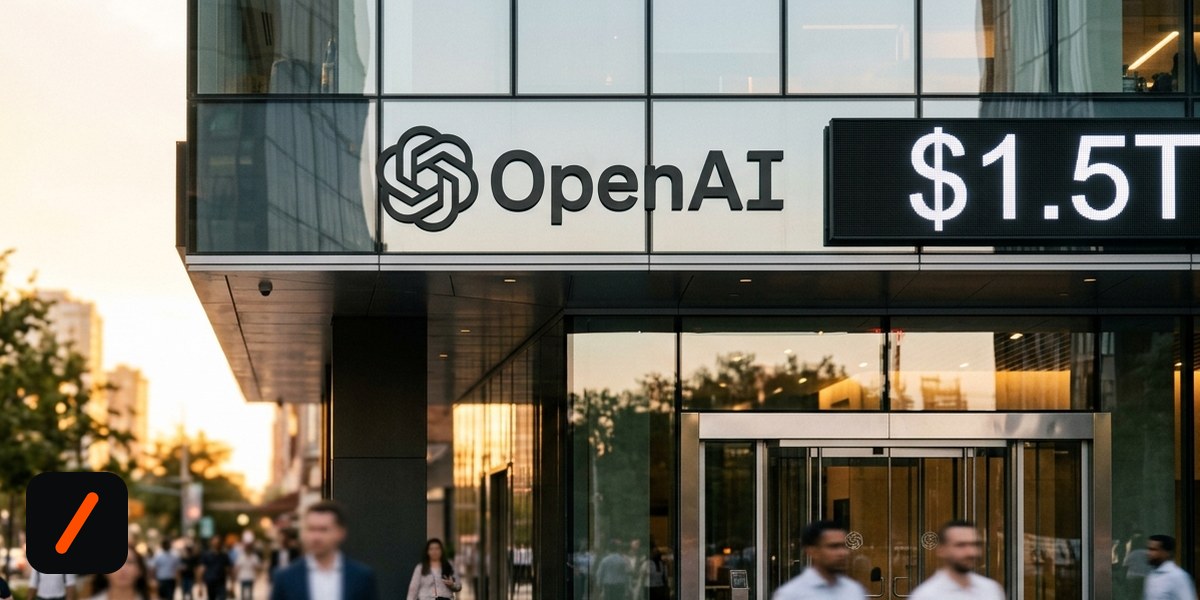
OpenAI wants a $1.5 trillion valuation for its next funding round. Investors it has approached have floated roughly $1.2 trillion instead. Both numbers come from early, informal conversations reported September 16, 2026 by the New York Times, with Bloomberg and the Financial Times separately confirming the lower figure. No round has closed and no amount raised has been reported. What exists right now is a $300 billion gap, nearly double the valuation OpenAI closed at five months ago.
- OpenAI is seeking $1.5 trillion; investors in early talks have proposed about $1.2 trillion. Nothing is signed.
- The March 2026 round valued the company at $852 billion post-money, up from $730 billion pre-money.
- Annualized revenue crossed $40 billion in August 2026, roughly double where it sat at the end of 2025.
- CEO Sam Altman says going public before 2027 would be "ill-advised."
How did OpenAI go from an $852 billion valuation to a $1.5 trillion ask?
The current number traces back to March 2026, when OpenAI raised $122 billion at a $730 billion pre-money valuation, closing at $852 billion post-money. Amazon, Nvidia and SoftBank were among the investors. Five months later, in August 2026, employees sold roughly $7 billion of stock in a secondary sale, a sign buyers were still willing to pay up for existing shares. OpenAI has now raised more than $180 billion in total since its 2015 founding. The September 16 reports of talks at $1.2 trillion to $1.5 trillion are the next step in that climb, not a finished deal.
RelatedNvidia in Talks to Invest in Perplexity at $30B+ Valuation
Why is there a $300 billion gap between the ask and the offer?
Run the math on revenue and the gap makes more sense. OpenAI's annualized revenue run rate was above $40 billion as of August 2026. A $1.5 trillion valuation prices the company at roughly 37 times that run rate. A $1.2 trillion valuation prices it at roughly 30 times. Both multiples are steep, but the ten-point spread is exactly the kind of gap that gets negotiated between an investor's opening offer and a company's counter. The interesting question is which figure the round actually closes near, and how long that takes.
What is actually driving the higher number?
Revenue growth is real, not just narrative. OpenAI booked $5.7 billion in quarterly revenue in Q1 2026 and $6.7 billion in Q2 2026. The jump to a $40 billion-plus annualized run rate by August followed a roughly 20% uptick tied to the GPT-5.6 release, the kind of acceleration that justifies a higher-multiple conversation with investors.
It is not the whole picture. The Wall Street Journal has reported that OpenAI's operating margins are declining even as revenue climbs, a sign the cost of serving that growth, compute, data centers, model training, is rising alongside it. A valuation built only on the top-line number tells half the story.
Why isn't OpenAI just going public already?
It has taken the first formal step. OpenAI filed a confidential IPO prospectus with the SEC in June 2026, and CFO Sarah Friar said in August that the company "will be a public company in 2027." On September 12, Altman pushed back on the timing directly: an IPO before 2027 is unlikely, he said, calling it "an ill-advised moment to go public" and citing AI safety concerns. Three days later, on September 15, Friar told CNBC "we still have an incredible balance sheet," a line that reads more like reassurance than new information.
Our read: the safety rationale is genuine, but it also buys OpenAI another year outside the reach of public-market scrutiny, scrutiny that would ask hard questions about those declining margins well before 2027. A private mega-round lets OpenAI raise at a headline valuation without opening its books to shareholders who price growth against burn every quarter.
RelatedAnthropic Filed Confidentially for an IPO, Ahead of OpenAI
What it means for the market
The public company with the most direct exposure is SoftBank Group (9984.T), OpenAI's largest outside backer. Around September 14, 2026, SoftBank secured an upsized $11.87 billion two-year loan, above its original $10 billion target, from roughly 20 banks, to fund more of its OpenAI investment. SoftBank expects its cumulative stake to reach about $64.6 billion by October 2026, for roughly 13% of the company. It also carries a $10 billion margin loan backed by its OpenAI shares and is reportedly weighing a bond sale of up to $20 billion, while it repaid the $25.9 billion balance left on an earlier $40 billion loan on September 15.
That is a lot of layered debt sitting on top of a valuation no new round has actually priced yet. SoftBank's stock is effectively the closest public proxy for what investors think OpenAI is worth. Microsoft (MSFT), Nvidia (NVDA) and Amazon (AMZN) carry the other side of this exposure as investors and infrastructure partners, though none is financing its stake with fresh debt the way SoftBank is. The signal here is to track SoftBank's cost of capital as a read on OpenAI sentiment, not to treat any of this as a cue to trade shares of a company that is not yet public.
| OpenAI | Anthropic | |
|---|---|---|
| Latest reported valuation | $852B (Mar 2026 round); $1.2T to $1.5T in early talks | $965B (May 2026 round) |
| Annualized revenue | $40B+ (Aug 2026) | $65B (end of Q2 2026, reported) |
| IPO status | Confidential S-1 filed Jun 2026; Altman says unlikely before 2027 | Reportedly targeting a Nasdaq IPO as early as October 2026 |
| Reported target IPO valuation | Not disclosed | Above $2T, reported |
- March 2026OpenAI raises $122B $730B pre-money, $852B post-money; Amazon, Nvidia, SoftBank among investors
- June 2026Confidential S-1 filed with the SEC
- August 2026Employee secondary sale, roughly $7B annualized revenue crosses $40B
- Sept 12, 2026Altman says an IPO before 2027 is unlikely
- Sept 14, 2026SoftBank secures upsized $11.87B loan
- Sept 15, 2026Friar: "incredible balance sheet" SoftBank repays $25.9B loan balance
- Sept 16, 2026Reports of new talks at $1.2T to $1.5T
- 2027Targeted IPO window
- Where the round closes. A print near $1.2 trillion favors investors; anything close to $1.5 trillion means OpenAI's negotiating position held.
- Margin trend. Further reporting on declining operating margins would complicate the higher multiple.
- SoftBank's balance sheet. The stacked loans and a possible $20 billion bond sale make 9984.T a leveraged bet on OpenAI's next valuation print.
- The 2027 IPO date. Friar has committed to it publicly twice; watch whether Altman's safety framing holds if market conditions shift.
Our take
The number that matters here is not $1.2 trillion or $1.5 trillion. It is $300 billion, the gap between what OpenAI wants and what investors have offered. That gap closes through negotiation, not revenue reports or safety statements, and whichever side gives more ground will say more about OpenAI's real leverage than any headline figure. SoftBank is the name doing the loudest talking, because it is the one taking on real, dated debt to bet on a number nobody has agreed to yet.
- ReportTNW: OpenAI eyes a private round at a $1.5tn valuation summarizes NYT, Bloomberg and FT reporting
- ReportForbes: OpenAI reportedly weighing new funding round at $1.5 trillion valuation
- ReportPYMNTS: OpenAI eyes $1.2 trillion valuation in pre-IPO round
- FilingBloomberg: SoftBank gets upsized $11.9 billion loan in OpenAI funding push
- DataGenZTech funding tracker
- DataBiggest AI funding rounds, ranked
Original analysis by GenZTech, drawing on the primary source and the sources listed above.