
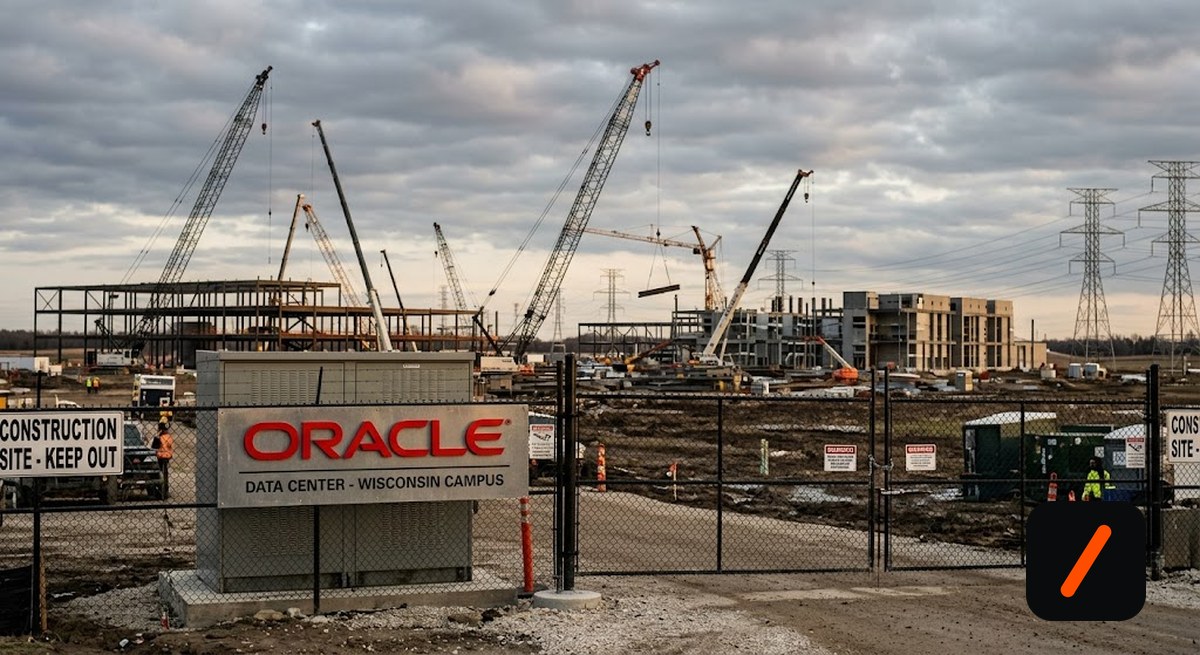
Wisconsin's Public Service Commission confirmed on Monday that it will not loosen the credit rules governing large data center customers, leaving Oracle facing a collateral requirement it estimates at more than $7 billion for its Port Washington campus. This is not an ordinary permitting fight. It is the clearest case yet of an AI buildout's credit rating converting directly into a hard operating cost, and the mechanism that did it is a utility tariff almost nobody in tech has read.
- The commission has no plans to reconsider the rule and will defend it in Ozaukee County Circuit Court, where Oracle sued on June 19.
- We Energies' "very large customer" tariff requires customers rated below A- to post cash or a letter of credit covering the new generation and transmission built to serve them. Oracle puts that above $7 billion, costing more than $100 million a year to carry.
- S&P cut Oracle to BBB- on July 9, one notch above speculative grade, citing AI capital spending and OpenAI concentration. That moved Oracle further from the threshold, not toward it.
- The site is a four building, roughly one gigawatt campus representing about $15 billion of investment, tied to Oracle's $300 billion compute commitment to OpenAI.
What did Wisconsin actually decide?
In April 2026 the three member Public Service Commission created a "very large customer" rate structure for We Energies. Data center developers in that class must either satisfy credit rating, liquidity and tangible asset tests, or post financial security before the utility will serve them. The trigger is a credit rating below A-. Commissioner Christi Nieto described the structure as a temporary stopgap measure.
RelatedCleanSpark Trades Bitcoin Mining for a $6.6B Lease
We Energies itself asked the commission to soften it on June 10, arguing that any investment grade rating, including the BBB tier, should qualify for an exemption. Oracle went further and sued on June 19 in Ozaukee County Circuit Court, arguing the commission acted outside its authority and without sufficient evidence to justify the rule. Monday's confirmation closes the administrative path. The commission is not reopening the docket, and the fight now happens in front of a judge.
Why does a credit rating decide who gets power?
The logic is about who absorbs a stranded asset. Serving a gigawatt scale campus means building generation and transmission that would not otherwise exist, and single plants run from hundreds of millions of dollars to more than a billion. If the developer walks away midway, that infrastructure still has to be paid for, and in a regulated utility the bill lands on the remaining ratepayers. The tariff converts that risk into a posted number: prove you can absorb the loss yourself, or leave the cash where the utility can reach it.
What makes Oracle's position awkward is timing. It was already at BBB, two notches under the line, when the rule passed. Then S&P cut it to BBB- on July 9 and dropped the short term rating from A-2 to A-3. So the utility's own argument, that investment grade should be good enough, got weaker at exactly the moment Oracle needed it to hold. A company arguing the threshold is unreasonably strict just got downgraded for the reason the threshold exists.
| Position | Oracle | We Energies | Wisconsin PSC |
|---|---|---|---|
| What they want | Rule invalidated, collateral waived | Exemption for any investment grade rating | Rule kept as written |
| Action taken | Lawsuit filed June 19 | Reconsideration request June 10 | Declined both, July 21 |
| Stated reason | Commission exceeded its authority | Threshold is stricter than credit markets require | Ratepayers should not carry developer risk |
| Cost if they lose | $7B+ posted, $100M+ a year | A harder sell to future tenants | Precedent falls in circuit court |
How big is the campus this is about?
Port Washington is a four building campus of nearly one gigawatt, already under construction, carrying roughly $15 billion of investment. It is not a standalone bet. It is one piece of the $300 billion computing commitment Oracle signed with OpenAI, and that contract is the same thing S&P pointed at when it cut the rating. The agency estimates roughly half of Oracle's $638 billion in remaining performance obligations traces back to OpenAI, and it forecasts fiscal 2027 capital spending of $90 billion to $95 billion against a previous $60 billion projection, with a free operating cash flow deficit near $42 billion.
What it means for the market
The exposed name is Oracle itself, ticker ORCL, and the signal is not the $7 billion. Against $90 billion of annual capital spending, a letter of credit is a rounding error, and the $100 million carrying cost is noise on that base. The signal is second order: a BBB- rating now has physical consequences. Utilities in other states can copy this tariff, and every one that does adds a cost that scales with how far below A- a developer sits. Oracle is the hyperscale builder most dependent on external financing and least able to absorb a downturn, which is exactly what S&P said, so it is the one that pays this tax first and most.
The thing worth watching is contagion into the financing stack. Lenders price data center projects on the assumption that a signed utility interconnection is money good. If a credit downgrade can pull that interconnection back open, project finance for AI capacity gets repriced, and the developers with the thinnest balance sheets feel it before Oracle does. That is a broader read than one campus in Ozaukee County, and it is not investment advice, just the direction the mechanism points.
RelatedNew York Orders First US Data Center Moratorium
- April 2026PSC creates the very large customer rate structure Credit tests or collateral before service
- June 10We Energies asks for reconsideration Wants any investment grade rating exempted
- June 19Oracle sues in Ozaukee County Circuit Court Claims the commission exceeded its authority
- July 9S&P cuts Oracle to BBB- One notch above speculative grade
- July 21PSC confirms it will not reopen the rule Will defend it in court instead
- NextOzaukee County Circuit Court hears the challenge Sets the precedent other states read
Who else is exposed to this?
Microsoft is already in the same docket from a different angle, asking the commission to clarify how transmission costs get allocated for its Mt. Pleasant campus while federal rules are potentially changing. That is the tell: the large developers are not treating this as an Oracle problem, they are mapping the rules before they commit capacity. Any developer whose rating sits below A- and whose site needs new generation is looking at the same arithmetic, and the number scales with megawatts, so the biggest projects generate the biggest bills.
The people this actually protects are We Energies' other customers, which is the part the coverage tends to skip. Wisconsin is not blocking the data center. It is refusing to let households underwrite it. That framing matters because it is durable in a way that a moratorium is not: a moratorium is a political fight, a collateral requirement is just a term sheet.
- The circuit court ruling. If Ozaukee County upholds the rule, expect utility commissions in Ohio, Georgia and Virginia to draft their own version within a year.
- Whether Oracle posts. Actually placing a $7 billion letter of credit while running a $42 billion cash flow deficit is the real test of the balance sheet, and it will show in the next filing.
- The next rating action. Another notch takes Oracle to speculative grade, and the collateral math is not the worst thing that happens at that point.
- Copycat tariffs. Watch for the phrase "very large customer" appearing in other states' rate cases. That is the rule spreading.
Our take
The interesting thing here is not that Oracle got a large bill. It is that a credit rating agency's opinion became a physical gate on a construction project, without any legislature voting on it. Wisconsin did not set out to regulate the AI buildout. It wrote a ratepayer protection rule, and the AI buildout ran into it because the buildout is being financed in a way that produces weak credit ratings. That is a genuinely new failure mode, and it is going to keep happening as long as compute commitments are signed faster than balance sheets can carry them.
We think Oracle probably loses this one, and that losing it costs less than the precedent it sets. The company can find $7 billion. What it cannot easily do is unwind a $300 billion obligation to a single counterparty that a rating agency has now flagged twice, in a market where every new gigawatt needs a utility to say yes first. The collateral is the symptom. The concentration is the condition.
- OfficialS&P Global Ratings: Oracle downgraded to BBB-/A-3 , the July 9 rating action
- OfficialWisconsin Public Service Commission , docket and orders for the very large customer tariff
- ReportingWisconsin Watch: regulators refuse to loosen the credit rules , filing dates, commissioner comment and rule terms
- ReportingEngineering News-Record: Oracle challenges the financing rule , campus size and the $100 million annual estimate
- ReferenceGenZTech: New York's data center moratorium , the other way states are slowing the buildout
Original analysis by GenZTech. Lead reporting on the commission's Monday confirmation: Financial Times.