
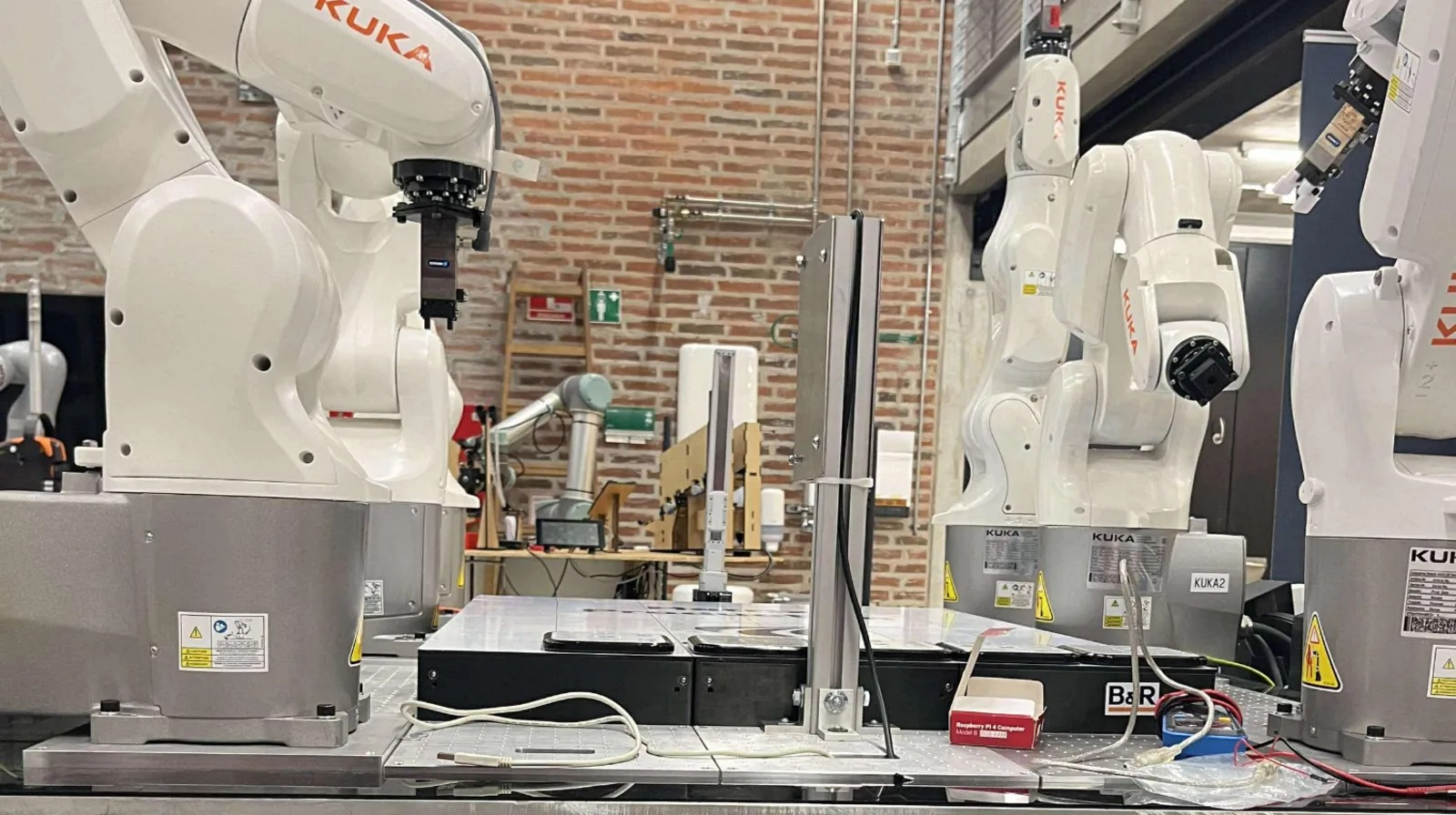
Most Campus Radar builds are finished demos. This one isn't, and that's exactly why it's worth writing about: Nikolaj Bjornager, a student at Aalborg University, built a C# control framework for a magnetic levitation manufacturing table that his own professors now use to teach the next batch of students, even though he stopped short of finishing it.
What Planar Mover Control actually does
"It provides a code base that acts as a control framework to get started with PMCs in C#," Nikolaj told us. PMCs, or planar movers, are the small shuttles that glide across a B&R ACOPOS 6D table using magnetic levitation instead of rails or belts, a flexible-manufacturing platform that lets a production line reroute itself instead of following one fixed path. Getting a shuttle to move at all from scratch means talking to that hardware correctly; Nikolaj's project is the base other students now build on top of instead of starting from zero.
RelatedThis Student Built a Powerbank With Batteries You Can Actually Replace
Built to change while it's running
"I built it to provide others the opportunity to create a very optimized and dynamic production line using a MES oriented codebase that can be changed during runtime," he said. MES, manufacturing execution system, is the layer that actually schedules and adjusts a factory floor in real time rather than just running a fixed program. "The hardest part was making shuttles act, path-finding and move independently, while maintaining a flow state," Nikolaj said, describing the actual difficulty: multiple shuttles need to plan their own routes and avoid each other without a human directing traffic, all while the line keeps moving.
Real lab hardware, real students
The ACOPOS 6D his code runs on isn't a simulation. "The ACOPOS 6D is one we have on-site at campus at my university (Aalborg University) in our Smart Production Laboratory which is a robotics lab. Students come and go and try to work on the table, and my work which you have come across is used by associate professors to educate new students on how to use the table through C#," he told us. That's the part that makes this Campus Radar-worthy on its own: a piece of student code that outlived the class it was built for and quietly became campus infrastructure.
| Trait | Planar Mover Control | Starting from B&R's raw SDK |
|---|---|---|
| Time to a moving shuttle | A working C# base to build from immediately | Read the ACOPOS 6D docs and wire up motion control yourself |
| Path-finding | Shuttles route and move independently, built in | Not included by default |
| Reconfiguring the line | Designed to be MES-style, changeable at runtime | Typically a stop-and-redeploy cycle |
| Who it's for | Aalborg students meeting the table for the first time | Engineers already fluent in B&R's own tooling |
An honest note: it's unfinished, and that's kind of the point
When we first reached out, we'd assumed the project's XML-driven state machine layer had shipped. Nikolaj corrected us directly: "the project is archived and was never fully finished. The XML-defined state machine system you mentioned was part of the intended architecture, but I stopped working on the project before getting as far as implementing the XML parsing." Nothing about the working parts changes because of that. The shuttle path-finding, the independent motion, the runtime-changeable production line, all of that is real, running code that other students use today. The state machine layer was the next planned step, and he was straight with us that it never happened.
RelatedNvidia's LPU Bets Inference Needs Its Own Silicon
Our take
Most spotlight-worthy student projects get pitched as finished. Nikolaj's is archived and admittedly incomplete, and he still corrected our own framing of it rather than letting an inflated claim stand, which is a better signal about the work than a polished README would have been. What actually shipped, an independent-motion, runtime-reconfigurable base for a piece of six-figure lab hardware that professors now hand to new students, would already be a solid Campus Radar story on its own. That it's honestly labeled as unfinished on top of that just makes it a more useful one to read.
Planar Mover Control was built by Nikolaj Bjornager at Aalborg University's Smart Production Laboratory. The project is open: GitHub · demo video · nikolajbjoernager.dk.
- Built something? Doesn't need to be finished or fancy: a side project, a hackathon build, or a class project you're proud of counts.
- Email hello@genztech.blog with what you built, why you built it, a link, and your name plus college.
- See every spotlight so far at genztech.blog/campus-radar.
Reporting based on a direct interview with Nikolaj Bjornager, including his own correction of an inaccurate assumption in our original outreach. GenZTech has not independently audited the codebase.