
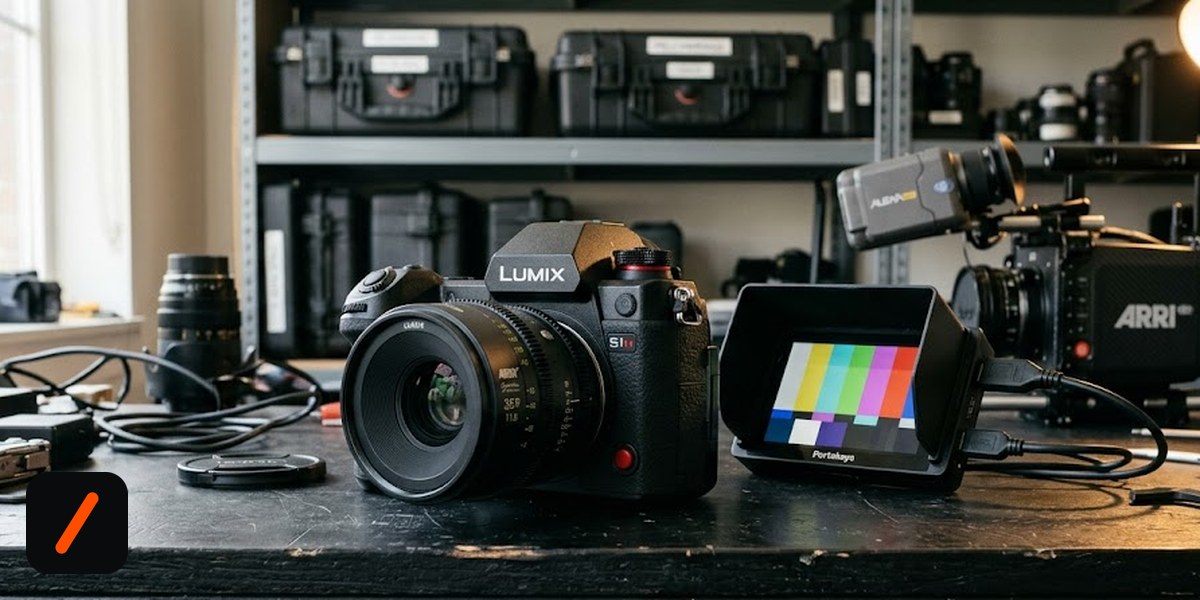
Panasonic has done what Sony, Apple and Nikon could not. On 30 June 2026 Japan's Intellectual Property High Court upheld the Japan Patent Office's invalidation of JP 5231529, the "Video Camera" patent that underpinned RED's grip on compressed RAW recording inside cameras. The decision surfaced publicly on 8 August. Claims 1 to 7 and 10 to 22 are dead in Japan. Claims 8 and 9 had already been deleted.
The delicious part is who lost. Nikon acquired RED in 2024, inherited the patent portfolio, and stepped in as successor to defend the appeal. Two years earlier Nikon had been on the other side of this exact fight, arguing in a US court that these patents should never have been granted.
RelatedSamsung's phone arm posts its first ever operating loss
What actually killed the patent?
One piece of prior art: US 2006/0061822 A1. It described compressing image data temporarily to cut memory requirements during buffering, and it did so on raw pixel information separated into R, G, B and second-G planes, with difference calculations run between those colour planes.
RED and Nikon argued two points of distinction. The court rejected both.
The first, call it the pre-demosaic argument, held that RED's method was special because it compressed mosaic RAW data before demosaicing, whereas the prior art compressed RGB data after. The court read the cited reference and found it already described R, B and dual-G planes, which is consistent with mosaic data, and that nothing in it required demosaicing to happen first. The judges specifically refused the inference that simple subtraction between colour planes proves full RGB reconstruction has already occurred. That inference was load-bearing for RED's case, and it collapsed.
The second argument concerned preprocessing. RED said its preprocessing step differed from the gamma correction in the prior art. The court found the claim language too broad to exclude ordinary gamma correction, which does the same basic thing: lift the dark values, restrain the bright ones. A claim written wide enough to capture competitors is also wide enough to capture the prior art that invalidates it. That is the trade every patent drafter makes, and here the bill came due.
Everyone else tried this and lost
This patent family has been attacked repeatedly for thirteen years by companies with effectively unlimited legal budgets. Every prior attempt failed.
| Challenger | Year | Forum | Outcome |
|---|---|---|---|
| Sony | 2013 | US courts | RED sued over the F65, F55 and F5. Patent emerged intact. |
| Apple | 2019 | US PTAB | Challenged the US patent, widely read as clearing ProRes RAW. Petition denied. |
| Nikon | 2022 | US courts | Countersued after RED sued over Z 9 internal RAW, arguing the tech was public pre-filing. Dismissed April 2023. |
| Panasonic | 2022 | JPO, then IP High Court | Invalidation trial 2022-800039. JPO invalidated Oct 2024, upheld 30 June 2026. |
Panasonic won by picking a different weapon. Sony, Apple and Nikon fought in US forums, where the standard of proof for invalidating a granted patent is punishing. Panasonic filed a JPO invalidation trial, a dedicated administrative proceeding built for exactly this, and then survived the appeal. Same patent family, different jurisdiction, opposite result.
RelatedNvidia's $21B SpaceX stake is already worth $17B
What changes for camera buyers?
Less than the headline suggests, and that is worth being honest about. The ruling covers one Japanese patent. It does not invalidate RED or Nikon patents in the United States, the EU or anywhere else, and it does not make compressed RAW globally free to implement.
What it does change is the risk calculus for manufacturers whose engineering and legal work happens in Japan, which is most of the camera industry. For nearly two decades, internal compressed RAW was a feature you licensed or avoided. Canon, Panasonic, Fujifilm and Sony have all shipped around this constraint in various ways, sometimes by routing RAW out over HDMI to an external recorder instead of writing it to the card. Remove the Japanese patent and the cheapest path, writing compressed RAW straight to internal media, gets meaningfully less dangerous to take.
- 2013RED sues Sony F65, F55, F5 accused. Patent survives.
- 2019Apple petitions PTAB Denied
- May 2022RED sues Nikon over the Z 9 Nikon countersues on validity
- 2022Panasonic files JPO invalidation 2022-800039 The one that worked
- Apr 2023RED v Nikon dismissed
- 2024Nikon acquires RED Inherits the patent it had just attacked
- Oct 2024JPO invalidates the claims
- 30 Jun 2026IP High Court upholds invalidation Nikon loses as successor defendant
- Whether Nikon appeals to the Supreme Court of Japan. It has the standing and the incentive, having paid for the portfolio.
- Parallel challenges elsewhere. A successful invalidation gives other challengers a tested prior-art roadmap, and US 2006/0061822 A1 is public.
- Internal RAW appearing on cheaper bodies. The clearest tell that manufacturers believe the risk has dropped.
- Nikon's licensing posture. It bought RED partly for this leverage. A quieter enforcement stance would say the leverage is worth less than it paid.
Our take
Nikon spent 2022 arguing this patent was invalid, bought the company that owned it, then lost an appeal defending it. That is not merely ironic, it is a reasonable summary of what the patent was always worth: enough to extract settlements from people who did not want a fight, not enough to survive a properly built invalidation case.
The wider lesson is procedural rather than technical. The prior art that killed this patent, US 2006/0061822 A1, was public the entire time. Three of the largest technology companies on earth failed to land it, and a fourth did, mainly by choosing a forum designed for the job. When people say the patent system rewards resources over merit, this is the more precise version of the complaint: it rewards knowing which door to knock on.
- AnalysisWhat actually killed RED's compressed RAW patent in Japan Claim-level breakdown of the IP High Court reasoning
- LegalJapan court upholds Panasonic win against Nikon MLex report on the 30 June 2026 decision
- ReferenceCineD on Nikon defending the patent it once fought Litigation history and successor-defendant detail
Original analysis by GenZTech. Story first reported by DPReview.