
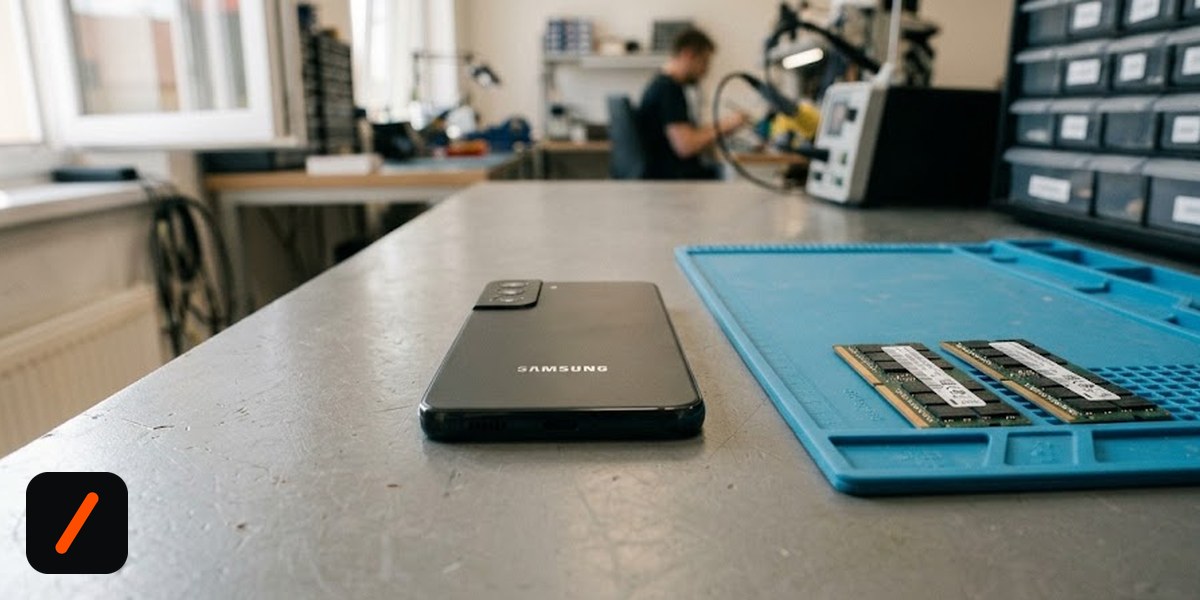
Samsung's phone business lost money for the first time in its history. In results published this morning for the quarter ended June 30, the MX mobile division posted an operating loss of roughly KRW 800 billion, about $544 million, while the same company's memory business turned in the best quarter it has ever had. Samsung blamed "increased cost burdens across the industry, such as rising component costs." That is a polite way of saying the memory shortage we have been tracking since June finally showed up on somebody's income statement, and the somebody was Samsung.
The scale of the split is what makes this worth stopping on. Group operating profit hit an all-time high of KRW 89.5 trillion on KRW 171.5 trillion of revenue, up 28% quarter on quarter. Nearly all of it, KRW 89.2 trillion, came from the Device Solutions chip division, where memory set records for both quarterly revenue and quarterly operating profit. Sell the RAM, win the decade. Buy the RAM, lose money on phones.
RelatedFoxconn's AI Servers Now Outsell Everything Else It Makes
What exactly did Samsung report?
The full quarterly release breaks the company into its usual divisions, and this time they point in opposite directions:
- MX (mobile): first operating loss on record, roughly KRW 800 billion, despite revenue growing year on year on solid Galaxy S26 sales.
- DS (semiconductors): KRW 127.5 trillion revenue, KRW 89.2 trillion operating profit, with divisional sales up 56% in a single quarter.
- Consolidated: KRW 171.5 trillion revenue and KRW 89.5 trillion operating profit, both all-time highs.
- Visual Display and Digital Appliances: KRW 14.5 trillion revenue and a slight operating loss, which is the same cost story in a quieter register.
For context on how unusual a mobile loss is: Samsung's phone division stayed profitable through the Galaxy Note 7 recall in 2016, the quarter where it pulled a flagship off the market worldwide and told customers to stop using it. That quarter still cleared about KRW 100 billion. Selling phones has been a reliably profitable business for Samsung for as long as Samsung has sold smartphones. Component prices ended that, not a product failure.
How can one company set a record and lose money at the same time?
Because Samsung's divisions do not get a family discount. MX buys DRAM and NAND at prevailing market rates, on internal transfer pricing that tracks what everyone else pays, and DS is obligated to sell where the money is. Right now the money is in AI servers: high bandwidth memory and server DRAM absorb capacity that used to go to phones, and every bit that leaves the mobile pool pushes the phone price up.
Vertical integration turns out to be a hedge, not an immunity. It protects the group's bottom line, spectacularly so in this case, but it does not protect the phone. If anything it makes the internal argument harder: an executive asking the chip division to hold back capacity for cheap handsets is asking it to leave record margin on the table.
Why did the cheap phones break first?
Memory is a bigger slice of a budget phone than of a flagship. Reporting around the results puts DRAM at roughly 23% of the component cost of an $800 phone, up from about 14%, with NAND flash adding another 15% or so. A flagship carries a $1,300 price tag, a premium camera stack and a margin cushion that can eat a nine point swing in one line item. A $250 device cannot. Samsung said as much in its own framing: budget models struggled to show a profit given higher component costs on already thin margins.
That is why the strategy Samsung laid out for the second half reads the way it does. The plan is flagship-first: push the Galaxy Z Fold 8 and the S26 Ultra, lean into high-value products, grow share at the top. Nobody at Samsung is saying the entry lineup gets abandoned. They are saying it gets repriced.
Who else is exposed?
Everyone who ships phones, and the ones without a memory business are in a worse spot than Samsung, not a better one.
RelatedThe Memory Supercycle Is Here, and AI Priced Everyone Out of RAM
| Maker | Owns memory fabs | Exposure to the squeeze |
|---|---|---|
| Samsung | Yes | Loses on phones, wins enormously at group level |
| Apple | No | Buys everything, but premium mix and supply contracts absorb more |
| Xiaomi, Oppo, vivo | No | Highest exposure: volume sits in the price bands with no cushion |
| Motorola, Nothing, smaller OEMs | No | Least buying power, first to cut configurations or raise prices |
Watch for the second-order move rather than sticker shock: base storage tiers quietly shrinking, 8GB of RAM returning to devices that shipped with 12GB last year, launch configurations trimmed, and mid-range refreshes slipping a quarter. Those changes cost a maker less political capital than a price rise, and they are already visible in this year's mid-range launches.
- Late 2025AI server demand pulls DRAM and NAND capacity toward HBM and server modules contract prices start climbing
- H1 2026Memory shortage becomes the defining supply story of the year mid-range phones begin cutting configurations
- Jul 30, 2026Samsung MX posts its first operating loss while memory sets records the first income statement casualty
- H2 2026Flagship-first push: Galaxy Z Fold 8 and S26 Ultra carry the mix entry lineup repriced or thinned
- 2027New capacity arrives, or phone prices reset at a higher baseline the fork everyone is watching
What it means for the market
The signal for investors is that memory and handsets have decoupled, and the market has been pricing that for months. Samsung Electronics and SK hynix are on the supply side of the trade, and this quarter is a loud confirmation that the memory cycle is doing exactly what the bulls said. The read-through runs the other way for handset-only exposure: Xiaomi, Transsion and the Android mid-market carry component risk with no offsetting chip revenue, and their margin guidance is where the strain shows up next. Apple sits in between, insulated by mix and by long-dated supply agreements rather than by ownership.
The number worth tracking is not Samsung's group profit, which is now essentially a memory stock in a conglomerate wrapper. It is whether MX returns to profit in Q3 without cutting specs. That is the honest test of whether the industry has absorbed this or merely postponed it. This is analysis, not investment advice.
- Base configurations, not price tags. The first cut lands on storage and RAM tiers, because it is less visible than a price increase.
- Mid-range launch slips. A refresh that quietly moves a quarter is a cost decision wearing a schedule costume.
- Whether MX gets back to break-even in Q3. If it does not, this stops being a cycle and starts being the new cost structure.
- Competitor guidance. Xiaomi and the Android mid-market report next. If their margins hold, Samsung's loss was mix-specific rather than industry-wide.
Our take
Three times this summer we covered the memory shortage as a supply story with a projected consumer cost. This is the receipt. A company that manufactures its own memory, at scale, with the best cost position in the industry, could not keep its phone division above water, and it is hard to construct a version of the next twelve months where a maker with no fabs does better than that. The interesting part is not that Samsung lost KRW 800 billion on phones. It is that Samsung made KRW 89.2 trillion in the same building, selling the thing that caused it. When the loss is that cheap relative to the win, nobody inside the company has much incentive to fix it, and the fix arrives on your next phone's spec sheet instead.
- OfficialSamsung Electronics Announces Second Quarter 2026 Results · divisional revenue and operating profit figures
- OfficialSamsung Investor Relations, earnings releases · full quarterly filings and presentations
- ReferenceRAMageddon 2026: the memory shortage explained · our earlier coverage of the price surge behind this
Original analysis by GenZTech. Figures from Samsung's Q2 2026 results release; reporting via Engadget.