
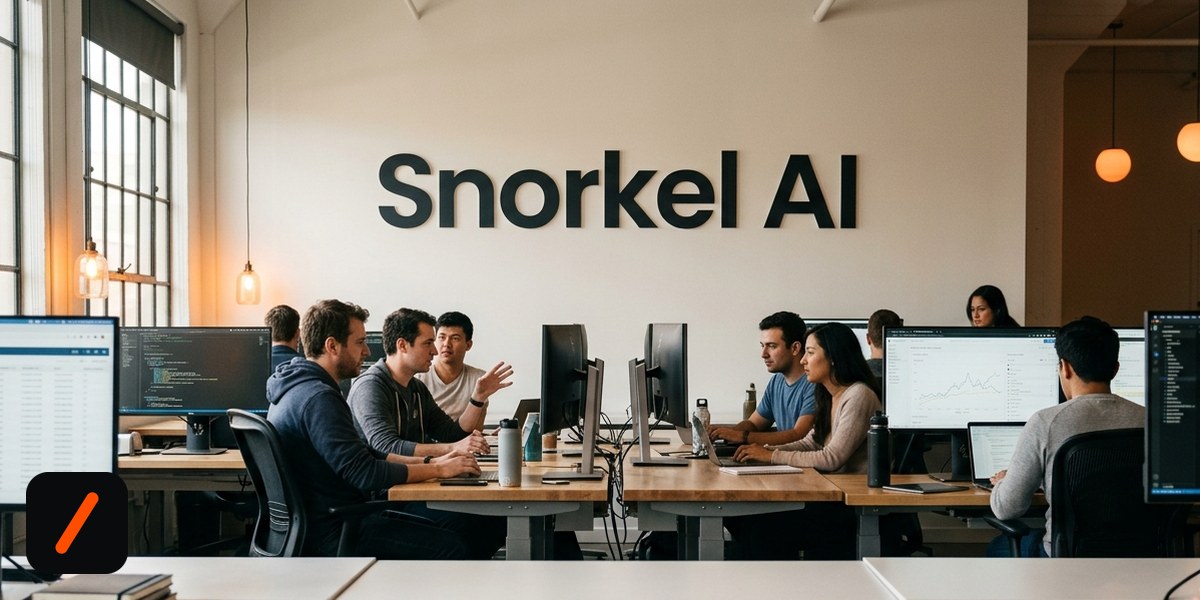
Snorkel AI tripled its valuation in sixteen months, and it did not do it by getting bigger at the thing that made it well known. On September 22, 2026, the company closed a $350 million Series E at a $3.5 billion valuation, up from the $1.3 billion mark it hit after May 2025's $100 million Series D. The number that explains why investors showed up sits on the revenue line: an annualized run rate above $350 million, which TechCrunch puts at about $375 million, up roughly 18x in twelve months from around $20 million a year earlier.
- The round: $350M Series E at a $3.5B valuation, co-led by Insight Partners and S32. New backers March Capital, Blumberg Capital, Allegis Capital, Frontline, Standard and Third Point Ventures joined existing investors Addition, Greylock, Lightspeed, GV, Factory, Prosperity7, Walden Catalyst and Wells Fargo.
- The pivot: Snorkel spent years selling software that helped companies label their own training data. It now sells finished datasets, benchmarks, evaluations and reinforcement-learning environments through what it calls an agentic data factory, mixing synthetic data generation with human subject-matter experts.
- The accounting wrinkle: Snorkel's run rate looks smaller than rivals like Mercor (about $2B gross) or Handshake ($1B), but the two numbers are not measuring the same thing, and that gap is most of this story.
- The use of funds: expanding data-factory capacity, vertical and enterprise AI solutions, research into new domains and modalities, and open research including Open Benchmarks Grants.
Why does a $375M run rate beat Mercor's $2B?
The comparison invites an obvious question: how does a company with less reported revenue than three rivals raise money at this valuation? The answer is in how each counts a dollar. TechCrunch's reporting on the deal puts Mercor at about $2 billion in gross annualized revenue, Handshake past $1 billion in early 2026, and Micro1 around $500 million gross. All three typically pass 60 to 70 percent of that revenue through to the contractors doing the labeling and evaluation work, so their real take-home is a fraction of the headline number. Snorkel does the opposite: it books expert pay as a cost of doing business rather than grossing it up as revenue and paying it back out. Its figure above $350 million, which TechCrunch puts at roughly $375 million, is already close to net.
RelatedCognition eyes $40B, and the multiple actually fell
| Company | Snorkel AI | Mercor | Handshake | Micro1 |
|---|---|---|---|---|
| Reported run rate | $350M+ (~$375M per TechCrunch) | ~$2.0B gross | ~$1.0B (early 2026) | ~$500M gross |
| How revenue is counted | Net, expert pay booked as COGS | Gross billings | Gross billings | Gross billings |
| Cut typically passed to contractors | Not applicable, not grossed up | ~60-70% | ~60-70% | ~60-70% |
| 12-month revenue growth | ~18x, from ~$20M | Not disclosed here | Not disclosed here | Not disclosed here |
| Latest valuation | $3.5B (Sept 2026) | Not disclosed here | Not disclosed here | Not disclosed here |
Put the two accounting methods on equal footing and the size gap most readers assume shrinks considerably, even without exact net figures for the rivals. That is the case Snorkel made to investors, and Insight Partners and S32 found it convincing enough to co-lead a round that nearly triples its price tag from sixteen months earlier.
What is Snorkel actually selling now?
Snorkel started as Stanford AI Lab research. Founder and CEO Alex Ratner and his co-founders built software that used weak supervision to help companies label their own training data faster, and the company has been commercial since 2019, with more than 250 peer-reviewed papers behind its approach. That original business is not what raised $350 million. Over the past two years Snorkel moved from selling the tool to selling the output: finished datasets, benchmarks, evaluations, and reinforcement-learning environments, what it calls expert-agentic environments, produced through an agentic data factory blending synthetic data with real subject-matter experts. The Data-as-a-Service line launched in September 2025 and now does most of the work on revenue. Ratner put the pitch this way: 'The teams pushing the frontier want a research data partner who pioneers the science of data development.'
- 2019Snorkel AI goes commercial. Spins out of the Stanford AI Lab after years of published research; the team eventually publishes more than 250 peer-reviewed papers.
- May 2025$100M Series D at a $1.3B valuation.
- Sept 2025Launches Data-as-a-Service. Shifts from labeling tools toward selling finished datasets, evaluations and benchmarks directly.
- Sept 22, 2026$350M Series E at a $3.5B valuation. Co-led by Insight Partners and S32, with six new investors joining eight existing ones.
What it means for the market
$3.5 billion on roughly $375 million in annualized revenue works out to about 9 to 10 times run rate, a multiple inside the range frontier AI infrastructure has priced at through 2026. What matters more than the multiple is what buyers are paying for. Nearly all of Snorkel's growth ties to reinforcement-learning environments and expert-produced evaluation data, the raw material frontier labs need to train and test agents rather than static chatbots. That is a different business than the labeling market Snorkel came from, and the same shift is showing up at Mercor, Handshake and Micro1: recruiting and workforce platforms turning into data-supply businesses for AI labs, at valuations and run rates none of them had eighteen months ago. Readers tracking how this round compares with the rest of the year's AI financings can check our Funding Tracker, and see where it lands among the largest deals of the cycle in Biggest AI Funding Rounds. None of this is investment guidance, just a description of where the money is flowing and why.
RelatedWonderful's $550M Series C Doubles Valuation to $5B
- Does the net-revenue framing hold up under scrutiny? Snorkel's growth story rests partly on an accounting choice. If a rival restates its own numbers net of contractor pay, the gap between the companies narrows on paper even if the underlying business does not change.
- Can the 18x growth rate survive another year? Going from $20 million to $375 million is the kind of jump that gets harder to repeat once the base is bigger.
- Do RL environments stay a distinct product line? Frontier labs building their own environments in-house would cut into the exact demand Snorkel is now selling into.
- Does Open Benchmarks Grants become a real differentiator? Funding open research is a cheap signal until it produces benchmarks other labs actually adopt.
Our take
The accounting difference is not a footnote here, it is close to the entire story. A company that books expert payments as cost of goods sold and a company that grosses up the same payment before passing most of it back out are not comparable on run rate alone. Treating $2 billion and $375 million as directly comparable numbers, the way a quick skim of headlines invites, gets the picture wrong. Snorkel's real achievement in this round was convincing two lead investors to underwrite that distinction at a $3.5 billion price. The more durable signal is what all four companies now sell: not labeled data for last generation's models, but the reinforcement-learning environments and expert evaluation frontier labs need to keep pushing agents forward. That demand is real and is not fading soon. Whether Snorkel's multiple looks smart in another eighteen months depends on whether 18x growth can happen twice.
- OfficialPR Newswire: Snorkel AI raises $350M the company's own announcement
- ReportingTechCrunch: Snorkel AI triples valuation to $3.5B revenue detail and competitor context
- ReportingBetaNews: Snorkel AI's $350 million Series E prior-year revenue baseline
- TrackerGenZTech Funding Tracker how this round compares to the rest of 2026
- ReferenceBiggest AI Funding Rounds where it ranks among 2026's largest AI raises
Original analysis by GenZTech. Figures reflect reporting as of September 27, 2026.