
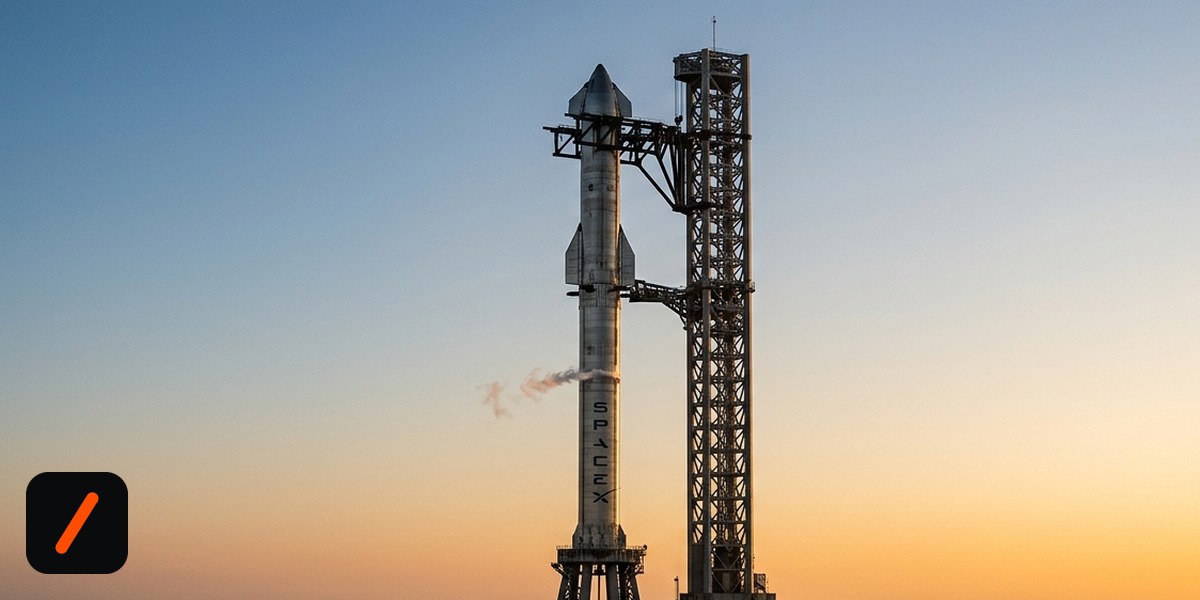
Starship reached orbit for the first time on Monday, then used the trip to release 26 Starlink V3 satellites, its biggest V3 batch yet. Thirteen earlier test flights got higher and further, but none made orbit. Flight 14 did, then came home seven hours early anyway.
- Flight 14 lifted off at 8:49 a.m. EDT on September 28, 2026, from Starbase in Boca Chica, Texas, flying Super Heavy Booster 21 and Ship 41 under clear skies.
- Ship 41 became the first Starship to reach orbit, then deployed 26 Starlink V3 satellites within about an hour of a mid-ascent engine issue.
- A Raptor 3 engine shut down on the way up and was relit for the final push into orbit. Booster 21 couldn't reignite two engines for its landing burn because of ice, and splashed down off the coast instead of being caught.
- SpaceX ended the flight after a single orbit, about seven hours earlier than planned, and still called it a success because both primary objectives, orbit and deployment, were met.
What actually happened on Flight 14?
"Weather is gorgeous," SpaceX spokesperson Dan Huot said before liftoff, then added the line that ended up describing the whole day: "This is the most complex range of operation we've ever had to do with Starship." Booster 21 and Ship 41 lifted off on time and staged cleanly. Partway through ascent, one Raptor 3 engine shut down on its own; controllers relit it rather than abort, and Ship 41 crossed into orbit for the first time in the program's history. It then opened its payload bay and cleared all 26 Starlink V3 satellites within roughly an hour.
RelatedThe Teen Suing Meta Over Addiction Just Dropped the Case
Why did SpaceX end the mission seven hours early?
Starship's flight plans carry built-in checkpoints rather than one fixed runtime, and Flight 14's plan gave SpaceX a decision point after a single orbit. The company took it, bringing Ship 41 down roughly seven hours ahead of schedule rather than flying the full multi-orbit profile. That reads as a shortened mission only if you're counting hours. Measured against what SpaceX actually needed, orbit and a working deployment, both were already done.
What went wrong with the booster?
Booster 21's trouble showed up on the way down. Ice kept two of its engines from reigniting for the landing burn, so instead of the tower catch SpaceX has chased since the earliest Super Heavy flights, the booster splashed down off the coast for a plain-water recovery. Nobody was hurt, but it's not the outcome Starship's flight cadence depends on, and it's not new. Flight 13 in July logged a similar shortfall, relighting fewer engines than planned and missing its Gulf splashdown target after deploying 20 disposable V3 test satellites on a suborbital arc. Two flights in a row with a clean ship and a short landing burn make the booster, not the ship, the harder half of this rocket to get right.
Why orbital Starship changes the Starlink V3 math
Falcon 9 has carried every Starlink satellite now in service, but it can't carry a V3; the satellites are too big for its fairing, which is why SpaceX built a rocket the size of Starship. Flight 13 proved the deployment mechanism on a satellite that never had to survive in orbit. Flight 14 proved it from an actual orbital insertion, closing the gap between V3 as a demo and V3 as a real upgrade.
| Launch vehicle | Starship | Falcon 9 |
|---|---|---|
| Satellite generation | Starlink V3 | Starlink V2 Mini |
| Typical batch size | 26, Flight 14 | ~2 dozen, fairing-limited |
| Deployed from orbit? | First proven, Flight 14 | Routine since 2019 |
| Booster recovery | Catch unproven, splashed down | Droneship/RTLS since 2015 |
SpaceX hasn't published fresh per-satellite throughput numbers with this flight; our Flight 13 coverage has the capacity figures disclosed then. What Flight 14 adds is proof the vehicle can now do what Falcon 9 cannot: put a real V3 batch into orbit on the first attempt, and set up two other milestones, in-orbit propellant transfer and the uncrewed Artemis lunar lander demo NASA is waiting on, neither reachable from a suborbital hop.
What it means for the market
SpaceX is privately held, so Monday's flight didn't move a ticker. What it moves is the timeline public satellite operators are watching: every proven V3 deployment pulls forward the day Starlink outpaces rivals on raw capacity, a signal for AST SpaceMobile (ASTS), building its own direct-to-phone constellation, and EchoStar, whose spectrum and satellite assets chase similar broadband demand. None of that is a reason to buy or sell anything. The signal for investors is that booster reliability, not payload, is now SpaceX's real bottleneck to a V3 capacity story.
RelatedCalifornia's AB 1709 Would Strip Under-16 Feeds of Algorithms
Flight 13 and Flight 14 close out the settled part of this story. What's next is still open.
- Jul 2026Flight 13: first Starlink V3 deploy test. 20 disposable satellites on a suborbital arc, booster missed its Gulf target.
- Sep 28, 2026Flight 14: first orbital Starship. 26 Starlink V3s deployed after reaching orbit, Booster 21 splashed down, not caught.
- NextBooster catch attempt. The landing-burn fix still needed after two shortfalls.
- NextOrbital propellant transfer demo. Ship-to-ship fuel transfer, needed for deep-space and lunar work.
- NextArtemis HLS uncrewed demo. NASA's lunar lander milestone, depends on reliable orbital flights.
- The next booster landing. Two shortfalls in a row make Flight 15's descent the one to watch.
- Whether 26 becomes routine. One orbital deploy is a proof point, not a cadence.
- Propellant transfer scheduling. No date yet, but it needs a reliable orbital Starship.
- How fast these satellites go live. Deployment isn't activation, and that's what matters for capacity.
Our take
Flight 14 is where Starship stopped proving it can fly and started doing a job, at least on one side of the mission. Reaching orbit on the first attempt and clearing 26 Starlink V3 satellites in under an hour is real progress, not a marketing beat. Cutting the mission short and calling it a win is honest framing, not spin, because the two things that mattered were already done. What isn't done is what was already unfinished after Flight 13: landing the booster. Two flights, two engines that wouldn't relight, two splashdowns instead of catches. The question is no longer whether Starship can reach orbit. It's whether SpaceX can make the boring half of the rocket as reliable as the exciting half just became.
- News wireUPI: SpaceX Starship Starlink launch reaches orbit flight timeline, engine anomalies, Huot quote
- IndustryAIAA: Starship reaches orbit for first time on Flight 14 mission analysis
- CoverageSpace.com: Starship megarocket Flight 14 orbital launch success mission recap
- Live blogCNN: SpaceX Starship Flight 14 launch real-time launch coverage
Original analysis by GenZTech. Source: UPI.