
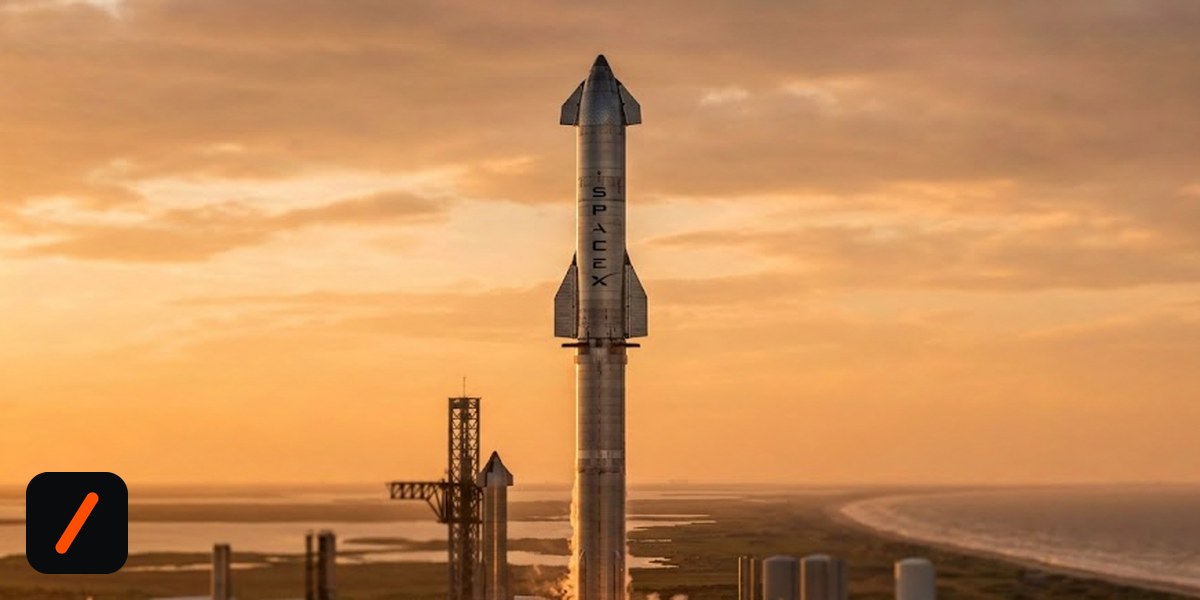
SpaceX launched Starship on its 13th test flight from Starbase in South Texas on Friday evening, and the flight did the one thing the previous twelve never had: it let go of Starlink satellites in space. Twenty of them, the new V3 design, pushed out the side of the ship in the first real test of the hardware that is supposed to carry the next decade of SpaceX's internet business.
Liftoff was at 6:45 p.m. EDT, after days of weather scrubs and an earlier attempt that ended in a pad abort while engines were spinning up. This was the second flight of the taller V3 Starship, and the objectives read like a checklist SpaceX has been trying to complete for a year: relight a Raptor in space, survive reentry on an upgraded heat shield, splash down under control, and this time also prove the ship can open its payload bay and dispense satellites without wrecking itself.
RelatedSamsung's phone arm posts its first ever operating loss
The upper stage got through most of that list. The booster did not.
What actually happened on the flight?
Ascent looked clean. Stage separation worked, the ship carried on toward space, and roughly a quarter of an hour into the flight it began releasing the 20 Starlink V3 units one at a time. Two of them carried cameras aimed back at Starship's belly, feeding SpaceX close-up footage of how the heat shield tiles held up, the kind of data that is hard to get any other way.
These were not operational satellites joining the constellation. They flew a suborbital arc on purpose and were built to reenter and burn up about 20 minutes after leaving the ship. The point was to prove the deployment mechanism and the satellite bus survive the ride, not to add capacity over your house tonight.
The ship then relit a single Raptor engine, flipped upright, rode its controlled entry down and splashed into the Indian Ocean. It reached its target and stayed upright even after dropping an engine late in the sequence, which is the sort of graceful degradation SpaceX wants to see before it ever tries this over land.
The Super Heavy booster is the asterisk. On its return it lit fewer engines than the landing burn called for and did not pull off the clean, targeted splashdown in the Gulf that SpaceX was aiming for. Trackers logged it as a partial failure. Nobody was hurt and nothing was meant to be caught this time, but a booster that cannot reliably relight its landing engines is not a booster you can catch back at the tower, which is the whole plan.
Why does the V3 Starlink matter more than the flight itself?
Because the whole reason Starship exists commercially is to fly satellites like these, and until Friday it never had. Falcon 9 has been carrying the current V2 Mini Starlinks for years, but it tops out at a couple dozen per launch and the satellites are size-limited by the rocket's fairing. Starship's payload bay is built to swallow the bigger V3 units, and each one is a different class of hardware.
A V3 satellite weighs around 2,000 kilograms, roughly 4,400 pounds, far heavier than the V2 generation. In exchange, SpaceX says a single V3 can push up to 1 terabit per second of downlink, about ten times a V2, plus 160 gigabits per second of uplink. Multiply that by the thousands SpaceX wants in orbit and the constellation stops being a rural-broadband product and starts being a serious slice of global backbone.
| Metric | Starlink V2 | Starlink V3 |
|---|---|---|
| Rides on | Falcon 9 | Starship |
| Mass per satellite | far lighter | ~2,000 kg |
| Downlink per satellite | baseline | up to 1 Tbps (~10x) |
| Uplink per satellite | baseline | up to 160 Gbps |
| Deploy proven? | yes, in service | first test Friday |
None of that arrives until Starship flies often and reliably. That is what makes the deployment test the real headline. SpaceX now has evidence the bay opens, the dispenser works, and the satellites clear the vehicle. The remaining problem is cadence, and cadence is a booster problem.
RelatedFoxconn's AI Servers Now Outsell Everything Else It Makes
How bad is the booster result?
It depends what you were hoping for. If the goal was a spectacular tower catch, this was a miss, and a real one. If the goal was to collect data on the ship, deployment and reentry, the booster was almost a sideshow and the mission got what it came for.
SpaceX's own framing tends toward the second reading, and it is not just spin. The company flies these to break things and learn, and the ship, the newer and riskier vehicle, behaved. But there is a limit to how long "the booster had an off day" stays a footnote. Rapid reuse of Super Heavy is the economic engine of the entire architecture. A booster you cannot trust to relight and land is a booster you throw away, and a thrown-away Super Heavy is not cheap.
- T-0Liftoff from Starbase 6:45 p.m. EDT, Friday
- ~T+3 minStage separation ship continues, booster begins return
- ~T+7 minBooster landing burn fewer engines relit than planned
- ~T+16 minStarlink V3 deploy begins 20 satellites, two with heat-shield cameras
- later in flightRaptor relight and controlled entry ship stays upright through descent
- end of flightIndian Ocean splashdown upper stage reaches its target
What does it mean for the market?
SpaceX is private, so there is no ticker to trade on Friday's flight, but the read for anyone watching the space and telecom sector is straightforward. Every successful V3 deployment step pulls forward the day Starlink can undercut terrestrial and legacy-satellite operators on raw capacity, which is a direct signal for incumbents like the GEO satellite players and, longer term, for the fixed-wireless and rural-broadband markets. The offsetting signal is schedule risk: a booster that cannot yet land reliably means the flight rate that would make V3 economics real is still unproven. The thing to watch is not any single launch outcome but the gap between "ship works" and "booster reuses," because the business case lives in that gap.
Our take
This was the most consequential Starship flight in a while, and not because anything blew up. Deploying real satellites is the moment the program stops being a rocket that flies to prove it can fly and starts being a rocket with a job. The ship did its job. The booster reminded everyone that the hard, boring, repeatable part, landing the big stage again and again, is still the part standing between SpaceX and the launch cadence its entire internet ambition is priced on.
- The booster fix. SpaceX needs a landing burn it can trust before a tower catch is back on the table. Watch the next flight's Super Heavy result closely.
- First operational V3 deploy. These 20 were disposable test units. The real milestone is V3 satellites that stay up and light up the network.
- Flight cadence. V3 economics need Starship flying often. Track the gap between test flights, not just whether each one works.
- OfficialSpaceX: Starship's Thirteenth Flight Test mission objectives and vehicle changes
- ReportEngadget: 13th Starship flight test with next-gen Starlink deployment of 20 V3 satellites, camera units, capacity figures
- ReferenceWikipedia: Starship flight test 13 flight timeline and booster landing-burn outcome
Original analysis by GenZTech. Reporting from Engadget and SpaceX.