
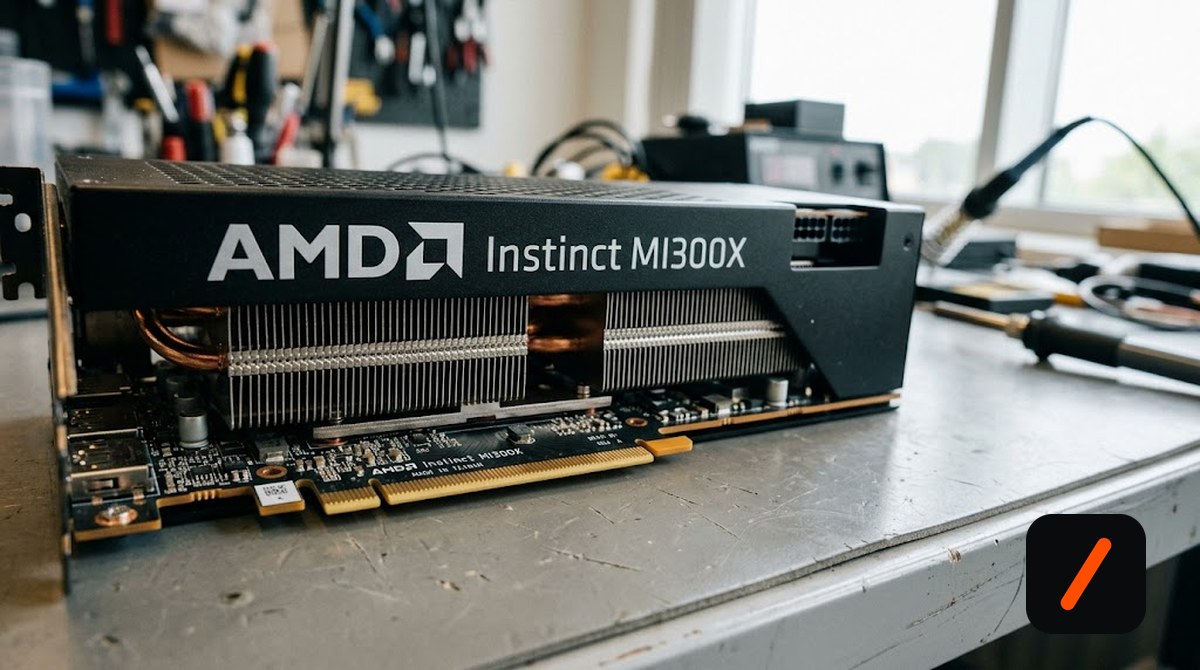
AMD and Anthropic announced a strategic partnership on July 22, 2026 under which AMD commits to an equity investment of up to $5 billion in Anthropic, and Anthropic commits to deploying up to 2 gigawatts of AMD Instinct MI450 Series GPUs, with the first gigawatt coming online in the first half of 2027. The deployment runs on AMD Helios rack-scale systems combining Instinct MI455X accelerators, EPYC "Venice" CPUs, Pensando networking and the ROCm software stack. The interesting part is not the size. It is that the money flows the opposite direction from AMD's OpenAI deal nine months earlier.
- AMD is the investor here, not the grantor. In October 2025 AMD issued OpenAI a warrant for up to 160 million AMD shares at a cent each, vesting against deployment milestones. With Anthropic, AMD writes a cheque into the customer instead.
- 2 gigawatts is a second-supplier commitment, not a Nvidia replacement. Anthropic already trains and serves across Google TPUs, AWS Trainium and Nvidia silicon. This adds a fourth lane.
- The first gigawatt lands H1 2027, which is the real risk line. Everything before that is contract, not capacity.
- ROCm is the deliverable that decides whether this works. The two companies also signed a multi-year engineering collaboration to use Claude to accelerate AMD's own software development.
What exactly was announced?
AMD committed to a strategic equity investment of up to $5 billion in Anthropic. Anthropic committed to deploying up to 2 gigawatts of Instinct MI450 Series capacity, specifically MI455X accelerators inside AMD Helios rack-scale systems paired with EPYC "Venice" CPUs and Pensando networking, all running ROCm. The first gigawatt is scheduled for the first half of 2027, and the deployment builds on Anthropic's existing use of MI355X GPUs, so this is an expansion of a working relationship rather than a cold start.
RelatedIntel's $15B Stock Sale Bets on Packaging, Not CPUs
Lisa Su framed it as bringing "the full strength of AMD high-performance computing" to frontier AI. Tom Brown, Anthropic's co-founder and chief compute officer, gave the more revealing quote: "Running across a diversified range of hardware lets us map the right workloads to the right hardware." That is a procurement thesis, not a loyalty pledge.
Why is the direction of the equity the real story?
In October 2025 AMD and OpenAI announced up to 6 gigawatts of Instinct deployment, and AMD issued OpenAI a warrant for up to 160 million AMD shares at $0.01 apiece, vesting in tranches tied to deployment volume and to AMD's share price, with the final tranche pinned to AMD reaching $600. That deal was widely read as AMD paying for anchor demand: give the customer up to roughly 10% of the company in exchange for validating a GPU line that had no frontier-lab reference customer.
Nine months later AMD does not need to pay for validation. It is buying into a customer instead, which is what a supplier does when it believes the demand is real and wants exposure to the customer's equity upside rather than needing to bribe the customer with its own. Same product line, opposite capital direction, and that flip says more about how AMD's position changed in 2026 than any benchmark slide would.
How much compute is 2 gigawatts, really?
Gigawatts have become the industry's preferred unit because they are vendor-neutral: they describe how much power a deployment draws rather than how many chips of which generation it contains. Two gigawatts is comparable to the continuous draw of a mid-sized city, and it is a useful unit precisely because it forces the conversation onto the actual constraint. The bottleneck for frontier labs in 2026 is not chip supply. It is interconnect, transformers, substations and grid interconnect queues.
That is also why the H1 2027 date matters more than the $5 billion. A gigawatt of AI capacity is a construction project with multi-year lead times on high-voltage equipment. Contracts signed in 2026 for capacity in 2027 are betting that the power side lands on schedule, and power schedules slip far more often than tapeouts do.
| Layer | AMD Helios stack | Nvidia rack-scale | Google TPU |
|---|---|---|---|
| Accelerator | Instinct MI455X, MI450 Series | Blackwell and successors | TPU v-series |
| Host CPU | EPYC "Venice" | Grace-class Arm | Google-designed host |
| Networking | Pensando | NVLink and Spectrum | Proprietary optical fabric |
| Software | ROCm, open source | CUDA, the incumbent moat | JAX and XLA |
| Availability to Anthropic | MI355X now, MI450 from H1 2027 | In production use today | In production use today |
| Lock-in risk | Low, open toolchain | High, CUDA-native code | High, single cloud |
- Oct 2025AMD and OpenAI announce up to 6 GW of Instinct, plus a 160M-share warrant AMD pays for anchor demand
- 2026Anthropic runs production workloads on MI355X GPUs the working relationship this deal extends
- Jul 22, 2026AMD commits up to $5B equity, Anthropic commits to up to 2 GW of MI450 capital direction reverses
- H1 2027First gigawatt of Helios racks scheduled to come online the first date that produces real revenue
- BeyondRemaining capacity toward the 2 GW ceiling staged, not guaranteed
What it means for the market
For AMD, the exposed signal is gross margin rather than headline revenue. AI accelerator deals at this scale are typically priced aggressively to win reference customers, and AMD has now signed two of them. Watch data-center segment margin in the quarters after H1 2027 rather than the announcement-day pop, and watch whether AMD discloses the accounting treatment of a $5 billion equity stake in a private company whose valuation it cannot mark independently.
For Nvidia, this is not a share-loss event in 2026. It is a credibility event for 2027. The reason CUDA commands its premium is that no frontier lab has run a full training and serving stack on an alternative at gigawatt scale. Anthropic is now publicly committed to trying, on top of an existing multi-vendor posture across Google TPUs and AWS Trainium. If ROCm holds up on Helios, the pricing power argument weakens for everyone selling accelerators. If it does not, the CUDA moat gets its best public proof yet.
RelatedAMD buys Taalas, betting on AI models etched into silicon
For Anthropic, the read is capital structure. Taking up to $5 billion from a supplier is cheaper than raising the same amount from a pure financial investor, because the supplier is also buying itself a customer. It also concentrates counterparty risk: Anthropic's compute now depends on Google, Amazon, Nvidia and AMD simultaneously, and each of those relationships carries equity attached to it. The signal for investors is that frontier-lab funding has largely stopped being venture capital and become vendor financing.
- ROCm release cadence. The engineering collaboration is the clause with teeth. If AMD ships materially faster kernel and compiler updates over the next three quarters, the deal is working before a single rack ships.
- Power, not silicon. The H1 2027 date depends on substations and interconnect queues. Any slip will show up there first.
- Whether the ceiling gets drawn down. "Up to 2 GW" and "up to $5B" are both maximums. Track the tranches, not the headline.
- Whether a third frontier lab follows. Two anchor customers is a strategy. Three would be a market shift.
Our take
The $5 billion is the smallest number in this announcement and the most informative one. AMD spent 2025 giving equity away to get a frontier customer on Instinct. In 2026 it is spending cash to buy into one. That is what a supplier does when it thinks the constraint has moved from "will anyone use our GPUs" to "can we get enough exposure to the people who will."
The part we would not overread is the competitive framing. Anthropic is not switching away from anything. It runs on Google TPUs, AWS Trainium and Nvidia hardware today and is adding a fourth supplier for capacity that arrives in 2027. Frontier labs buy every gigawatt they can source, from everyone who can source it, and the reasonable interpretation of a multi-vendor posture is scarcity rather than preference.
The genuine open question is ROCm. AMD has had competitive silicon for several generations and has consistently lost on software maturity. Putting Claude to work on AMD's own toolchain is a clever answer to that, and it is also an admission of where the gap still is. Judge this deal in mid-2027 on kernel coverage and training-run stability, not on the press release.
- OfficialAMD investor relations, Anthropic partnership release , the primary announcement with the $5B and 2 GW figures and the executive quotes
- OfficialAMD investor relations, OpenAI 6 GW partnership , the October 2025 deal and the 160-million-share warrant used for the contrast in Fig 1
- ReferenceROCm documentation , the software stack the engineering collaboration is meant to accelerate
- ReferenceAMD Instinct product family , MI355X in production use today and the MI450 Series arriving H1 2027
- FundingGenZTech funding tracker , our running record of confirmed AI rounds and strategic investments
- DataBiggest AI funding rounds, ranked , where this strategic investment sits against pure venture rounds
Original analysis by GenZTech, built from AMD's July 22, 2026 partnership announcement and the October 2025 AMD and OpenAI agreement. Story confirmed against CNBC's report and Tom's Hardware. Nothing here is investment advice.