
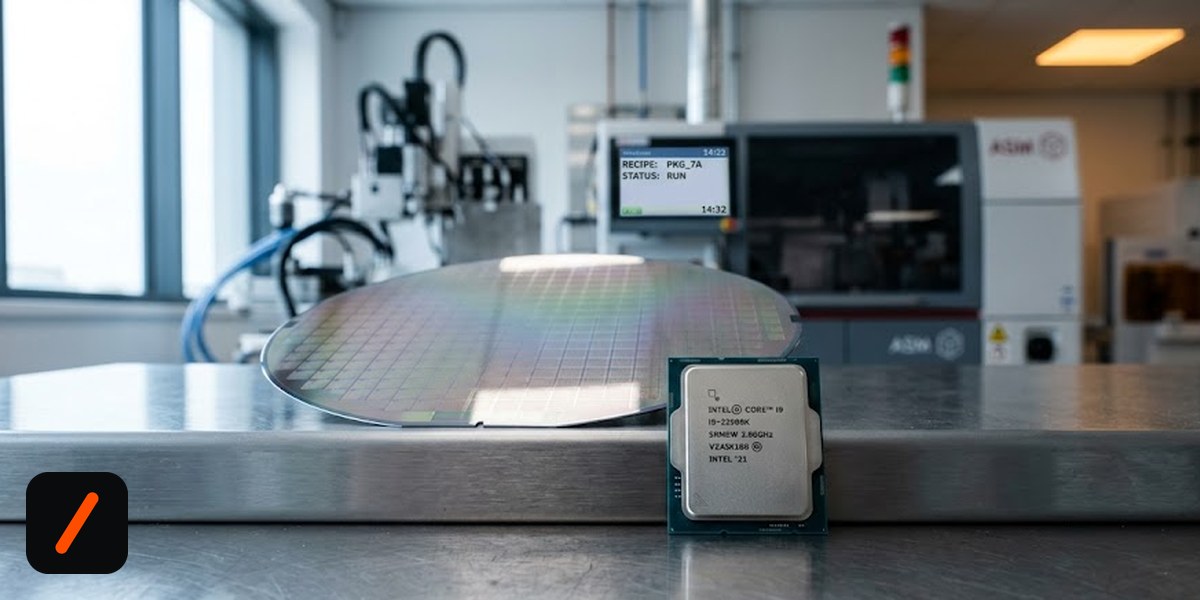
Intel announced a $15 billion public stock offering on August 10, and the interesting part is not the number. It is the list of things the company says the money is for. Intel's own statement names "physical AI, purpose-built silicon, advanced packaging and external wafers" as the growth opportunities it is funding. Three of those four have very little to do with selling processors.
Read plainly, this is a foundry and packaging raise wearing a general-purpose label. Intel is asking public shareholders to fund the least glamorous, most capacity-constrained step in the AI hardware chain, at a moment when that step is the thing everyone is short of.
RelatedAMD Bets Up to $5B on Anthropic for 2GW of MI450 GPUs
What exactly did Intel announce?
The offering is $15 billion of common stock, underwritten, with J.P. Morgan Securities, Goldman Sachs, Morgan Stanley and Citigroup Global Markets as joint book-running managers. The banks hold a 30-day option to buy up to $2.25 billion in additional shares at the offering price less underwriting discounts, which would take the total to $17.25 billion if exercised in full.
Stated use of proceeds is "general corporate purposes, which may include, but are not limited to, capital expenditures and working capital." That is boilerplate, and it is supposed to be. The signal sits in the surrounding language: Intel cites a "strong and sustainable demand environment, driven by unprecedented investment in AI compute," and says it wants to "pursue the growth opportunities ahead while maintaining a strong balance sheet and its commitment to an investment-grade rating."
The market's first reaction was the textbook one for a large equity raise. Intel fell around 3 to 4 percent in premarket trading. Dilution is dilution, and the shareholders being diluted have had a very good year.
Why sell equity when the stock just tripled?
Because that is exactly when you sell equity. Intel's shares have more than tripled over the past year on optimism about its data center and AI business, which grew revenue 59 percent last quarter. Issuing stock into strength is the cheapest capital a company ever gets, and it is the opposite of what Intel could have done two years ago.
The alternative was debt, and Intel explicitly ruled out leaning on it. The sentence about "maintaining a strong balance sheet and its commitment to an investment-grade rating" is doing real work. Fab and packaging capacity is a multi-year cash commitment with a long gap between spending and revenue. Funding that with borrowed money, on a balance sheet that already carries heavy capital obligations, is how a rating downgrade happens. Equity has no coupon and no maturity. It just costs the existing owners a slice.
Why does advanced packaging matter more than logic right now?
An AI accelerator is not one chip. It is several dies plus stacks of high-bandwidth memory assembled onto an interposer, and that assembly step has its own dedicated tooling, its own yield curve and its own queue. For the past two years the queue, not the transistor, has set the ceiling on how many accelerators the industry can ship. TSMC's CoWoS line is the name most people know for this, and TSMC has been adding capacity to it continuously.
Intel arrives at this with genuine assets rather than ambition. Foveros and EMIB are shipping packaging technologies, not roadmap slides, and Intel owns the fabs and the assembly sites outright. What it has lacked is capacity at the scale customers want and a credible reason for those customers to route work through a competitor. "External wafers" appearing in the priority list is Intel saying it intends to sell that capacity to companies that design their own silicon.
RelatedNvidia's LPU Bets Inference Needs Its Own Silicon
| Advanced packaging race | Intel | TSMC |
|---|---|---|
| Packaging technology | Foveros, EMIB | CoWoS |
| Latest disclosed momentum | Data center and AI revenue up 59% last quarter | July revenue NT$467.58 billion, up 45% year over year |
| How expansion is funded | $15B equity offering, August 10 | Operating cash flow |
| External customer posture | Newly named priority | Pure-play by design |
| Rating consideration | Explicitly cited as a constraint | Not a stated constraint |
What it means for the stock
The immediate mechanical effect is dilution, and the roughly 3 to 4 percent premarket drop is the market pricing that in rather than rejecting the strategy. For INTC holders the signal worth tracking is not the raise itself but what it buys and how quickly. Equity issued at a tripled share price to fund capacity that earns nothing for two or three years is a bet on demand persisting through the build-out. If AI capital spending stays where Intel says it is, the dilution is cheap. If it cools before the capacity lands, shareholders paid for an expensive option.
The more useful read for investors is comparative. TSMC is funding the same bottleneck out of operating cash flow while posting 45 percent revenue growth. Intel has to sell shares to do it. That gap is the whole investment case in one line, and it also explains why Intel chose the dilutive route over the ratings-risky one. Watch for named external foundry customers, because a signed anchor customer converts this from capacity speculation into contracted revenue, and nothing else in the story matters as much.
- Q2 2026Data center and AI revenue grows 59% the number underwriting the raise
- Aug 10, 2026$15B common stock offering announced shares fall 3-4% premarket
- Within 30 daysUnderwriters' $2.25B option window closes full exercise takes the raise to $17.25B
- NextExternal wafer and packaging customers the disclosure that would validate the thesis
Our take
This is the most honest thing Intel has done in a while. The company is not claiming it can out-design Nvidia or win back share in server CPUs with one raise. It is pointing at the part of the chain where its existing physical assets are genuinely competitive, admitting that expanding there costs more cash than it generates, and asking shareholders to cover the difference at a price that happens to be favorable.
The risk is plain enough. Packaging capacity is only valuable if someone else's accelerator design needs it, and every potential customer already has a relationship with TSMC. Intel is buying a seat at a table it does not yet have a guest for. The offering funds the seat. It does not fund the invitation.
- A named anchor customer. External wafers is the priority Intel listed last and needs most. One disclosed design win changes the story more than another good quarter does.
- Whether the greenshoe gets exercised. Full exercise inside 30 days means demand for the paper was strong, which is its own signal about how the market reads the plan.
- Capex disclosure cadence. "General corporate purposes" is legally sensible and analytically useless. The first quarter that breaks out packaging spend is the first quarter this is verifiable.
- TSMC's CoWoS additions. If TSMC keeps pace with its own cash flow, Intel's window to sell scarce capacity narrows before its capacity arrives.
- OfficialIntel Announces Proposed $15 Billion Common Stock Offering the offering terms, underwriters and stated priorities
- ReferenceIntel to launch $15B stock sale amid AI boom, advanced packaging demand market reaction and packaging context
- BenchmarkGenZTech AI Coding Leaderboard what the compute this capacity serves is actually producing
Original analysis by GenZTech. Reporting on the offering via Intel Newsroom. This is factual analysis, not investment advice.