
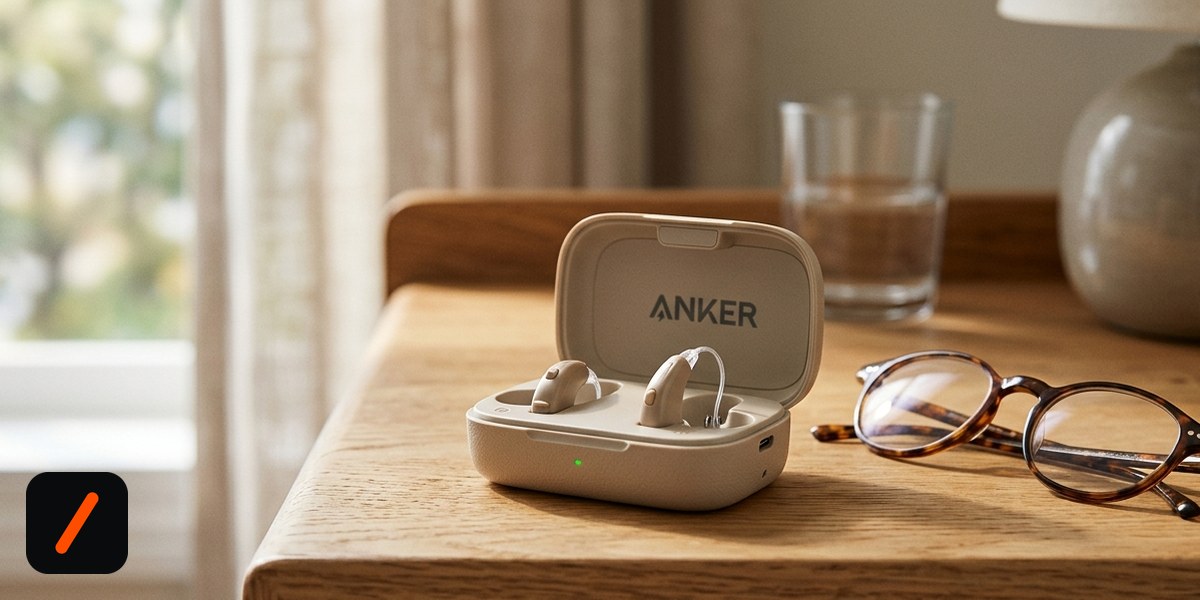
Anker used IFA 2026 in Berlin to walk into a market two of its biggest would-be rivals are actively walking out of. The company unveiled the Anker RIC Hearing Aids on Wednesday, a receiver-in-canal design built around a custom chip Anker calls "Thus," four embedded microphones, and a battery that promises 12 hours per charge and 36 with the charging case. It is Anker's first hearing aid, full stop, and it lands the same week Sony's remaining CRE stock is being sold off by retailers and Eargo's parent company is telling US customers their support ends September 15.
- The Thus chip runs 40 billion operations per second and drives the four built-in microphones, which Anker says are tuned to isolate the voice a wearer is trying to hear from background noise.
- A five-minute wireless top-up in the case adds roughly two hours of listening time, on top of a 12-hour per-charge rating and 36 hours total with the case.
- Anker is calling the RIC line "clinical-grade," the same self-fit, non-prescription category the FDA opened up in 2022, though it has not yet said what a pair will cost or when they ship.
- The announcement rode alongside a wider Anker push at IFA: eufy's MindBase home server with a built-in LLM, a new MagGo power bank, and Soundcore earbuds sharing the same Thus chip lineage.
Why is Anker jumping into hearing aids now?
Timing is the actual story here. The US Food and Drug Administration's over-the-counter hearing aid rule, which took effect in October 2022, let anyone with mild to moderate hearing loss buy a hearing aid off a shelf or a website, no audiologist visit, no prescription. Bose got there first with the SoundControl in 2021, won FDA clearance ahead of the rule even existing, then quietly shut its whole hearing health division down within a year and licensed the tech to Lexie Hearing's parent company, hearX Group, rather than keep running it itself. That should have been the warning sign that OTC hearing aids are a harder business than the "no prescription needed" pitch makes it sound.
RelatedPixel 11 Starts at $899 as Google Raises Every Price
- Oct 2021Bose SoundControl becomes the first FDA-cleared self-fitting hearing aid ahead of the formal OTC category
- Oct 2022FDA's OTC hearing aid rule takes effect opens mild-to-moderate loss to non-prescription sales
- 2022 to 2023Bose exits, licenses SoundControl tech to Lexie / hearX Group cited competition from Apple for core products
- Apr 2026Sony winds down its CRE line WS Audiology honors existing warranties only
- Jul 2026LXE Hearing (Lexie and Eargo's parent) begins winding down US operations support guaranteed only through Sep 15, 2026
- Sep 2026Anker unveils the RIC Hearing Aids at IFA 2026 no price or ship date yet
So the category Bose helped create is shedding participants right as Anker, a company with an existing consumer audio brand in Soundcore and a manufacturing and retail machine most hearing-aid startups never had, decides to show up. That is either very good timing or a sign Anker thinks the earlier entrants got the product wrong rather than the market wrong.
What's actually different about the hardware?
A receiver-in-canal, or RIC, design puts the main body of the device behind the ear with a thin wire running a small speaker into the ear canal itself. It is the same form factor most prescription hearing aids already use, which matters because it is the one audiologists trust for a reason: it is easier to keep comfortable across a range of ear shapes than a fully in-canal design, and it leaves room for a bigger battery and more microphones than something that has to disappear entirely inside the ear.
Four microphones on a device this small is worth pausing on. Most budget OTC hearing aids run two mics per ear at most, which limits how well they can do directional beamforming, the trick of boosting sound from in front of a wearer while damping noise from the sides and behind. More microphones generally means better beamforming, provided the chip driving them can process four channels fast enough to keep up with a moving, noisy room, which is presumably what the 40-billion-operations-per-second Thus chip is there for. Anker has not published independent audio benchmarks yet, so that claim is still Anker's to prove.
How does it compare with what's already on the market?
| Trait | Anker RIC | Jabra Enhance Select 700 | Eargo 8 | Sony CRE-C10 |
|---|---|---|---|---|
| Price per pair | Not yet announced | $1,995 | ~$2,699 | ~$999 (remaining stock) |
| Form factor | Receiver-in-canal (RIC) | Receiver-in-canal | Fully in-canal | Receiver-in-canal |
| Battery | 12h, 36h with case | Not disclosed | Not disclosed | Not disclosed |
| Company status | New entrant, IFA 2026 | Actively sold | US support ends Sep 15, 2026 | Line discontinued, Apr 2026 |
Jabra Enhance is the one name in this table still fully committed to the category, and it is also the most expensive at the high end, with three years of remote audiologist support bundled in. Anker skipping straight to a RIC design rather than a cheaper in-canal shell suggests it is aiming at that same serious-user segment rather than the sub-$300 impulse-buy tier Amazon has been filling with generic sound amplifiers.
What it means for the stock and the category
Anker Innovations trades on the Shenzhen Stock Exchange under ticker 300866, with a market cap around 73 billion yuan. Hearing aids are a rounding error next to Anker's charging and Soundcore audio revenue today, so this launch alone will not move the stock. The more interesting signal for anyone tracking 300866 is what it says about Anker's playbook: take a category where the incumbents are struggling on distribution and support costs, not on the underlying FDA rule, and out-manufacture them the way Anker already does in chargers and earbuds. If the RIC line ships at a price closer to Sony's exited $999 than Eargo's $2,699, that is the number that would actually matter to the category, not to Anker's balance sheet this quarter.
RelatedNintendo Switch 2 Hits $499.99 as AI Chip Demand Drains DRAM
What's still unknown
Anker has not said when the RIC Hearing Aids ship, what they cost, whether the fitting happens through the existing Soundcore app or a dedicated one, or whether Anker plans any remote audiologist support to compete with Jabra Enhance's model. None of that is confirmed yet, and a company entering a regulated medical device category for the first time has more approval steps ahead of it than a new pair of earbuds would.
- Launch price. Anywhere near Sony's exited $999 undercuts Jabra Enhance meaningfully; anywhere near Eargo's $2,699 makes this a premium play instead.
- Independent hearing tests. The 40-billion-operations Thus chip claim needs a third-party audiology review before it means much next to Jabra's established beamforming.
- Whether Anker keeps at it. Bose's exit is the cautionary tale here: winning FDA clearance and shipping a device is the easy half, ongoing support and audiology infrastructure is what actually broke two of the last three entrants.
Our take
The product itself is plausible. Four mics, a dedicated chip, and a RIC shell are the right ingredients, and Anker has the supply chain to hit a price the smaller hearing-aid startups never could. What is missing from Wednesday's announcement is any acknowledgment that this exact category just ate Bose, Sony, and now Eargo's US business inside four years. Hardware was never the hard part of OTC hearing aids. Keeping people fitted, supported, and coming back for firmware updates and warranty service on a medical device is, and that is a business Anker has not run before. The chip specs are a good opening pitch. The support model, which Anker has said nothing about yet, is the part that will actually decide whether the RIC line is still shipping in three years.
- CoverageThe Verge first report on Anker's RIC Hearing Aids announcement
- CoverageCGMagazine Anker's full IFA 2026 lineup, including chip and battery specs
- ReferenceThe Hearing Review Bose's 2022 exit and Lexie licensing deal
- ReferenceOTC HealthMart 2026 pricing and status for Jabra Enhance, Eargo, Sony CRE
- DataStockAnalysis.com Anker Innovations (300866.SZ) market cap and listing
Original analysis by GenZTech. First reported by The Verge.