
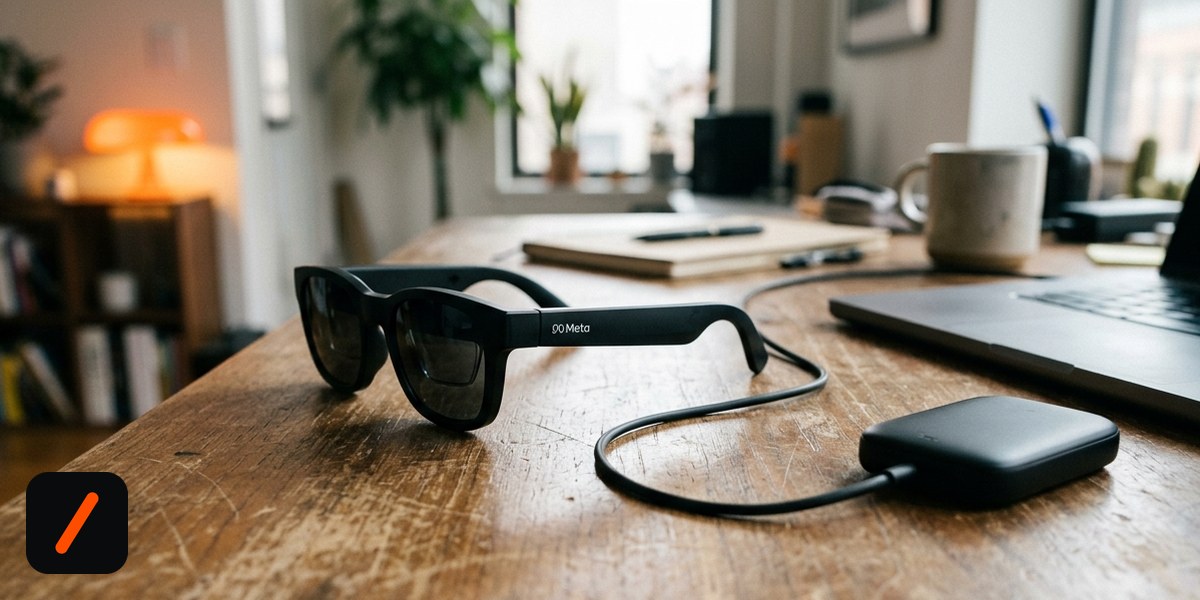
Meta's new VR glasses cost $1,299.99, ship in spring 2027, and split the headset into two physical pieces: a 100-gram pair of glasses for your face, and a 300-gram compute puck for your pocket. That split is the whole story here. Meta pulled the chips, battery and storage off your head so the visible part could be light enough to wear for hours, and the price lands squarely between a Quest 3 and an Apple Vision Pro.
- Announced at Meta Connect on September 23, 2026. Price $1,299.99, shipping spring 2027, with 128GB of base storage.
- Dual 120Hz, 2412x2288 HDR micro-OLED displays (Meta calls it "5K"), 70° horizontal by 66° vertical field of view, 37 pixels per degree at the center. It's the first Meta headset with OLED panels since the original Quest in 2019.
- All compute, battery and storage live in a separate 300-gram puck: Snapdragon Reality Elite, 12GB of RAM, 128GB of storage plus a microSD slot, about 3 hours of high-res media playback, 45W fast charging.
- Controllers are optional and sold separately. The glasses use 4-camera eye, face and hand tracking on their own, and pair with existing Quest 3 and 3S controllers when you want them.
Why does the compute live in a puck instead of on your face?
A 100-gram magnesium frame with no fan has no room for a phone-class chip, a battery that lasts more than a few minutes, or 128GB of flash storage, and it can't shed the heat those parts produce either. Every one of those pieces still has to exist somewhere, so Meta moved all of it into a pocketable puck and connected the two with a thin hybrid fiber-optic cable that carries both power and data. The puck runs the same operating system as Quest 3, adds a USB-C DisplayPort input so a phone, laptop or handheld console can feed it a screen directly, and does the work behind the photoreal, face-tracked avatars Meta wants for video calls. Existing Quest 3 titles run through it too, upscaled to the glasses' higher resolution using foveated rendering rather than rebuilt from scratch.
RelatedMeta's Slim Project Phoenix Headset Leaks Ahead of Connect
Here is how the numbers compare against Meta's own Quest 3 and Apple's Vision Pro, using the display and price figures from UploadVR's side-by-side breakdown:
| Spec | Meta VR Glasses | Quest 3 | Apple Vision Pro |
|---|---|---|---|
| Display | Micro-OLED | LCD | Micro-OLED |
| Resolution per eye | 2412×2288 | 2064×2208 | 3660×3200 |
| Field of view | 70°×66° | 110°×96° | ~100°×73° |
| Pixels per degree | 37 PPD | 25 PPD | 44 PPD |
| Chip | Snapdragon Reality Elite (in puck) | Snapdragon XR2 Gen 2 | Apple M5 |
| RAM | 12GB | 8GB | 16GB |
| Form factor | Glasses + separate puck | All-in-one headset | All-in-one headset |
| Price | $1,299.99 | $600 | $3,700 |
What's the catch with a 70-degree field of view?
The trade is right there in the numbers. Quest 3 wraps 110° by 96° around your eyes; Vision Pro covers roughly 100° by 73°. Meta's glasses cover 70° by 66°, noticeably narrower than either, and that's the price of cramming a sharper, OLED panel into a frame that weighs a fifth of a normal headset. Color passthrough runs at a lower 26 PPD than the main display, so the pass-through camera feed of your actual room won't look as crisp as the virtual content layered over it. In exchange, Meta is leaning hard into media: IMAX Enhanced certification and Dolby Vision HDR support point at a device meant to be watched, not just played in. A narrower window that looks genuinely sharp is a different bet than a wide window that looks like a screen door, and Meta picked the first one on purpose.
Who is this actually for?
Meta's own pitch is "a private cinema, multiple monitor workspace, and game console" that fits in a bag. That framing matters more than the spec sheet. This isn't pitched as a Quest 3 replacement for room-scale games; the narrow FOV and cabled puck work against that. It's pitched at someone who wants a sharp, HDR screen for movies on a flight, a stack of virtual monitors that beats a laptop display, or face-tracked video calls, without paying Vision Pro money or accepting Vision Pro's fully self-contained bulk. If you want the widest possible field of view for VR gaming, Quest 3 still does that for $600 today. If money isn't the constraint and you want Apple's ecosystem and the sharpest display available, Vision Pro is still ahead on both PPD and resolution. Meta's glasses occupy the middle lane: sharper and lighter than Quest 3, cheaper and narrower than Vision Pro, and built around media and work rather than immersive play.
RelatediPhone 18 Pro: Price, Specs and Release Date
- Does the cable-and-puck combo hold up daily? A tether to a pocket is a new failure mode: snagging, battery anxiety in the puck, and a second object to remember to charge.
- How much content actually looks good at 70° FOV? Quest 3's library was built for a wider view; some experiences may feel cramped rather than cinematic.
- Battery reality versus the 3-hour figure. That number is for high-res media playback; workloads that push the display and passthrough harder will likely drain faster.
- Where the price settles against Vision Pro's next move. $1,299.99 only looks like a clear middle ground until Apple's next Vision Pro revision lands.
Our take
Meta is finally admitting that an all-in-one headset forces a bad compromise between weight and power, and the puck is a sensible fix. Moving the heat and the battery off your face is the only way to get a 100-gram frame with a real micro-OLED panel, and IMAX Enhanced plus Dolby Vision HDR support signal that Meta wants this taken seriously as a media device, not just a lighter Quest. The 70° field of view is the honest cost of that choice, and it will bother anyone who wanted this as a wide-FOV gaming upgrade. As a private screen for flights, hotel rooms and a multi-monitor desk that folds into a bag, priced under half of Vision Pro, the trade looks worth it. As a general-purpose VR headset that beats Quest 3 at everything, it isn't one, and Meta doesn't seem to be claiming it is.
- OfficialMeta — VR Glasses announcement specs, pricing and shipping window from Meta Connect
- AnalysisUploadVR — Meta VR Glasses officially announced spec comparison against Quest 3 and Vision Pro
- Hands-onRoad to VR — hands-on at Connect 2026 first impressions of weight, display and the puck
Original analysis by GenZTech. Figures current as of September 2026.