
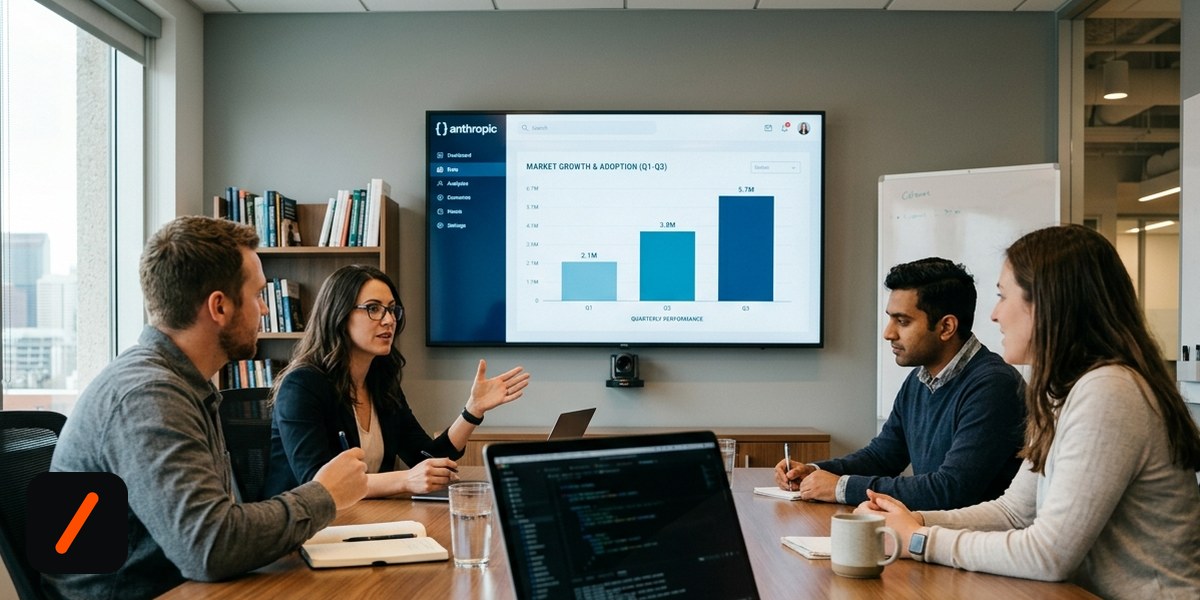
Anthropic published an interactive model this morning, September 9, 2026, that lets anyone explore three different pictures of what AI does to the US economy by 2030, backed by a technical paper laying out the math behind each one. The headline number is a $10 trillion spread: depending on how much of the economy AI actually takes over, the paper puts 2030 US GDP anywhere between $34.1 trillion and $44.4 trillion, versus a no-AI path that lands around $33.5 trillion.
- Three named 2030 outcomes: Modest (AI's impact resembles the internet's, GDP +1.6% to $34.1T), Substantial (AI does roughly half of all knowledge work, GDP +8.3% to $36.3T), Extreme (self-improving AI outproduces humans at most knowledge work, GDP +32.4% to $44.4T).
- In the extreme scenario, labor's share of GDP falls from about 60 cents to 45 cents of every dollar earned, and roughly 14% of workers lose their jobs to AI, fewer than half finding new work.
- A survey of 10,000+ Americans from August 2026 found the median respondent's expectations track closest to the substantial scenario; about 10% expect something closer to extreme.
- The paper, "Economic Scenarios for Transformative AI," is by Korinek, Jones, Sacher, Cotter, and McCrory, reviewed by economists including Daron Acemoglu and David Autor.
What exactly did Anthropic publish today?
Two things, released together. The first is a public, interactive tool at anthropic.com called "Scenarios for our Economic Future," built by a new group inside the company calling itself the Anthropic Institute, through its Economic Futures Program. Click through three named futures and watch how each reshapes GDP, jobs, and wages by 2030. The second is the underlying academic work, "Economic Scenarios for Transformative AI," which does the modeling the tool visualizes and went through review by outside economists, including Daron Acemoglu and David Autor, both of whom have spent careers studying what happens to workers when machines take over tasks people used to do.
RelatedGrok 4.7 Lands After SpaceXAI Missed Its September Date
The three scenarios aren't forecasts in the normal sense. They're structured bets about one variable, how much human knowledge work AI ends up doing, run through a growth model to see what falls out. Modest assumes AI matters about as much as the internet did. Substantial assumes AI autonomously handles roughly half of all knowledge work by 2030. Extreme assumes AI becomes recursively self-improving, getting better at building better AI with little human input, and ends up more productive than people at most knowledge work.
Why does a $10 trillion spread between scenarios matter?
Because it's the gap between "AI is a solid new technology" and "AI restructures who owns the economy," and nobody, including Anthropic, actually knows which one we're heading toward. A company whose entire business is selling AI capability just published a model showing its own product could, in one branch of the future, cut workers' share of national income by a quarter. Most corporate research doesn't volunteer numbers like that. Substantial alone still projects growth at roughly twice the historical rate while keeping unemployment inside its normal range, which makes it worth the most attention: it's also the scenario the median American surveyed already expects.
The mechanism most coverage is skipping: where does the growth actually go?
Here's the detail buried under the GDP headline. In the extreme scenario, labor's share of GDP, the portion of every dollar of output that goes to wages rather than profits or returns on capital, falls from about 60 cents to about 45 cents. That's the whole story of who benefits, and the mechanism is standard economics, not unique to this paper. When software can do a task, ownership of that software becomes what generates income from it, not the labor of operating it. A worker who once got paid to draft contracts or write code was supplying labor combined with a little capital to produce output. If AI does that at near-zero marginal cost, the income flows to whoever owns the AI system, not the person who used to do it by hand. GDP keeps growing, sometimes faster than before, but a shrinking slice reaches paychecks, the arithmetic "$44.4 trillion by 2030" completely obscures.
Who actually loses out if the extreme scenario happens?
Knowledge workers specifically. About 14% of workers lose their jobs to AI under the extreme scenario, and fewer than half of those displaced find new employment, worse than past automation waves, where displaced workers eventually found roles the technology itself helped create. This time looks different because the automation targets the same cognitive work, writing, analysis, planning, judgment, that used to be the safe lane for anyone with a degree. Worth being precise, though: that figure is Extreme's number, not a prediction. Modest and Substantial both describe far less disruptive labor markets, and Substantial keeps unemployment within its historical range even while GDP grows twice as fast as normal.
What do regular Americans think is actually going to happen?
Anthropic didn't just model scenarios, it asked people. In August 2026 the company surveyed more than 10,000 Americans about their own expectations for AI's economic impact by 2030. The median answer landed closest to Substantial, something like 10% GDP growth and around 5% unemployment, a broad cross-section of the public converging on roughly the same middle scenario Anthropic's economists modeled. About 10% held views closer to Extreme, a meaningful minority already expecting the more disruptive outcome.
RelatedGemini 3.8 Flash Model Card Leaks Ahead of Google Launch
What happens between now and 2030?
The scenarios diverge fastest after 2027, per the paper, when the Extreme case's growth curve starts compounding toward an annual rate near 15%, a pace with no real historical precedent for an economy this size. The more useful thing to track isn't GDP forecasts, which won't be testable for years, but the leading indicators the paper is built on: how much knowledge work AI handles autonomously, whether labor's share of income starts moving before 2030, and whether white-collar displacement shows up the way it briefly did in customer service and content roles.
- Aug 2026Anthropic surveys 10,000+ Americans on their AI-economy expectations. Median answer lines up with the Substantial scenario.
- Sep 9, 2026Anthropic Institute publishes the scenarios tool and paper. Reviewed by Daron Acemoglu and David Autor before release.
- 2027Extreme scenario's growth curve starts compounding toward ~15% annually, per the paper. The point where the three scenarios visibly pull apart.
- 2030The scenarios' target year: GDP outcomes range from $34.1T to $44.4T. Labor's share of GDP is the number to watch, not just the total.
- Labor share of GDP, not headline growth. A rising GDP with a falling wage share suits a good or a bad outcome for most workers; watch which way that ratio moves first.
- Whether Substantial keeps outperforming Modest. The public already expects something like Substantial; a real-world undershoot means a correction in AI sentiment well before 2030.
- Re-employment rates for displaced knowledge workers. The "fewer than half find new work" figure is the single most testable, and consequential, claim in the release.
- Competing models from outside Anthropic. Two reviewers signing off isn't the same as agreeing with the numbers; watch for independent academic scenarios with different assumptions.
Our take
Treat the numbers seriously and the framing with a raised eyebrow, because both are warranted. Anthropic sells AI for a living, and modeling a future where AI becomes wildly, transformatively productive isn't a neutral act from a company whose valuation depends on that story being plausible. That conflict of interest doesn't make the economics wrong: Acemoglu and Autor reviewing the paper is a real check, and Modest and Substantial are notably conservative next to some AI-hype forecasts floating around this year. What's genuinely useful isn't the $44.4 trillion topline, which is speculative by design. It's that Anthropic put a number on the labor-share mechanism at all, in public, where it can be tested against real data as 2027 and 2030 arrive.
- OfficialScenarios for our Economic Future Anthropic's interactive scenarios tool
- OfficialIntroducing the Anthropic Economic Futures Program Anthropic's announcement of the program behind the paper
- CoverageA new Anthropic model seeks to test how AI could impact the U.S. economy NPR, September 9, 2026
Original analysis by GenZTech, based on Anthropic's Economic Scenarios tool.