
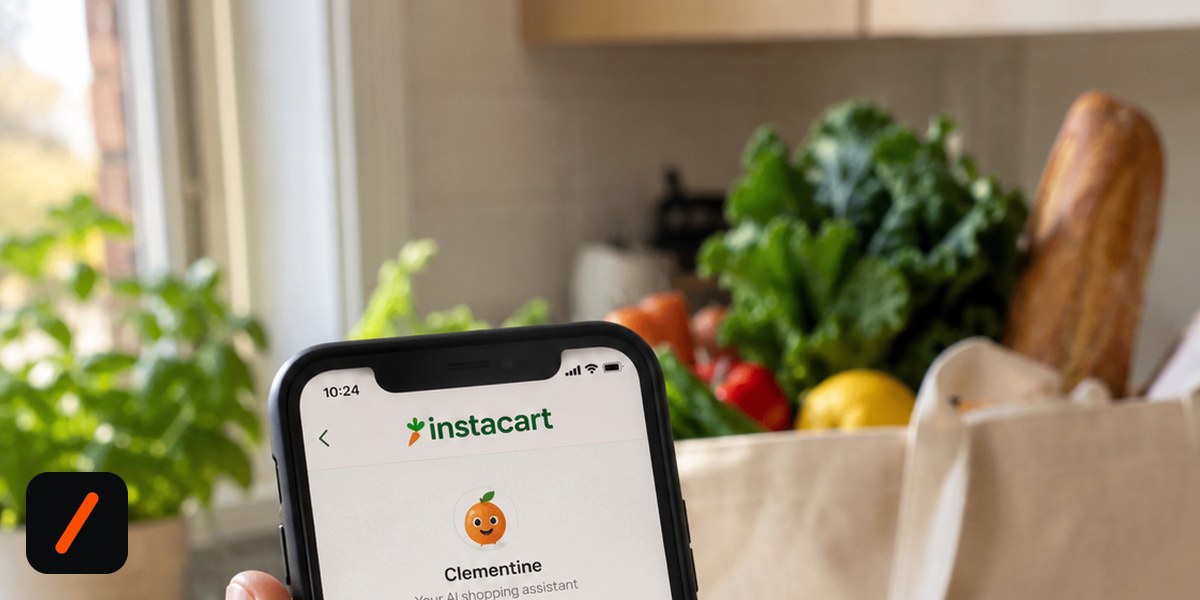
Instacart's app got a chat window this morning: type a request like "budget-friendly kids' lunches" or snap a photo of a handwritten grocery list, and a new assistant called Clementine fills your cart instead of making you search each item by hand. It went live across the US and Canada today, September 9, and it makes Instacart the third major delivery platform to ship this exact idea in 2026, arriving three months after DoorDash's version and seven after Uber Eats'.
- Clementine turns natural-language requests or photos of grocery lists and recipes into a ready-to-buy cart, live now in the US and Canada.
- It generates recipes from trusted publishers, adjusts for dietary needs like gluten-free or nut-free, and swaps in cheaper alternatives where it finds a deal.
- Instacart shipped it seven months after Uber Eats' Cart Assistant (February 2026) and three months after DoorDash's Ask DoorDash (June 2026), making it the last of the three major delivery apps to add one.
- CEO Chris Rogers is betting the feature keeps meal planning inside Instacart's app instead of shoppers asking ChatGPT what's for dinner and copying the answer elsewhere.
What does Clementine actually do?
You describe what you want in plain English, or hand it a picture, and it does the tedious part of grocery shopping: finding each item, checking it's in stock, and dropping it in your cart. Instacart's own examples include "high-protein, easy dinners for two" and "appetizers for a graduation party." Ask for a recipe and Clementine pulls one from a publisher Instacart already licenses content from, then converts every ingredient into a purchasable line item at whichever store you shop. Tell it you're gluten-free, vegetarian or feeding a nut allergy and it filters accordingly. It also looks for deals, swapping a full-price item for a cheaper one it thinks you'll accept, and it can read a photo of a handwritten list or a screenshot of one and turn the scrawl into a digital cart without you retyping anything.
RelatedAnthropic's Claude Science targets neglected diseases
Why is this Instacart's third AI shopping product this year?
Clementine isn't Instacart's first swing at this. In November 2025 the company introduced Cart Assistant, a separate, white-labeled version of the same underlying technology that grocers like Kroger, Publix and Sprouts Farmers Market can drop into their own websites and in-store kiosks, badged with their own name instead of Instacart's. Confusingly, Uber Eats named its own consumer-facing feature "Cart Assistant" too, three months later, so the phrase now means two different things depending on which company says it. Clementine is Instacart's answer to the branding mess and the missing consumer piece: it is the version that lives inside Instacart's own app under Instacart's own name, aimed directly at shoppers rather than retail partners. Instacart has said internally that Cart Assistant already drives bigger average orders where retailers have turned it on, which is the commercial case for pushing a version of it onto Instacart's own 15+ million monthly active users too.
Why did Uber Eats and DoorDash get there first?
Because the prize isn't the transaction, it's the habit. Uber Eats shipped Cart Assistant in February, letting shoppers build carts across grocers including Albertsons, Aldi, Kroger and Wegmans through text or an uploaded photo. DoorDash followed in June with Ask DoorDash, which does much the same thing and also checks whether you already own a staple like sugar or butter before adding a duplicate. Both moves were framed the same way industry-wide: delivery apps don't want to be the last stop after someone plans a meal with ChatGPT, they want to be where the planning happens too, so the order never leaves their ecosystem. Instacart arriving last with Clementine looks less like innovation and more like catching up to a feature its two biggest delivery-adjacent rivals already normalized with shoppers months earlier.
What it means for Instacart's stock
Instacart trades as Maplebear Inc. under the ticker CART, and the market's read on AI shopping assistants so far has been about retention, not novelty. All three platforms are converging on the same feature within a seven-month window, which is itself the signal: a conversational cart-builder is becoming table stakes, not a moat. The differentiator investors should actually watch is data, not chat design. Instacart has 14 years of purchase history across nearly 100,000 stores to personalize Clementine's suggestions, an advantage DoorDash and Uber Eats can't fully replicate since neither started as a grocery-only platform. If Clementine measurably lifts basket size the way the enterprise version reportedly has for retail partners, that shows up in Instacart's order-value metrics next earnings call. If it doesn't move the number, the feature was a defensive parity play, not a growth lever, and CART's premium over DASH and UBER on any grocery-specific thesis gets harder to justify.
RelatedGoogle DeepMind Maps All 9 Billion Human DNA Mutations
| Assistant | Clementine | Cart Assistant | Ask DoorDash |
|---|---|---|---|
| Platform | Instacart | Uber Eats | DoorDash |
| Launched | Sep 9, 2026 | Feb 11, 2026 | Jun 11, 2026 |
| Input | Text or list/recipe photo | Text or list photo | Text, recipe link or photo |
| Recipe generation | Yes, licensed publishers | Limited | From uploaded recipe/cookbook photo |
| Duplicate-item check | Not stated | Not stated | Yes, flags staples you may already own |
| Regions | US & Canada | US (dozens of grocers) | US, select markets |
- Nov 2025Instacart unveils enterprise Cart Assistant. White-labeled for grocers; Sprouts is the first retail partner.
- Feb 2026Uber Eats launches its own Cart Assistant. Consumer-facing, across dozens of grocery partners.
- Jun 2026DoorDash launches Ask DoorDash. Adds recipe-photo and duplicate-item checks.
- Sep 9, 2026Instacart launches Clementine. Its own consumer-facing assistant, live in the US and Canada.
- Does basket size actually move? Instacart has claimed bigger orders from the enterprise version; whether Clementine repeats that on Instacart's own traffic is the real test, not the launch itself.
- Two "Cart Assistants," one confused customer. Instacart's white-label product and Uber Eats' consumer feature share a name. Expect support-ticket confusion at grocers running both.
- Retailers running white-labeled Cart Assistant vs. Clementine. If Kroger or Publix shoppers get a different assistant experience than Instacart.com shoppers, the fragmentation could undercut the "one AI layer" pitch.
- Privacy scrutiny. Consumer coverage already flagged data-collection questions around Cart Assistant's purchase-history use; a similar look at Clementine is likely once it scales past early rollout.
Our take
Three grocery-adjacent platforms now offer nearly the same feature, shipped within seven months of each other, which tells you the feature itself isn't the strategy, it's the entry fee. What actually separates them is what each company already knows about its shoppers, and there Instacart has a real edge: over a decade of grocery-specific purchase data that Uber Eats and DoorDash, both restaurant-first businesses, don't have in the same depth. Clementine landing last isn't damning on its own, plenty of good products ship second or third. The number that matters is whether it changes what people actually buy, and that won't be visible until Instacart reports an order-value trend that shows the assistant, not just the news cycle, moved the business.
- OfficialInstacart: Clementine launch announcement company blog, capabilities and rollout details
- CoverageTechCrunch: Instacart launches Clementine launch report with CEO quote
- EnterpriseInstacart: Cart Assistant (enterprise) the separate white-labeled product for retailers
- CompetitorCNBC: Uber Eats launches Cart Assistant February 2026 launch
- CompetitorTechCrunch: DoorDash's Ask DoorDash June 2026 launch
Reporting and analysis by the GenZTech team, published as this story broke.