
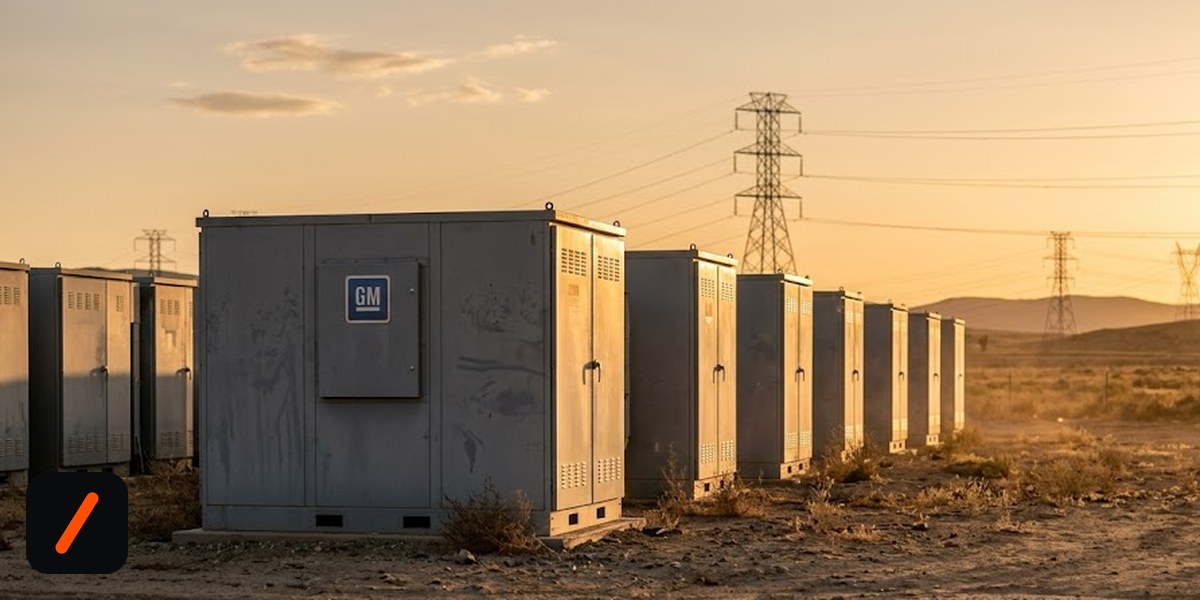
General Motors is putting money into a battery chemistry it has no plans to sell in a car. Its partner Peak Energy announced a $71 million sodium-ion factory near Sacramento this month, sized at 4 GWh a year, aimed entirely at grid storage. The pitch is not that sodium beats lithium on performance. It is that sodium stops caring about the two things that make lithium storage expensive: cooling and cycle life.
That reframing is the whole story. For a decade the grid-storage industry has bought whatever chemistry the EV industry made cheap, which meant lithium iron phosphate. Peak's argument is that a battery which never has to move should not be designed like one that does.
RelatedNevada Clears 7,000 Robotaxis for Tesla, Waymo and Uber
What did GM and Peak actually commit to?
GM is codeveloping and manufacturing the cells with Peak rather than simply buying them, which puts a carmaker's process engineering behind a chemistry its own vehicles will not use. The Sacramento-area plant is scheduled to come online in 2027 at 4 GWh of annual output, which Peak frames as enough to power four million homes.
The product is the GS1.1 system, storing 3.1 MWh per 36-module unit. There is already a customer: Jupiter Power has signed for up to $500 million through 2030, opening with a 720 MWh deployment. That contract matters more than the factory announcement, because grid storage is a business where offtake agreements, not press releases, determine whether a line ever runs at capacity.
How does sodium-ion actually compare to LFP?
Badly, on the specs everyone quotes. Peak's cells do not match lithium iron phosphate on energy density and do not currently compete on cost per cell. If you were choosing a battery for a vehicle, or for anywhere square footage is scarce, this would end the conversation.
The comparison inverts once you look at what a stationary installation actually spends money on over twenty years.
| Peak sodium-ion | LFP storage | |
|---|---|---|
| Energy density | Lower | Higher |
| Cost per cell | Not competitive yet | Benchmark |
| Claimed lifetime cost | 20% lower | Baseline |
| Cycle life | 20,000 to 80% | 8,000 to 70% |
| Round-trip efficiency | 96% | ~93-94% |
| Cooling | Passive, no fluid loop | Active liquid cooling |
| Thermal headroom | ~2x LFP operating temp | Baseline |
Why does passive cooling change the economics?
This is the part most coverage skips. A lithium grid installation is not just cells. It is cells plus a liquid cooling loop, plus pumps, plus the power those pumps draw, plus the maintenance schedule that loop generates, plus the failure modes it introduces. Peak's cells stay stable at roughly double LFP's typical operating temperature, which means the cooling infrastructure can simply be deleted rather than optimized.
Delete it and three costs go away at once. Capital cost drops because there is less hardware. Parasitic load drops, which is part of how a 96% round-trip efficiency beats LFP's 93 to 94% by two or three points. Operating cost drops because nobody services a pump that does not exist. Stack that against 20,000 cycles instead of 8,000 and you get to Peak's headline claim of 20% lower lifetime cost without ever winning on cost per cell.
Sodium also has a supply-chain argument that lithium cannot answer. Sodium is not a constrained mineral, it is not concentrated in a handful of jurisdictions, and its price does not move with EV demand. For a grid operator signing a twenty-year contract, decoupling from the lithium market is a feature independent of any spec sheet.
What it means for the market
The obvious exposure is GM itself, and the signal is smaller than the headline implies. Grid storage is not going to move a company that size in the near term, and GM is not selling these cells in vehicles. What it does buy is optionality: a manufacturing position in a chemistry that becomes strategically important if lithium tightens again, at a cost that barely registers against GM's capital budget. Read it as a hedge, not a pivot.
RelatedKioxia and SanDisk unveil 9th-gen QLC flash built for AI
The more direct read is on the storage integrators and the lithium supply chain. If passive-cooled sodium proves out at utility scale, the addressable market for liquid-cooling subsystems in stationary storage shrinks, and LFP loses the assumption that it is the automatic default for grid projects. The number worth watching is not the factory. It is whether Jupiter Power exercises the full $500 million, because a repeat order from a real operator is the only evidence that the 20-year projections survive contact with a field deployment.
Investors should treat every efficiency and cycle figure here as vendor-reported. Peak is projecting 80% capacity retention at 20,000 cycles, and no sodium-ion grid installation has run long enough for anyone to confirm that empirically.
- Does the Sacramento line hit 4 GWh? Announced capacity and running capacity are different numbers, and 2027 is the first honest checkpoint.
- Jupiter Power's second order. The opening 720 MWh proves the product ships. Exercising the rest of the $500 million proves it works.
- Independent cycle data. Nothing about the 20,000-cycle claim is verifiable today. Third-party degradation testing is what would move it from marketing to fact.
- Whether LFP responds on cooling. If lithium vendors close the thermal gap, sodium's structural advantage narrows to supply chain alone.
Our take
Sodium-ion has been the perpetual almost-technology of grid storage, always two years out, always losing on density to a chemistry the EV industry was busy making cheaper. What changed is that somebody stopped trying to win the density argument. Peak's system is worse at the thing batteries are usually judged on and better at the thing a stationary asset is actually judged on, which is total cost over two decades of sitting in a field.
GM's involvement is the useful signal here, and not because a carmaker's endorsement means much technically. It means the cells will be built by people who know how to run a production line at yield, which is where most promising battery chemistries have historically died. The claims still need third-party validation, and we would not treat the 20,000-cycle projection as fact until a deployment has cycled long enough to test it. But the economic logic does not depend on a breakthrough. It depends on deleting a cooling loop, and that part is already true.
- ReportingIEEE Spectrum: GM Backs Sodium Ion Batteries for U.S. Grid Storage factory figures, GS1.1 specs, Jupiter Power agreement
- OfficialPeak Energy vendor claims on cycle life, efficiency and passive cooling
Original analysis by GenZTech, based on IEEE Spectrum's reporting and Peak Energy's published specifications. Source: spectrum.ieee.org