
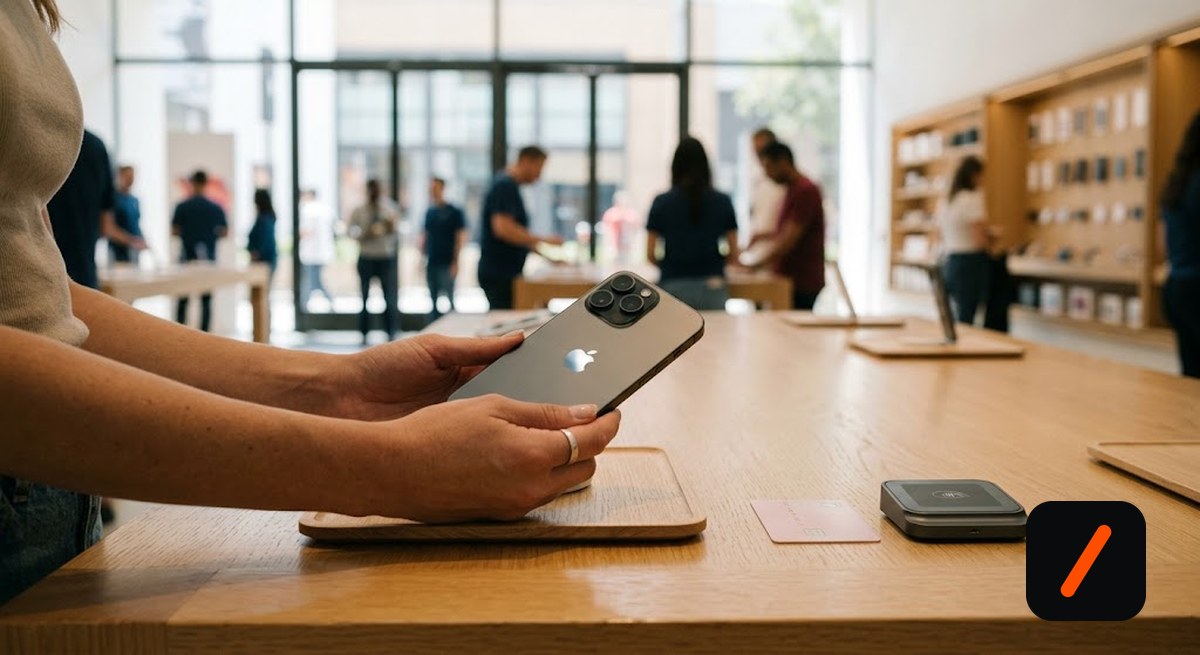
Apple is getting into the leasing business. Bloomberg reported late this morning that Apple will launch Apple Upgrade on July 28, a device leasing program financed by Klarna that lets US customers take an iPhone, Mac, iPad or Apple Watch on a fixed term and hand it back at the end. This is not a payment plan for a phone you are buying. It is a lease, structured much closer to how you get a car, and that single distinction is the whole story.
- Terms split by device class. iPhone and Apple Watch leases run 24 months; Mac and iPad leases run 36. At the end you return the device, pay the remaining balance to keep it, or upgrade early. Some of those moves carry extra fees.
- Klarna carries the credit, not Apple. Enrollment runs through a soft credit check by Klarna. Klarna shares (NYSE: KLAR) jumped as much as 11% to $20.78 on the report before closing up 1.87% at $19.11.
- AppleCare is unbundled. The old iPhone Upgrade Program folded AppleCare+ into the monthly payment. Apple Upgrade does not, so coverage is a separate purchase.
- The cheap models are excluded. iPhone 16, the base iPad, Apple Watch SE and the MacBook Neo are not eligible, and neither are business or education purchases.
What exactly did Apple announce?
Technically, Apple has announced nothing. The details come from Bloomberg's reporting published around 11:37 a.m. Eastern on Tuesday, July 21, roughly a week ahead of the program going live. Apple Upgrade opens on July 28, initially in the United States only, through both Apple retail stores and apple.com. Enrollment requires a soft credit check run by Klarna, which means checking eligibility should not dent a credit score on its own.
RelatedGoogle Sets August 12 for Pixel 11 and Watch 5 Reveal
Coverage spans most current iPhone, Mac, iPad and Apple Watch models. Leases on iPhone and Apple Watch run 24 months. Mac and iPad leases run 36, which tracks how long people actually keep those machines. At the end of a term a customer picks one of three exits: return the hardware, pay off the outstanding balance and keep it, or roll into a newer model early. Bloomberg notes that some of those transactions carry additional fees, and the specifics of the early-upgrade fee are the part nobody has seen yet.
Two exclusions matter. AppleCare is not bundled into the lease, so anyone who wants coverage buys it separately on top of the monthly payment. And the program is consumer-only: purchases through Apple's business and education channels are out. Apple plans to stop new enrollments in the existing iPhone Upgrade Program and its standard financing once Upgrade is live.
How is a lease different from the installment plan Apple already had?
This is the part most of today's coverage skipped past, and it changes the math for every reader. An installment plan is a loan to buy something. Your payments add up to the purchase price, and at the end the device is yours. A lease is a rental with a purchase option. Your payments cover the depreciation across the term plus the lender's margin, and the lessor keeps the residual value, which is whatever the hardware is still worth on the day you hand it back.
The practical effect is that a lease payment on the same phone can look smaller than an installment payment, because you are not paying off the whole price. The tradeoff is that you finish the term with nothing unless you write a buyout cheque. For a reader who upgrades every two years anyway, that is fine, and arguably it is exactly what they were doing already. For a reader who keeps a phone for four or five years, leasing is straightforwardly the worse deal.
| iPhone Upgrade Program | Apple Upgrade (new) | |
|---|---|---|
| Structure | Installment loan | Lease |
| Term | 24 months | 24 months phone and watch, 36 months Mac and iPad |
| At end of term | You own the device | Return, buy out, or upgrade |
| AppleCare+ | Included in the payment | Bought separately |
| Credit provider | Bank installment lender | Klarna, soft credit check |
| Device range | iPhone only | iPhone, Mac, iPad, Apple Watch |
| Status | Closing to new enrollments | Live July 28, US only |
Why does the excluded-device list matter?
Look at what is not eligible: the iPhone 16, the entry-level iPad, the Apple Watch SE and the MacBook Neo. Those are Apple's cheapest current models in each line, and the pattern is not an accident. Leasing only works as a business when the asset holds resale value at the end of the term. On a low-priced device, the residual is small, the monthly payment shrinks to a rounding error, and the servicing cost of a multi-year contract eats the margin.
There is a second, quieter reason to like returns. A device that comes back at month 24 goes into Apple's refurbishment pipeline and gets sold again. That is a second revenue event on the same unit, on hardware Apple already built. A leasing program is therefore not just a financing product; it is a supply line for certified refurbished stock, and it puts Apple rather than a trade-in aggregator in control of the used market for its own products.
What does it mean for the market?
Klarna is the obvious exposure. KLAR jumped as much as 11% to $20.78 intraday on the Bloomberg report, then gave most of it back to close at $19.11, up 1.87%. Analyst consensus sits at Buy with an average price target of $22.75, with recent moves from Goldman Sachs at $25 and UBS at $23. The company reports Q2 on August 18, where the consensus models a 7-cent loss per share on $991.82 million of revenue.
The signal for investors is distribution, not immediate revenue. Apple retail checkout is one of the highest-intent funnels in American consumer electronics, and a 24 to 36 month lease book is far stickier than a pay-in-four button at an online cart. It also moves Klarna up the credit stack, from short-duration point-of-sale advances toward secured, asset-backed terms. The market's decision to fade most of the pop looks like a fair read: nobody outside Apple and Klarna knows the economics of the deal, whether it is exclusive, or how the risk is shared.
RelatedInter's Payment Ring Bets on Screenless Banking
The less obvious exposure is the US carriers. Verizon, AT&T and T-Mobile have spent a decade using device subsidies to lock customers into service plans. If Apple owns the financing relationship on the phone itself, that lever gets weaker, and the carrier promotion becomes a discount competing against Apple's own monthly number rather than the anchor of the purchase. This is analysis, not investment advice.
Who is actually affected?
Annual and biennial upgraders are the target customer, and for them the arithmetic probably improves: they were already handing the old phone back through trade-in, and a lease just formalizes it. Long-hold owners should stay away, because they would be paying a financing margin for the privilege of giving the device up. Anyone buying through a business or education account is out of scope entirely and keeps the existing options.
The group with the most to check is existing iPhone Upgrade Program members. Their current agreements are not being cancelled, but new enrollments are closing, and the replacement product does not include AppleCare+. Coverage on a current flagship iPhone runs meaningfully per month, so the honest comparison is Upgrade's monthly payment plus AppleCare against the old program's all-in number, not the headline figure on its own.
- 2015Apple launches the iPhone Upgrade Program 24-month installment loan through a bank partner, AppleCare+ bundled in
- Jul 21, 2026Bloomberg reports Apple Upgrade with Klarna as credit partner KLAR trades up as much as 11% intraday, closes +1.87%
- Jul 28, 2026Apple Upgrade goes live US only, Apple Store and apple.com, consumer purchases
- Aug 18, 2026Klarna reports Q2 2026 First chance for management to describe the Apple book
Our take
Apple has spent years turning one-time purchases into recurring revenue, and this is the same move applied to the last holdout: the hardware itself. A lease book smooths the lumpiest line in Apple's business, shortens the replacement cycle by design, and feeds refurbished inventory back through Apple's own channel. Calling it Upgrade rather than Lease is good marketing, but the mechanics are a rental.
The part worth sitting with is the choice of partner. Apple has the balance sheet to fund this itself many times over, and it chose not to. Handing the credit relationship to Klarna means Apple gets the cash-flow shape it wants without the consumer-credit exposure that comes with it, which is the same instinct behind every card partnership it has run. Klarna gets the retail funnel of a lifetime and, presumably, thin economics. Whether that is a good trade for Klarna is a question its August 18 print starts to answer.
- The monthly numbers on July 28. If an iPhone lease undercuts carrier promotions on the same device, this becomes a genuine channel fight rather than a financing footnote.
- AppleCare attach rate. Unbundling coverage is a quiet price increase for anyone who wants it. If attach falls, Apple loses a high-margin services line to save on the sticker.
- Geographic expansion. The program is US-only at launch. Europe is Klarna's home turf, so an EU rollout would say the pilot worked.
- Klarna's Q2 disclosure. Whether management sizes the Apple book, and whether the deal is exclusive, matters more to KLAR than today's headline did.
- ReportBloomberg: Apple to Launch 'Upgrade' Device Leasing Program With Klarna — the original report, published Jul 21
- OfficialApple: iPhone payment options and the iPhone Upgrade Program — the program being closed to new enrollments
- InvestorKlarna newsroom and investor updates — where any confirmation and the Aug 18 results will land
Original analysis by GenZTech. Reporting informed by Bloomberg. Not financial advice.