
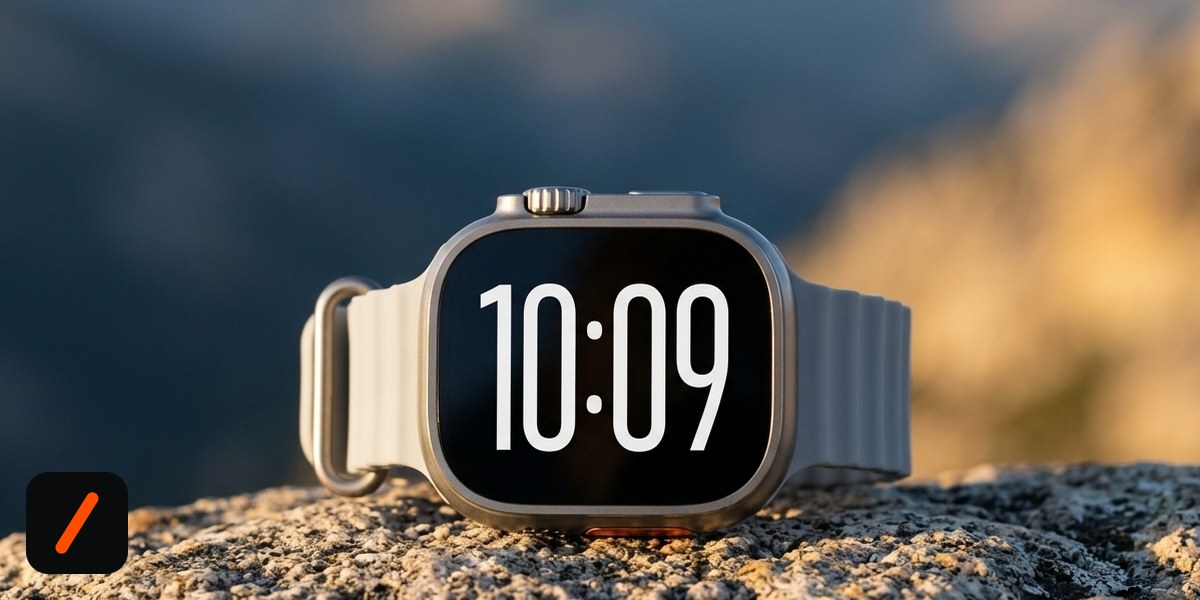
The Apple Watch Ultra 4 landed at today's Apple keynote holding its $799 price and pushing battery life to 50 hours of everyday use, which is the first time an Apple Watch has cleared two full days on Apple's own rating. It runs the same S11 chip and the same rebuilt health sensing system as the Series 12, adds satellite communications, and comes in natural and black titanium. Pre-orders opened today and it ships on September 18.
- $799, unchanged, in natural and black titanium with a case Apple says is 100 percent recycled titanium.
- Battery goes to 50 hours of everyday use, 84 hours in Low Power Mode, and 15 minutes on the charger adds up to 18 hours.
- Workout endurance is the real pitch: 25 hours with GPS and heart rate, and up to 45 hours in the maximum extended mode.
- It inherits the new sensing stack: heart rate every five seconds, HRV sampled up to 24 times more often, the daily Readiness score, and Audio Intelligence.
Is the battery jump real?
Apple credits a larger battery and the efficiency of the S11, and the numbers it published are specific enough to be testable. Fifty hours of everyday use, 84 in Low Power Mode, 25 hours of extended workout tracking with GPS and heart rate active, and 45 hours in the maximum extended mode. Fast charging is rated at 15 minutes for up to 18 hours of use.
RelatedApple Watch Series 12: Price, Specs, Health Features
The workout figures are the ones that decide purchases in this category. Twenty five hours with full GPS and continuous heart rate covers a hundred mile race, a long alpine day, or a dive trip without a mid-event charge, and that is exactly the buyer Apple is aiming at with a titanium watch that costs $799.
What did it inherit from the Series 12?
All of the sensing work. The larger ECG electrode surface, the ring of photodiodes, the bigger and more efficient green LEDs, the background heart rate reading every five seconds, and heart rate variability sampled up to 24 times more often. It also gets the Readiness score, which grades recent activity, sleep and overnight vitals from 0 to 10 each morning, and Audio Intelligence, which brings Sound Recognition, a 15 second Live Rewind transcript and Siri Recap notes to the wrist.
That shared platform is the point. In previous years the Ultra was mostly a bigger battery and a brighter screen wrapped around the same internals. This year the internals themselves are new, so the gap between the $399 watch and the $799 watch is once again endurance, titanium and satellite rather than sensing quality.
Who is the Ultra 4 actually for?
Apple pitched three things that the Series 12 does not have: satellite communications, what it calls the most accurate on-device GPS in a sports watch, and the endurance figures above. If none of those three describe your week, the Series 12 does the health work for half the money. If you spend real time outside cell coverage, satellite plus 50 hours is a genuinely different product, and it is the closest Apple has come to a Garmin alternative rather than a Garmin-adjacent one.
| Ultra 4 | Series 12 | |
|---|---|---|
| Price | $799 | $399 |
| Material | Titanium, natural or black | Aluminum, titanium or ceramic |
| Everyday battery | Up to 50 hours | Up to 24 hours |
| Low power | Up to 84 hours | Not quoted |
| Workout tracking | 25 hours, 45 in max mode | Up to 10 hours outdoors |
| Satellite | Yes | No |
| Sensing system | New, shared with Series 12 | New |
What does it mean for the market?
Garmin has owned the multi-day, satellite-capable end of the wearable market on battery life alone, and 50 hours does not beat a Fenix on paper. What it does is remove the excuse. An athlete who wanted Apple's ecosystem but needed to survive a two-day event without a charger now has a device that clears it, with sensing hardware Apple claims is the most accurate in any wearable and a recovery score that costs nothing extra each month.
RelatediPhone 18 Pro: Price, Specs and Release Date
For Apple (AAPL), holding $799 while the bill of materials rises across the industry is the same story as the Series 12 at $399. Apple is spending its component leverage on keeping prices flat in wearables while raising them on iPhones, which tells you where it thinks the volume growth is.
- Real-world workout drain. Twenty five hours with GPS is the number to verify. Cold weather and continuous heart rate are where these ratings usually slip.
- Satellite coverage in practice. Apple keeps expanding satellite features. How usable they are in a canyon rather than an open field is the test.
- Whether Garmin responds on price. A $799 Apple watch that lasts two days puts pressure on the mid-range Fenix and Epix tiers, not the top of the line.
Our take
The Ultra 4 is the least surprising launch of the day and the easiest to recommend to the people it is for. Two days of real use, 25 hours of GPS tracking, satellite when the towers run out, and the same new heart sensor that makes the Series 12 interesting. Apple did not reinvent it, and at $799 unchanged it did not need to. The open question is not whether it is good, it is whether Apple's endurance numbers survive contact with a cold, wet, all-day effort. That is what the Ultra buyer is actually paying for.
- OfficialApple Newsroom: Apple unveils Apple Watch Ultra 4 battery figures, materials and pricing
- OfficialApple Newsroom: Apple Watch Series 12 shared sensing system details
- ReportingMacRumors: Apple Watch Series 12 and Ultra 4 Announced
Original analysis by GenZTech Team, based on Apple's September 9, 2026 keynote and its official announcement.