
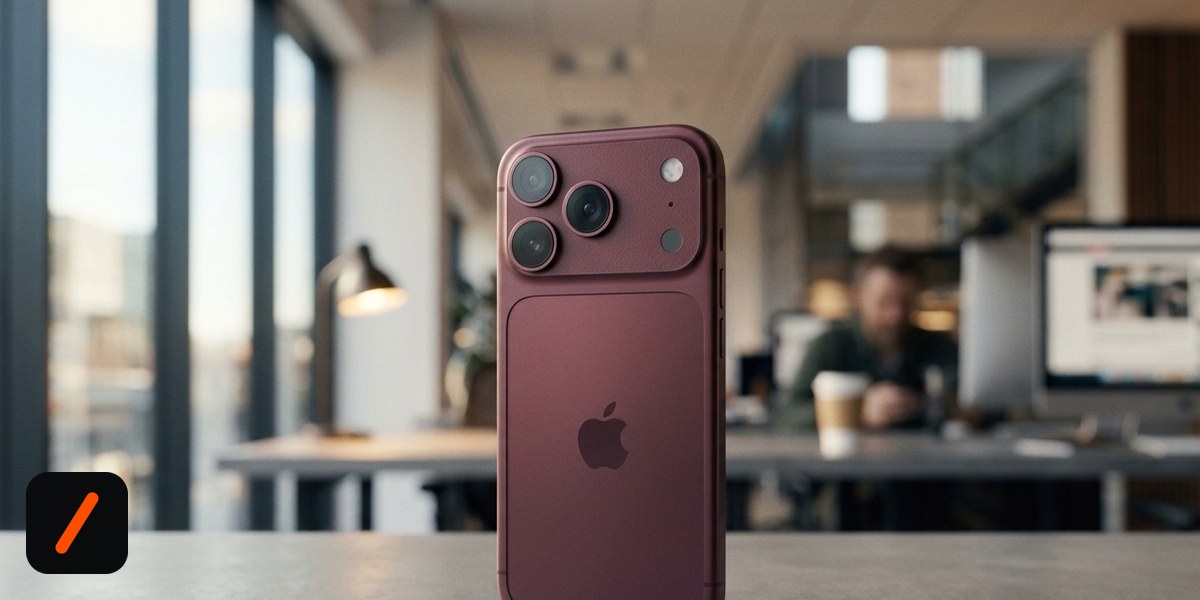
Apple opened its "Surprise and Shine" keynote this afternoon with the iPhone 18 Pro and iPhone 18 Pro Max, the first iPhones introduced under new chief executive John Ternus. The outside barely moved. Almost everything Apple spent stage time on sits under the glass: a 2nm A20 Pro chip, a main camera whose aperture physically opens and closes, a vapor chamber with three times the surface area of last year's, and the longest battery life Apple has ever quoted for an iPhone. Both models cost $100 more than last year: the iPhone 18 Pro starts at $1,199 and the Pro Max at $1,299, with pre-orders opening Saturday and delivery from September 18.
- The A20 Pro is Apple's first 2nm phone chip: a 6-core CPU with two "super cores" Apple rates as up to 20 percent faster, four efficiency cores, and a redesigned 7-core GPU it claims is up to 40 percent quicker.
- Both models get a 48-megapixel Fusion main camera with a variable aperture, that ranges from ƒ/1.48 to ƒ/4, built from six laser-cut blades thinner than a human hair and letting in roughly 50 percent more light in dark scenes.
- Battery ratings jump to 36 hours of video on the 18 Pro and 45 hours on the 18 Pro Max, up from 33 and 39 hours, helped by a next-generation vapor chamber with triple the surface area.
- The Dynamic Island shrinks and now tracks three Live Activities at once, and a new sensor-level signing feature called Apple Reference Image marks photos as camera-original at the moment of capture.
What actually changed on the iPhone 18 Pro?
Externally, very little. The 18 Pro keeps the shape and the camera plateau of the 17 Pro, with color-matched aluminum and a matching Ceramic Shield back, and arrives in black, silver, glacier and burgundy. The visible change is the Dynamic Island, which is physically smaller this year while gaining the ability to run three Live Activities side by side instead of two. If you have been waiting for the redesign that ends the plateau era, this is not it. Apple is widely expected to save that for the twentieth-anniversary iPhone.
RelatedApple iPhone Duo: Price, Specs and Release Date
The interesting engineering is structural. Apple redesigned the physical package around the silicon, borrowing an idea from its M-series Macs by sitting the die next to the memory, and it did that specifically to move heat. Paired with the new vapor chamber and a more thermally conductive graphite layer, the point is sustained performance rather than a bigger number in a benchmark burst. Phones have been thermally limited for years, and Apple spent an unusual amount of keynote time explaining why that matters.
How much faster is the A20 Pro?
Apple describes the A20 Pro as "an exceptional chip that sets a new bar for mobile computing," and the specifics are unusually aggressive. The CPU splits into two new super cores, which Apple calls desktop class and the fastest in any smartphone, plus four new efficiency cores. The GPU moves to a 7-core layout with more memory bandwidth and neural accelerators that double FP8 throughput. The Neural Engine gains an extra engine for 32 cores in total, twice the compute of the A19 Pro generation, with 8-bit floating point support.
Apple pairs it with its own N1 wireless chip, which brings Wi-Fi 7, Bluetooth 6 and Thread, and the C2 cellular modem. Read together, those are three separate bets on the same thing: running larger models on the phone instead of in a data center. Apple said as much, calling the A20 Pro "the ultimate chip for running advanced on-device models" and noting it ships with the widest memory interface ever used in an iPhone. Memory width is the quiet constraint on local inference. A model that does not fit, or cannot be fed fast enough, does not run well no matter how many neural cores sit next to it.
Why does a variable aperture matter?
Every iPhone Pro since the 15 has used a fixed f/1.78 main lens. Software decided how a shot looked; the optics never changed. The 18 Pro adds six physical blades, each cut by laser and thinner than a human hair, that open and close the lens the way a camera body does. The range runs from ƒ/1.48 wide open to ƒ/4 stopped down. Apple says the wide setting takes in about 50 percent more light in dark environments, and that closing the iris produces the diffraction spikes photographers usually have to fake in editing.
The other half of it is the new Pro Controls interface, which surfaces a live histogram, manual settings and four selectable aperture stops, and works in video as well as stills. Combined with post-capture Cinematic effects at 60 frames per second, 4K time lapse and a smart focus tracker driven by on-device models, this is Apple moving the Pro camera from computational-only toward something a person with camera habits can actually drive.
Can you trust a photo shot on it?
One announcement got less applause than it deserved. Apple Reference Image is built into the main sensor and signs photo data at the pixel level as the shot is taken, which gives a verifiable claim that an image came out of a camera rather than a model. Apple also said it will support SynthID, the watermarking standard Google uses to mark AI-generated media. Those two things point in opposite directions on purpose: one proves a photo is real, the other flags that an image is synthetic. Shipping both inside the highest-volume camera on earth does more for provenance than any voluntary industry pledge has managed so far.
RelatedApple Watch Series 12: Price, Specs, Health Features
| iPhone 18 Pro | iPhone 17 Pro | |
|---|---|---|
| Starting price | $1,199 | $1,099 |
| Chip | A20 Pro, 2nm | A19 Pro, 3nm |
| CPU / GPU | 6-core CPU, 7-core GPU | 6-core CPU, 6-core GPU |
| Main camera | 48MP Fusion, variable aperture | 48MP Fusion, fixed f/1.78 |
| Video playback | Up to 36 hours | Up to 33 hours |
| Wired charging | 50% in about 15 min | 50% in about 20 min |
| Storage | 256GB to 2TB | 256GB to 1TB |
| Dynamic Island | Smaller, three Live Activities | Two Live Activities |
| Colors | Black, silver, glacier, burgundy | Silver, cosmic orange, deep blue |
What does the iPhone 18 Pro cost?
The iPhone 18 Pro starts at $1,199 and the iPhone 18 Pro Max at $1,299, each $100 above the model it replaces. Apple pitched two ways to soften that: the Apple Upgrade program at $34.99 a month over twelve months, and trade-in credit of up to $1,200 for an iPhone 14 or newer. Pre-orders open Saturday, September 12, and the phones ship September 18. Storage runs from 256GB to 2TB, and both phones charge to 50 percent in about 15 minutes on a wire, with Apple claiming five minutes on the Pro Max is worth roughly seven hours of video. The devices reach more than 65 countries on September 18 and a second wave on September 25. The increase is smaller than some supply-chain reporting predicted, which matters in a year when memory prices have climbed for everyone building phones.
What does it mean for the market?
Apple (AAPL) is selling an iterative phone in a year when component costs are hostile. DRAM and NAND prices have climbed industry-wide as AI data center demand absorbed fab capacity, which is the same pressure that shaped the pricing of Apple's foldable. The A20 Pro also puts Apple first in line at TSMC's 2nm node, a lead that historically buys it a full generation of efficiency advantage over Qualcomm and MediaTek parts that reach that node later. Watch TSMC's advanced-node mix and Samsung's foundry response over the next two quarters: being the launch customer on a new node is expensive, and Apple only does it when the volume math works.
For investors the signal is not this quarter's units. It is that Apple keeps spending its silicon lead on local inference rather than on raw benchmark wins, which is the bet that Apple Intelligence eventually becomes a reason to upgrade rather than a footnote.
- Pre-orders on Saturday. Apple opens orders September 12 with delivery from September 18, so lead times on the burgundy and glacier finishes will show which colors it under-built.
- Real aperture results. A physical iris is easy to demo and hard to tune. The first low-light comparisons against the Pixel and the Galaxy will tell you whether 50 percent more light survives Apple's processing.
- Whether Reference Image spreads. Sensor-level signing only matters if platforms read the signature. Watch whether any social network surfaces it.
Our take
The iPhone 18 Pro is the kind of update that looks boring in a spec table and better in your hand. A camera that physically changes its aperture is the first genuinely new photographic capability on an iPhone in years, and 45 hours of video playback is the sort of number that changes how you treat a charger on a trip. The A20 Pro's neural claims deserve real testing before anyone repeats them, because vendor inference numbers have a habit of shrinking under independent measurement. But the direction is coherent: Apple is building a phone that runs models locally, and this is the first one where the memory interface, the thermals and the Neural Engine were all rebuilt for that in the same year.
- OfficialApple Newsroom: Apple debuts iPhone 18 Pro and iPhone 18 Pro Max official specs, pricing and availability
- ReportingMacRumors: Apple Announces iPhone 18 Pro and iPhone 18 Pro Max
- ReportingMacRumors: Both iPhone 18 Pro Models Feature Variable Aperture Camera camera mechanism detail
- ReferenceApple: iPhone 17 Pro tech specs baseline for the comparison table
Original analysis by GenZTech Team, based on Apple's September 9, 2026 keynote and its official announcement.