
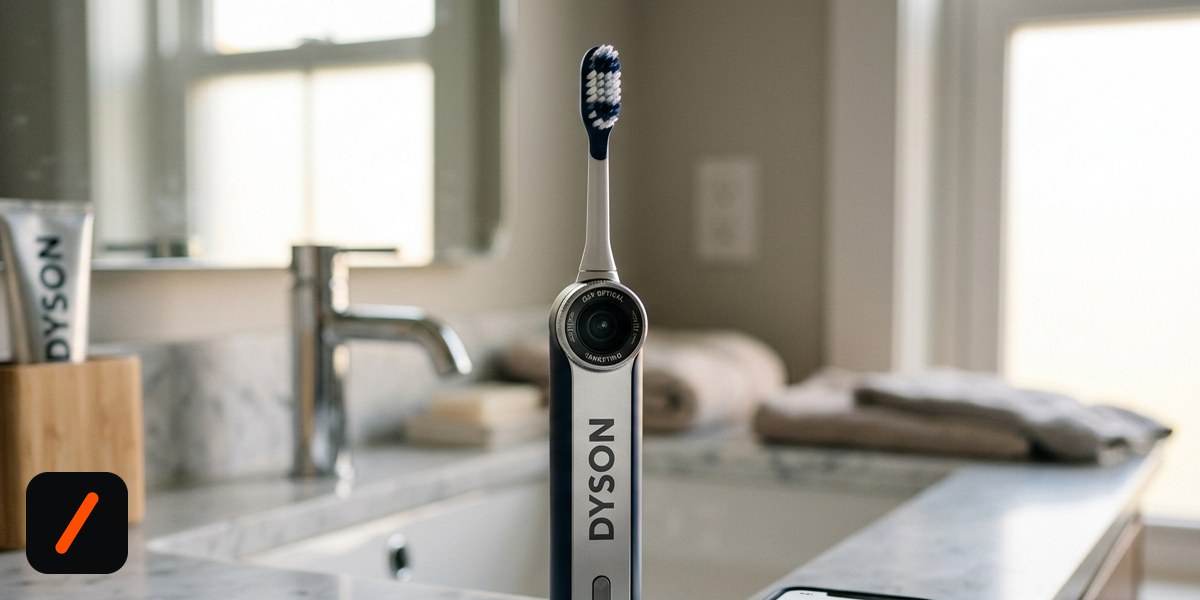
Dyson's CameraJet packs a macro-lens camera, a machine-learning gap detector, and a precision water jet into one electric toothbrush, and it costs $499. It is the company's first-ever toothbrush and the first product under what Dyson is calling its Dental System, and it ships September 8, 2026 after opening for pre-order on September 1.
- CameraJet is Dyson's first electric toothbrush, combining a brush, a water flosser, and a camera in a single handle.
- A 100,000-pixel macro-lens camera built into the brush head captures 28 images per second while you brush.
- Dyson's "Gap Optical Targeting" AI reads those images in real time and fires a targeted burst of water at gaps between teeth within roughly 100 milliseconds.
- It launched September 1, 2026 at $499 in two colorways, Ceramic Ultra Blue and Ceramic Pink, and ships September 8 via dyson.com, Dyson Demo Stores, and select retailers.
What exactly is the Dyson CameraJet?
Strip away the branding and CameraJet is three devices wearing one handle: an electric toothbrush, a water flosser, and a camera system that connects them. The brush head houses a 100,000-pixel macro-lens camera that shoots 28 images per second of your teeth and gumline as you brush. Those frames feed straight into Gap Optical Targeting, the onboard machine-learning system that looks for the narrow spaces between teeth where plaque tends to collect and regular brushing tends to miss.
RelatediPhone 18 Pro: Price, Specs and Release Date
When the system flags a gap, CameraJet doesn't wait for you to switch tools. It fires a short, aimed burst of water or mouthrinse, about 100 milliseconds after detection, directly at that spot. The result is interdental cleaning folded into the brushing motion itself, rather than a separate flossing step most people skip entirely. Dyson is selling it at $499, in Ceramic Ultra Blue and Ceramic Pink, available for pre-order now on dyson.com and in Dyson Demo Stores and select retailers ahead of a September 8 ship date.
How does Gap Optical Targeting actually work?
The pipeline runs in three steps, and the speed of the last one is the whole point. First, the brush head's camera continuously images the teeth in front of it, at a high enough frame rate that it can catch gaps as the brush moves rather than only at a fixed angle. Second, the machine-learning model processes those frames in real time, distinguishing an actual interdental gap prone to plaque buildup from ordinary tooth surface. Third, the moment a gap is confirmed, the device triggers a precisely aimed jet, timed to land within about 100 milliseconds so it fires while the brush head is still positioned over the right spot.
What makes this different from a toothbrush with a companion app is that none of this happens after the fact. Most smart toothbrushes today log your brushing pattern and show you a report later. CameraJet is closing the loop while the brush is still in your mouth, using the camera as a live sensor rather than a marketing add-on.
Why is Dyson entering oral care now?
Dyson built its business on a fairly narrow set of skills: motors, airflow, fluid dynamics, and filtration, applied first to vacuums, then fans and heaters, then hair care. Oral care is a less obvious extension until you notice what CameraJet actually requires. Firing a precise burst of liquid at a target moving through your mouth in real time is a fluid dynamics problem wrapped around a very fast motor and pump, which happens to be exactly the kind of engineering Dyson has spent decades refining. The camera and machine-learning layer are new territory for the company, but the actuation, the part that makes the water go exactly where it needs to go in a fraction of a second, is a natural fit.
There's also a market logic to the timing. Dyson has been pushing into personal care categories beyond its original hardware base, and oral care is a large, sticky, repeat-purchase market currently split between Oral-B, owned by Procter & Gamble, and Sonicare, owned by Philips. Both are entrenched, but neither has shipped a mainstream product that puts a camera inside the brush head. Entering with a feature incumbents don't have, rather than a cheaper version of what they already sell, is a familiar Dyson playbook from vacuums and hair dryers alike.
CameraJet vs Oral-B and Sonicare
On paper, $499 puts CameraJet well above the usual ceiling for premium electric toothbrushes, but the comparison changes once you account for what's bundled in. Oral-B and Sonicare's top models sell brushing feedback and pressure sensing as their premium features, while flossing stays a separate purchase and a separate step. CameraJet folds the flosser into the brush itself.
| Model | Dyson CameraJet | Oral-B iO Series | Philips Sonicare DiamondClean |
|---|---|---|---|
| Price | $499 | Roughly $200 to $300 at the top of the lineup | Roughly $200 to $280 at the top of the lineup |
| Onboard camera | Yes, 100,000px macro lens at 28 images per second | No | No |
| Flossing mechanism | Built-in targeted water jet, fired automatically during brushing | Manual flossing, a separate step and separate tool | Manual flossing, with AirFloss sold as a separate device |
| AI features | Real-time computer vision gap detection (Gap Optical Targeting) | App-based pressure sensing and brushing-pattern coaching | App-based sensors tracking coverage and brushing habits |
Is a $499 toothbrush worth it?
The honest answer depends on what you're comparing it to. Against a $5 spool of floss, CameraJet is an absurd markup for something string has done adequately for a century. Against the actual behavior of most adults, who own floss and rarely use it consistently, CameraJet is selling convenience: a way to get interdental cleaning done without a separate habit to maintain. That's a real problem, and it's the one Dyson is explicitly targeting.
RelatedNintendo Switch 2 Hits $499.99 as AI Chip Demand Drains DRAM
The people most likely to buy in are existing premium toothbrush owners already spending $200-plus on an Oral-B iO or Sonicare DiamondClean, plus early adopters drawn to Dyson's design language and willing to pay for the novelty of the camera itself. What's missing at launch is independent, real-world validation that Gap Optical Targeting reliably finds gaps across different mouths and brushing styles, rather than in a controlled demo. That's the gap, so to speak, between an impressive engineering pitch and a proven daily-use product.
What happens next for Dyson's Dental System
Dyson has framed CameraJet as the first product under a broader Dental System, which suggests more oral-care hardware is coming rather than a one-off release.
- Dyson expands into personal care beyond its original vacuum, fan, and hair-care lines.
- CameraJet announced September 1, 2026, priced at $499 in Ceramic Ultra Blue and Ceramic Pink.
- Pre-orders open the same day on dyson.com, in Dyson Demo Stores, and at select retailers.
- CameraJet ships to customers September 8, 2026.
- Speculative: competitive response and follow-on Dental System products through the rest of 2026 and beyond.
- Incumbent response: whether Oral-B and Sonicare fast-track their own camera-equipped or AI-targeting models rather than ceding the high end to Dyson.
- Real-world accuracy: whether Gap Optical Targeting holds up across different teeth, gaps, and brushing habits once it's out of controlled demos and in daily bathroom use.
- Price movement: whether $499 holds, gets bundled with promotions, or drops as Dyson pushes into more retail channels.
- Retail expansion: how far CameraJet spreads beyond Dyson's own stores and site into mainstream retailers over the next few quarters.
Our take
CameraJet is genuinely clever engineering wearing an eye-watering price tag. Putting a camera and a real-time detection loop inside a toothbrush head, then acting on it within 100 milliseconds, is a harder problem than it sounds, and it plays directly to what Dyson is actually good at: precision fluid control under tight physical constraints. That part isn't hype.
Whether it's worth $499 is a separate question from whether it's impressive, and right now the honest answer is that nobody outside Dyson's own testing has proven Gap Optical Targeting works reliably across real mouths over months of use. Dyson has a track record of charging a premium for engineering that eventually trickles down to more affordable versions, and oral care is likely to follow that pattern: an expensive first product proving the concept, competitors scrambling to match the camera trick, and cheaper versions arriving once the technology stops being a novelty. For now, CameraJet is a bet that people will pay to skip a habit they already know they should have, and that bet says as much about how badly incumbents have failed to make flossing effortless as it does about Dyson's engineering.
- OfficialIntroducing CameraJet : Dyson's official product announcement
- NewsDyson Announces $499 CameraJet Smart Toothbrush With AI, Built-In Camera : Bloomberg launch coverage
- NewsDyson's $500 toothbrush puts a high-tech camera in your mouth : Washington Post analysis
- OfficialDyson CameraJet press release : PR Newswire official release
Original analysis by GenZTech. Sources: Dyson, Bloomberg, Washington Post.