
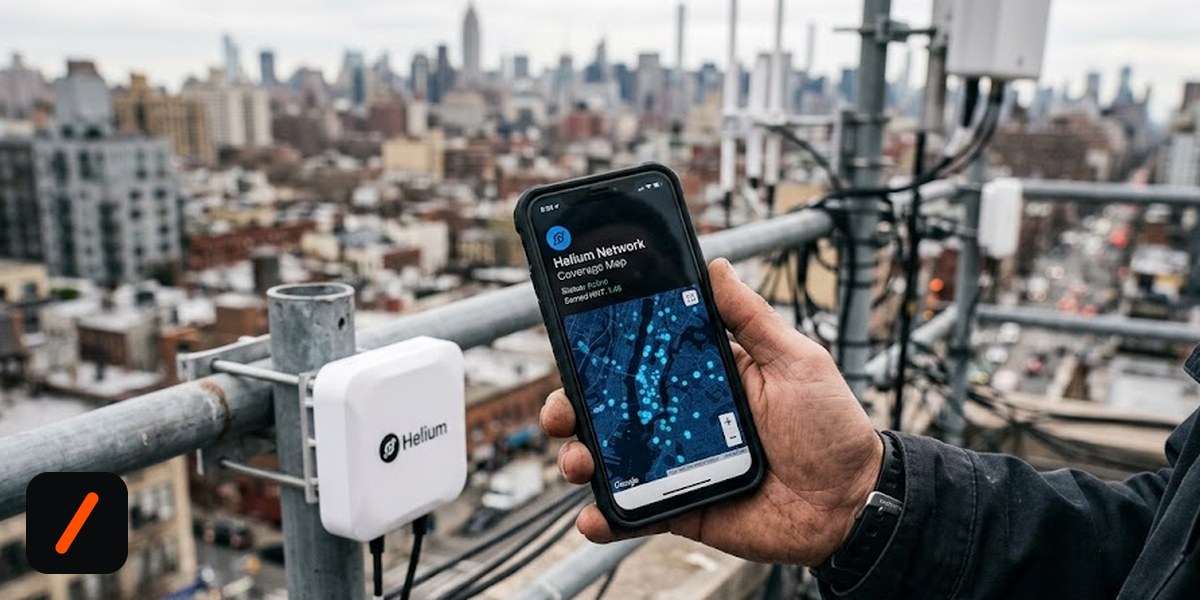
Helium spent years getting individual people and small companies to plug in Wi-Fi and cellular hotspots for token rewards. On September 1, 2026, it started selling something different: the software that runs a connectivity business on top of that network. The company calls it HeliumOS, and it's aimed squarely at carriers, MVNOs, and venue operators who want to launch service without building a backend from scratch.
- HeliumOS is a full BSS/OSS platform (subscriber management, analytics, Wi-Fi offload tooling) with native integration into Helium's decentralized wireless network.
- It's built for carriers, MVNOs, and operators of large venues such as airports, arenas, schools, and shopping malls.
- Affiniti Ventures, the company behind Noble Mobile and Helium Mobile, is the first announced customer.
- This follows Helium's June 2026 sale of its own Helium Mobile MVNO to Noble Mobile: a pivot from running one carrier brand to selling the platform many carriers can run on.
What does HeliumOS actually let a carrier do?
Strip away the acronyms and HeliumOS is a management layer. BSS (business support systems) covers the customer-facing side: billing, plans, subscriber accounts. OSS (operations support systems) covers the network-facing side: monitoring capacity, routing traffic, keeping service running. Helium bundled both into one platform and added its own network underneath, so a carrier signing up gets subscriber management, intelligent analytics, and Wi-Fi offload tools out of the box, plus a direct plug into Helium's hotspot coverage.
RelatedSilencio Turns Idle Phones Into a Global Noise Sensor Net
The pitch, in Helium's own words, is giving operators the tools to "launch, operate, and scale a connectivity business faster and smarter." Practically, that means a mall operator wanting to offer branded Wi-Fi, or a regional MVNO wanting to offload cellular traffic onto Wi-Fi where it's cheaper, doesn't need to build subscriber databases and analytics dashboards from zero. They rent the stack.
What is DePIN, and how does Helium's hotspot network actually work?
DePIN stands for Decentralized Physical Infrastructure Network. The idea: instead of one company buying and owning every piece of hardware a network needs, individual operators buy and deploy the hardware themselves, and get paid for the capacity they provide. Filecoin does this with storage drives, Render does it with spare GPU power, Hivemapper does it with dashcams that map roads. Helium does it with small radio units that provide Wi-Fi and cellular coverage.
Anyone can buy a Helium hotspot, plug it into their home or office internet, and start earning HNT, Helium's token, for the coverage and data it provides to nearby devices. String enough of those hotspots together across a city or region and you get a wireless network nobody centrally built, funded instead by thousands of small operators chasing token rewards. That network is the raw infrastructure. HeliumOS is the business layer sitting on top of it.
Why is Helium selling software instead of just running hotspots?
Because running one MVNO only captures a fraction of what the network can support. Earlier this year, in June 2026, Helium sold its own Helium Mobile MVNO business to Noble Mobile. That looked at the time like Helium stepping back from the phone-plan business. HeliumOS reframes it: Helium isn't leaving the connectivity business, it's productizing the parts of it that scale. Rather than compete with every carrier for subscribers under one brand, it sells the operating system that lets many carriers run their own brands on the same underlying network.
That shift lines up with where the broader DePIN sector is heading in 2026. Networks like Helium, Filecoin, Render, Hivemapper, io.net, and Grass built early momentum on token incentives paid to hardware operators. Now they're chasing enterprise customers who pay real money for real service. DePIN networks industry-wide reportedly generated roughly $150 million in on-chain revenue in January 2026 alone, from storage deals, compute jobs, data credits, and mapping contracts. That figure spans the whole category, not Helium specifically, but it shows the direction: DePIN projects are trying to prove they can be businesses, not just token-reward schemes.
Who is Affiniti Ventures, and why does it matter as the launch customer?
Affiniti Ventures is the company that now owns Noble Mobile and Helium Mobile, the MVNO brand Helium itself used to run before selling it off in June 2026. Naming Affiniti as HeliumOS's first live customer is a tidy piece of continuity: the same brand that used to be Helium's in-house carrier is now the proof case for the platform Helium built to serve carriers generally. It also removes some of the skepticism that comes with any brand-new enterprise product. Affiniti already knows the network intimately, having run a business on it, which makes it a credible first reference rather than a hand-picked pilot with no track record.
RelatedHelium's Carrier Pivot Hits 2.5M Users and 7 Networks
How does this stack up against other DePIN projects doing the same thing?
Helium isn't the only DePIN network trying to turn raw physical capacity into something a business can rent. The specifics differ by category.
| Network | Physical resource | What it sells to businesses |
|---|---|---|
| Helium | Wi-Fi and cellular hotspots | HeliumOS: BSS/OSS platform for carriers and venues |
| Filecoin | Decentralized storage drives | Storage deals and data retrieval contracts |
| Render | Spare GPU compute | Rendering and AI compute jobs |
| Hivemapper | Dashcam-collected map data | Mapping and geospatial data licensing |
What sets HeliumOS apart is that it isn't selling raw capacity by the unit, the way storage or compute deals typically work. It's selling a management platform that other companies operate their own customer relationships through. That's closer to a SaaS model bolted onto a DePIN backend than a straight token-for-resource trade.
Whether more carriers or MVNOs sign onto HeliumOS beyond Affiniti Ventures will be the real signal, since one launch customer that used to be Helium's own brand isn't yet proof of outside demand. Watch too whether this changes how HNT gets used: if HeliumOS deals route real payments through the network rather than just token emissions to hotspot operators, that's a different demand story for the token than pure DePIN mining. And it's worth tracking whether other DePIN networks follow the same script, wrapping their raw infrastructure in an enterprise software layer instead of selling capacity piecemeal.
- Official Introducing HeliumOS Helium's own announcement of the platform and its first customer
- Reporting HeliumOS Brings Wi-Fi Offload and Intelligent Connectivity to Carriers trade press coverage of the launch and its carrier positioning
- Reporting Helium Launches HeliumOS crypto-industry coverage framing the launch against Helium's DePIN roots
Original analysis by GenZTech Team. Source: Helium official blog