
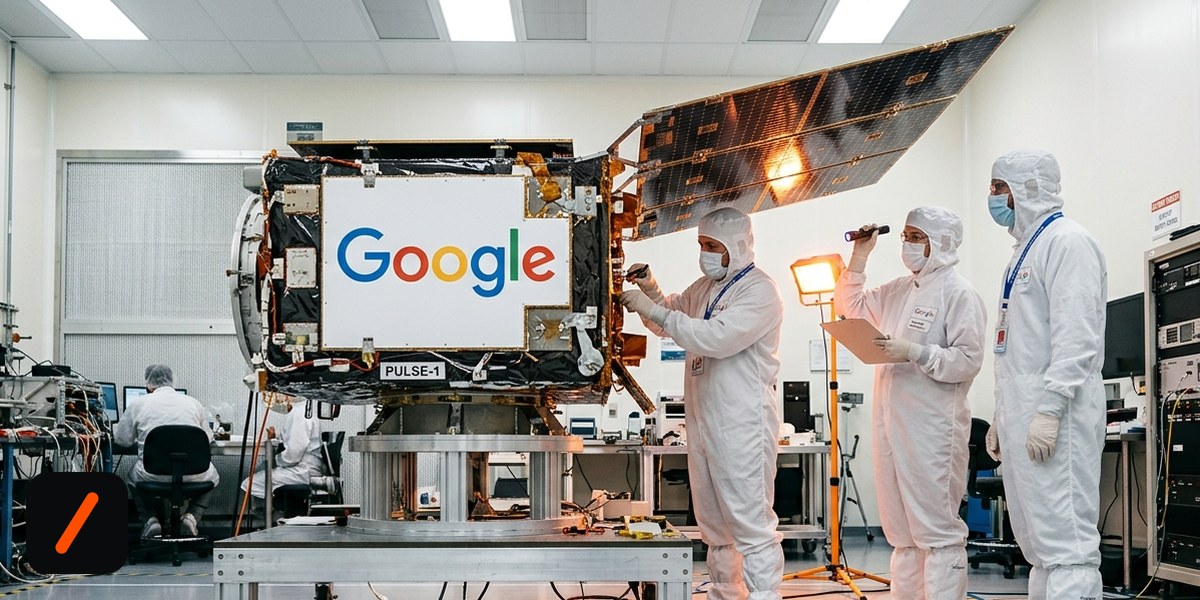
Google put four of its TPUs into orbit on October 1, 2026, and the interesting part is how modest the payload is. The Project Suncatcher prototype is a refrigerator-sized satellite built to find out whether AI chips survive space at all, which makes this a hardware-reliability test and not the first space data center.
- The satellite rode a SpaceX Falcon 9 on the Transporter-18 rideshare mission and will be deployed and operated by Planet (NYSE: PL) in a sun-synchronous low Earth orbit for a planned one year.
- It carries four Trillium-generation TPUs running Gemma, but the chips can only run about 15 minutes at a time because of heat.
- Two more satellites follow in 2027 to test laser links between spacecraft, the first step toward Google's paper vision of an 81-satellite cluster.
- The program's own lead calls this "a very minimal test" and does not expect orbital compute to beat terrestrial data centers on cost within five years.
What did Google actually launch?
A small satellite, built with Planet, which handles deployment and operations. The four chips are Trillium-generation TPUs, per Google's blog, and they will run Gemma, Google's open-weight model. The stated goals are plain: see how the hardware handles the physical stress of spaceflight, radiation and thermal extremes, collect reliability data, evaluate cooling in real orbit, and surface engineering problems before anyone builds something bigger.
RelatedNew York Orders First US Data Center Moratorium
Travis Beals, who leads Project Suncatcher, described the prototype as "a very minimal test." He also said, in his own words, that space data centers will not become cheaper than terrestrial ones over the next five years.
Why does the orbit matter, and why only 15 minutes?
A sun-synchronous orbit keeps the satellite crossing the equator at the same local solar time on every pass. Pick the dawn-dusk variant and the spacecraft rides the day-night boundary, so its panels see the sun nearly all the time and rarely sit in Earth's shadow. For a machine whose entire pitch is "free" solar power, that is the point of the whole design.
Then comes the awkward detail. The chips can run only about 15 minutes at a time. On the ground, a TPU rack throws heat into moving air or liquid. In vacuum there is no convection, so every watt has to leave as infrared radiation from a radiator, and radiator area means mass, and mass is launch cost. A 15 minute duty cycle is a thermal wall made visible.
Can an AI chip survive a launch and the radiation?
Google ran ground tests first. Its Trillium TPUs can survive a total ionizing dose greater than what they would receive over a five-year space mission. The launch is its own ordeal: about ten minutes to low Earth orbit, with sustained acceleration up to 10g and individual components seeing 50 to 100g. Once up there, solar events and cosmic rays cause bit flips, which is the failure mode that matters most for dense accelerator silicon running long jobs.
Surviving a test bench is not the same as computing correctly for a year. Silent corruption is harder to catch than a dead part, and twelve months of telemetry can start to measure it.
How far is this from a real orbital data center?
Very far, and the roadmap says so. Two more satellites are planned for 2027 to test laser, or free-space optical, links between spacecraft. The long-term vision in Google's research paper is fleets of solar-powered satellites carrying TPUs and tied together by free-space optics, including a cluster of 81 satellites inside a one kilometer radius.
RelatedQualcomm's AI200 and AI250 Chase Nvidia in Inference
This is why four TPUs are enough for now and nowhere near enough for the thesis. Four chips can reveal bit-flip rates, thermal behavior and how long hardware lasts. They cannot show that thousands of chips can be linked, cooled and kept serviceable,, and nothing in orbit can be repaired. The satellite count is the unproven variable, and fleet-scale networking is what 2027 begins to probe.
Who else is racing, and how do they compare?
| Effort | Google Suncatcher | Starcloud | SpaceX orbital compute |
|---|---|---|---|
| Chip | 4 Trillium TPUs | Nvidia H100 | Not specified |
| Launched | Oct 1, 2026 (Falcon 9) | Nov 2025 | No |
| Status | One year test, 15 min runs | Spacecraft flown | Planned "orbital AI compute satellites" |
| Next step | Two satellites with laser links, 2027 | Not covered here | Target by 2028 |
Starcloud got a Nvidia H100 up in November 2025, so Google is not first to put a modern accelerator in space. Its claim is a multi-year program with in-house silicon and a published path to clusters. The economic hinge for all three is launch cost, which is why our Starship Flight 14 coverage matters here.
- Nov 2025Starcloud launches an H100. First Nvidia data center GPU flown on a spacecraft.
- Sep 24, 2026Google publishes its Suncatcher update.
- Sep 29, 2026Starship reaches orbit on Flight 14. 26 Starlink V3 satellites deployed.
- Oct 1, 2026Suncatcher prototype launches. Falcon 9, Transporter-18.
- 2027Two satellites test laser links.
- 2028SpaceX targets orbital AI compute satellites.
What it means for the market
Google's 2026 capital spending guidance is $180 to $190 billion, which Sundar Pichai gave in May and which is roughly six times its 2022 outlay. The signal for investors is that Alphabet (GOOGL) is buying an option on a post-2030 power constraint, not near-term capex relief, and its own program lead has ruled out a cost advantage inside five years. Planet (PL) is the cleaner read: it earns revenue by hosting and operating the spacecraft, so the story supports its platform narrative without depending on whether orbital compute ever pays off. SpaceX is private, but its 2028 target and its launch pricing sit under every scenario.
Our take
This is a good experiment wrapped in a larger story than it can carry. Launching real TPUs to learn about bit flips and heat is exactly how you find out whether the idea has a floor, and Google deserves credit for being honest that the payoff is distant. But the 15 minute duty cycle tells you where the physics pushes back. Rejecting heat in vacuum is the problem, and cheaper launch only softens it, because radiators still have to be big. Watch the thermal data and the 2027 laser links. Those are the numbers that tell you whether this is engineering or a very expensive slide.
- Bit-flip and error rates. Silent corruption in a year of Gemma runs matters more than survival.
- Duty cycle growth. Does the 15 minute limit stretch, or is it the design ceiling?
- The 2027 laser links. Optical links between satellites are the gate to any cluster.
- Launch pricing. Starship cadence sets whether radiator mass stays affordable.
- OfficialGoogle: Project Suncatcher facts mission goals, ground testing, hardware
- ReferenceDatacenterDynamics on Suncatcher the 81 satellite cluster plan
- NewsNPR via KCCU: Google launches Project Suncatcher launch coverage and program comments
- NewsGizmodo: pre-launch report payload and timing details
Original analysis by GenZTech. Reporting via NPR.