
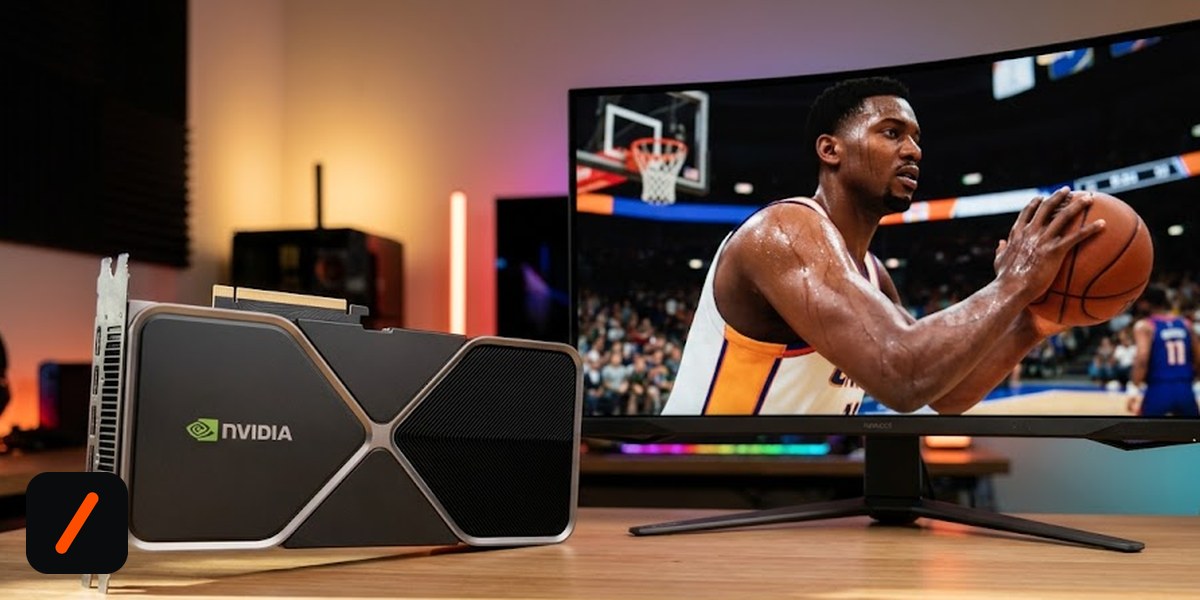
Nvidia is done treating DLSS as an upscaler with extra steps. DLSS 5, officially confirmed hours ago on Nvidia's own GeForce blog, launches September 3 at 9pm Pacific in NBA 2K27, and for the first time the headline feature isn't more frames per second. It's a neural network that generates the lighting and material detail a rasterized frame never had in the first place, running only on RTX 50-series hardware.
- DLSS 5 ships September 3, 9pm PT, first in NBA 2K27, gated to RTX 50-series desktop and laptop GPUs plus GeForce NOW Ultimate.
- Its new component is 3D-Guided Neural Rendering: an AI model that reads motion vectors and scene data straight from the game engine to add subsurface scattering, hair light transmission and contact shadows that were never rasterized.
- Nvidia's own NBA 2K27 numbers at 1440p Ultra with ray tracing: RTX 5070 at 262fps, 5070 Ti at 350fps, 5080 at 410fps, and 5090 at 590fps (370fps at 4K).
- The catch fueling the "controversial" label: it's RTX 50-only, and it leans harder on AI-generated detail than any DLSS version before it, at a moment when gamers are already split over multi-frame generation.
What actually launches on September 3?
A new GeForce Game Ready Driver drops at 9pm Pacific alongside a day-one patch for NBA 2K27 from Visual Concepts, the first and so far only game confirmed to ship 3D-Guided Neural Rendering. Nvidia is positioning basketball as the proving ground on purpose: skin, hair and jersey fabric under arena lighting are exactly the surfaces where rasterized rendering has always looked flat. Peter Kavic, Visual Concepts' senior producer, put it plainly in Nvidia's announcement: "DLSS 3D-guided neural rendering helped boost the visual quality of our materials and lighting, bringing a real jump to photorealism across the game." The feature runs on RTX 50-series desktop and laptop GPUs, and GeForce NOW Ultimate subscribers get it in the cloud the same day, no local RTX card required.
RelatedNvidia's Vera Rubin NVL72 Enters Production, and AI Scale Climbs
How is this different from Frame Generation or Ray Reconstruction?
Every prior DLSS component still worked from pixels the engine already produced. Frame Generation interpolates between two rendered frames. Ray Reconstruction denoises a path-traced image. 3D-Guided Neural Rendering skips that constraint. It reads engine-level 3D data, motion vectors, object identity, material tags, and light source positions, and predicts detail that was never rasterized in the first place: how light scatters under skin, how it catches individual strands of hair, where a jersey should throw a soft contact shadow. Nvidia says the model is deterministic, meaning identical inputs produce identical outputs frame to frame, which matters because a neural model that flickered or hallucinated differently every frame would be unusable in a fast-moving basketball game. Developers get real controls over it too: separate sliders for structural detail (ambient occlusion, reflections, subsurface scattering) and tonal response (lighting and color), plus semantic AI masking so an artist can exclude specific objects from the effect entirely.
What do the benchmarks actually show?
Nvidia's own first-party numbers, run in NBA 2K27 with ray tracing and DLSS 5 enabled, scale roughly linearly down the RTX 50 stack. The chart below is Nvidia's data, not third-party testing, so treat it as a ceiling rather than a guarantee once independent reviewers get hands-on time before the launch.
The 6x multi frame-generation mode is doing most of that heavy lifting, layered on top of DLSS Super Resolution at the Quality setting. That's worth flagging plainly: these are not 590 "native" frames, they're a mix of rendered and AI-generated frames, and how that feels in a hand-eye-coordination-heavy sports game is something only independent, controller-in-hand testing will settle.
Why are people already calling it controversial?
Two separate arguments have collided into one headline. The first is philosophical: earlier DLSS tools amplified or smoothed real rendered data, but 3D-Guided Neural Rendering invents detail the artists never explicitly authored, a neural network's best guess standing in for a lighting engineer's actual work. Nvidia's counter is that its structural and tonal controls, plus per-object masking, keep a human in the loop. The second argument is simpler and more familiar: RTX 40-series and older cards, along with every console, get nothing. That exclusivity sits on top of an existing fight over multi-frame generation, where critics already argue Nvidia's marketed frame-rate gains lean on interpolated frames rather than frames the GPU actually rendered from scratch. DLSS 5 adds a third rail to that same debate rather than resolving it.
RelatedNvidia's RTX PRO 5500 Pairs 5090 Cores With 84GB of VRAM
What it means for Nvidia's stock
This is a software story riding on hardware Nvidia has already sold, so its market impact is more about narrative reinforcement than a fresh revenue line. Nvidia's gaming segment is the smaller sibling to its data-center business, but DLSS has been the company's most durable proof that its silicon advantage compounds through software nobody else can replicate at the same latency. A visibly next-generation feature gated to RTX 50-series cards gives Nvidia a fresh reason for anyone still on a 30- or 40-series GPU to upgrade sooner, which is the actual lever on near-term gaming-segment revenue. The signal for investors to watch isn't September 3 itself, it's whether AMD or Intel can show a comparable neural-rendering answer within a couple of quarters; so far neither has announced one.
- Independent benchmarks. Nvidia's own numbers are the ceiling. Third-party reviewers with an RTX 5070 through 5090 in hand will tell you the real story within days of September 3.
- Does it spread past one basketball game? A single launch title proves the tech exists, not that developers will widely adopt it. Watch for a second and third confirmed game.
- Image-quality scrutiny. Expect frame-by-frame comparisons hunting for artifacts, ghosting or "AI guesswork" moments the way Frame Generation got picked apart in 2022.
- AMD and Intel's response. FSR and XeSS have chased Nvidia's upscaling and frame-gen moves before. Neither has a neural-rendering answer yet.
Our take
DLSS 5 is a bigger swing than a version-number bump suggests. Every previous DLSS shipped as a performance trick with a quality cost you could tolerate or turn off. 3D-Guided Neural Rendering is the opposite bet: spend compute to add visual quality no rasterizer could produce, and let performance be a side effect of the hardware you already own. That's a genuinely different pitch than "more fake frames," even if the multi-frame-gen skepticism will bleed onto it regardless. The RTX 50-only gate is the real friction point, not the AI philosophy debate. Nvidia has never been shy about using new DLSS features to sell new GPUs, and tying a legitimately interesting rendering technique to a single hardware generation is a business decision dressed up as an engineering one. Whether NBA 2K27 actually looks as good in motion as Nvidia's screenshots suggest is the only claim that matters, and nobody outside Nvidia and Visual Concepts has verified it yet.
- OfficialNvidia GeForce News DLSS 5 announcement, benchmarks and developer quotes
- CoverageTom's Hardware launch details and hardware requirements
- ReferenceGenZTech AI Coding Leaderboard our independent tracker for AI benchmark claims generally
DLSS 5 goes live September 3 at 9pm PT. GenZTech will follow up once independent benchmarks land.