
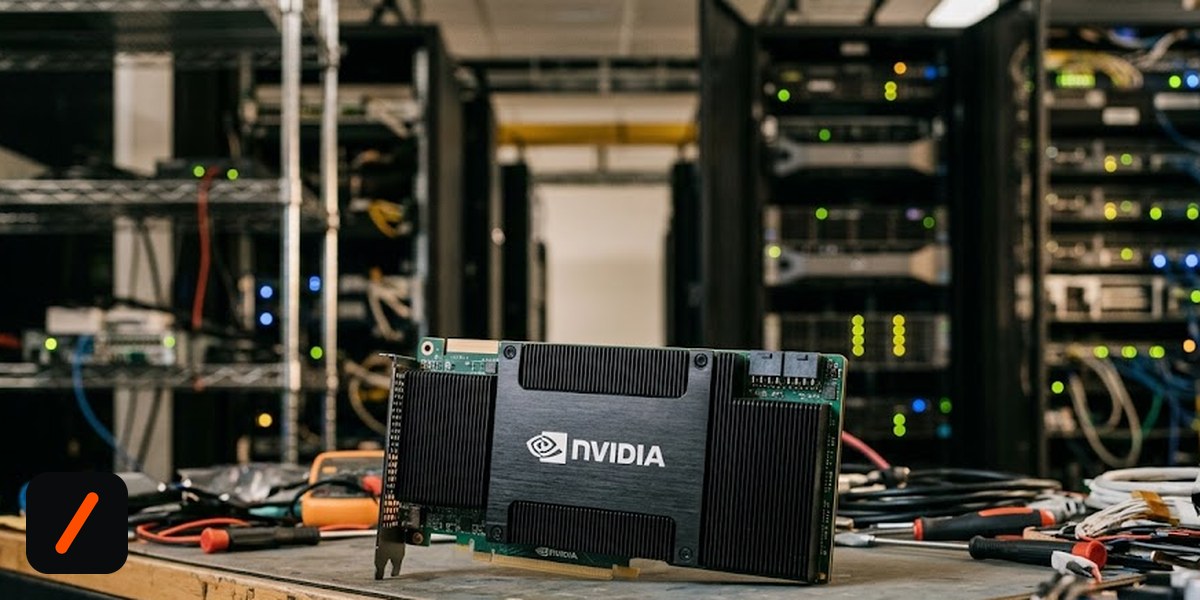
Nvidia CEO Jensen Huang met Rebellions co-founder and CEO Sunghyun Park this week at Nvidia's Santa Clara headquarters, and according to Bloomberg, the conversation has opened the door to a partnership, an investment, or an outright acquisition. Nothing is signed, and the talks are described as early. Rebellions builds inference chips, the kind of hardware Nvidia doesn't dominate the way it dominates AI training, and that gap is probably why Huang picked up the phone in the first place.
- Jensen Huang and Rebellions CEO Sunghyun Park met in Santa Clara during the week of August 17-21, 2026, with talks reportedly covering everything from a commercial partnership to a full acquisition.
- Rebellions, a Seoul-based startup founded in 2020, designs neural processing units built specifically for AI inference in data centers, a workload where Nvidia's general-purpose GPUs are less specialized.
- The company has raised roughly $850 million from backers including SK Hynix, Samsung Ventures, and Arm Holdings, and was last valued around $2.3 billion.
- The talks emerged just days after Rebellions' CFO said the company is preparing a listing on South Korea's KOSPI exchange, and any acquisition would still need to clear US antitrust review and South Korean regulators.
What actually happened in Santa Clara
Strip away the speculation and the confirmed part is fairly simple: Huang and Park sat down at Nvidia's headquarters this week, and the two sides are now exploring what a deeper relationship might look like. Bloomberg's report frames it as preliminary, with partnership, investment, and acquisition all still on the table and no structure locked in. Rebellions itself is a five-year-old company, founded in 2020, that designs neural processing units purpose-built for running trained AI models rather than training them from scratch. It has pulled in about $850 million across its funding history from SK Hynix, Samsung Ventures, and Arm Holdings, and its most recent valuation landed around $2.3 billion. None of that is small for a chip startup outside the usual Silicon Valley orbit.
RelatedJim Keller's Tenstorrent Guns for Cerebras and Nvidia
Why is Nvidia interested in a Korean NPU startup?
Training and inference are not the same business, even though people talk about "AI chips" as one category. Training a frontier model rewards raw parallel throughput and a software stack developers already know, and that's exactly where Nvidia's CUDA ecosystem has built a moat few competitors have cracked. Inference is a different math problem. It's about serving millions of requests cheaply, at low latency, without burning power you don't need to burn. A chip tuned narrowly for that job can beat a general-purpose GPU on cost per query even if it's a worse chip on paper. Rebellions builds for exactly that narrower job, and as more of the industry's compute spend shifts from training new models to running the ones that already exist, that narrower job keeps getting bigger.
Why does Nvidia keep investing in potential rivals?
This isn't the first time Nvidia has moved toward a company whose whole premise is chipping away at Nvidia's own turf. The pattern shows up across the industry, actually: a dominant player writes a check into, partners with, or buys the startup that could otherwise grow into a real threat, and in doing so gets two things at once. It buys optionality if the challenger's architecture turns out to matter, and it buys visibility into that architecture's roadmap either way. A stake in Rebellions doesn't cost Nvidia its GPU business. It just means that if inference-specific silicon becomes the thing customers actually want, Nvidia isn't standing outside that market watching someone else win it.
What happens next, and who else is watching?
The honest answer is that nobody outside these two companies knows yet, including whether a deal happens at all. An acquisition of this size would draw US antitrust scrutiny almost by default given how much of the AI chip market already runs through Nvidia, and South Korean regulators would have their own say given Rebellions' strategic position and its government-adjacent backers. Samsung and SK Hynix aren't just investors here, they're also the memory suppliers any NPU maker depends on, so their interests run deeper than a cap table. Arm has its own stake in the outcome as a Rebellions investor. And the timing next to Rebellions' CFO confirming IPO prep on KOSPI means South Korea's exchange, and its broader push to build a homegrown chip industry beyond memory, is watching closely too.
What it means for the market
For Nvidia, this reads less like fear and more like housekeeping. The company has the cash to hedge against inference-specialized challengers rather than compete against every one of them head-on, and folding an NPU maker into its orbit, formally or informally, extends its reach into a segment its own GPUs weren't purpose-built for. The signal for investors watching this space is that inference economics have become important enough that a company as dominant as Nvidia is willing to spend real money securing a foothold rather than assuming its GPU lead covers every workload forever. It's also a signal about Korea's chip ambitions specifically: whether or not this particular deal closes, having Nvidia at the table validates the idea that Korea can produce more than memory, and that alone matters to how Samsung and SK Hynix get valued as AI suppliers rather than just DRAM vendors.
RelatedNvidia's $96.2B Quarter Meets Its First Real Challenger
Rebellions isn't the only company betting that the next phase of AI economics runs through chips built for inference instead of training. A few of the more visible names in that race:
| Rebellions | Groq | Cerebras | SambaNova | Tenstorrent | |
|---|---|---|---|---|---|
| Approach | NPU built for data center inference | Custom LPU with deterministic execution | Wafer-scale single chip, skips GPU clustering | Reconfigurable dataflow architecture | RISC-V based AI chips, licensable IP |
| Funding status | ~$850M raised, ~$2.3B valuation, prepping KOSPI IPO | Multiple large private rounds | Large private rounds, prior public listing attempt | Large private rounds | Backed by strategic chip and auto investors |
| Notable backers | SK Hynix, Samsung Ventures, Arm Holdings | Cisco, BlackRock among investors | G42 as major backer and customer | SoftBank among early backers | Samsung and Hyundai among investors, led by Jim Keller |
- Deal structure. Whether talks land on a commercial partnership, a minority investment, or a full acquisition will say a lot about how much control Nvidia actually wants here.
- IPO timing. Watch whether Rebellions' KOSPI listing moves forward on its own schedule or gets paused if a Nvidia deal firms up.
- Regulatory posture. Any acquisition-shaped outcome will test how aggressively US antitrust regulators scrutinize Nvidia's expansion into adjacent chip categories.
- Korean government reaction. Given SK Hynix and Samsung Ventures' stakes, expect Seoul to have a view on whether a homegrown NPU maker ends up under a US company's roof.
Our take
Read this as Nvidia buying insurance, not as Nvidia looking nervous. The more interesting story is the timing. Rebellions' CFO confirmed IPO prep right before this meeting became public, and that's not a bad position for a startup to be in. It can walk into any negotiation with Nvidia knowing it has a credible path to going public without Nvidia at all, which is exactly the kind of leverage that turns a courtesy meeting in Santa Clara into a real conversation about price. Whether that ends in a term sheet or just a supply agreement, Rebellions comes out of this week more valuable than it went in.
- ReportingNvidia in Talks With Chip Startup Rebellions for Potential Deal : Bloomberg, original report on the Santa Clara meeting and deal talks
- AnalysisNvidia explores potential partnership or acquisition with Rebellions : Dataconomy, context on Rebellions' inference chip focus
- AnalysisNvidia-Rebellions talks coverage : BiGGo Finance, additional detail on funding and valuation
Original analysis by GenZTech, based on reporting from Bloomberg.