
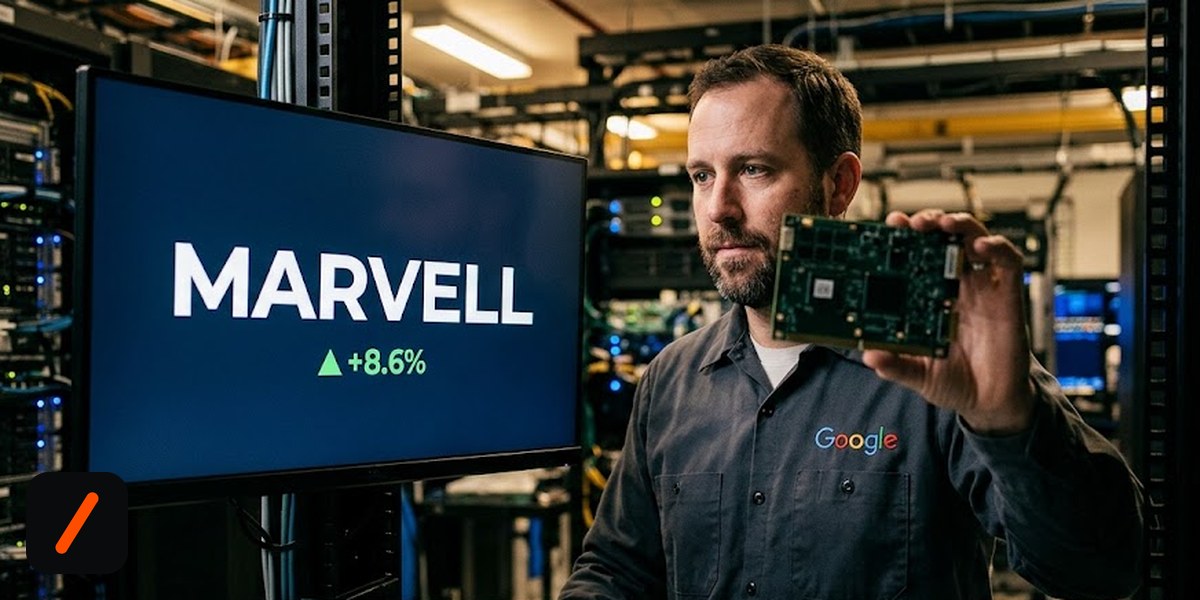
Marvell just handed Google the option to become one of its biggest shareholders, without Google spending a dime up front. The chipmaker granted Alphabet a warrant to buy up to $12.2 billion of Marvell stock, nearly 59 million shares at $206.58 each, as the sweetener on an expanded custom silicon supply deal announced August 19.
- The warrant covers up to roughly 58.9 million MRVL shares at a fixed $206.58 apiece, vesting in tranches tied to every $500 million Google spends on Marvell chips.
- About 1.4 million shares are set to vest in year one, a small slice of the total, with the rest depending on future purchase volume.
- If Google exercises the full warrant, it becomes roughly Marvell's fifth-largest shareholder.
- Analysts estimate the underlying purchasing commitment could be worth close to $120 billion in revenue for Marvell through fiscal 2033.
What exactly did Marvell hand over?
The number everyone's repeating is $12.2 billion, but the mechanics matter more than the headline. Marvell issued Alphabet a warrant, essentially a long-dated option, to purchase up to 58.9 million shares of MRVL stock at a fixed price of $206.58 each. That's close to where the stock was trading before the deal was disclosed, so Google isn't getting today's shares at a discount. It's getting the right to buy at that price later, no matter how high Marvell's stock climbs between now and then.
RelatedNvidia Bets $3.5 Billion on MediaTek to Ride the Custom-Chip Wave
The warrant doesn't vest all at once. Shares unlock in tranches, and each tranche is tied to a purchasing milestone: every $500 million Google spends buying chips from Marvell triggers another slice of vested stock. Roughly 1.4 million shares are expected to vest in the first year alone, a small fraction of the total, which tells you the bulk of this deal is a bet on years of sustained purchasing, not a single transaction.
The silicon itself isn't limited to one chip type. The agreement spans processors that run AI models, controllers that manage data storage, and the networking silicon that moves data between servers, all the supporting hardware that sits around Google's TPUs rather than competing with them directly.
Why give away equity instead of just signing a purchase order?
Google could have just signed a supply contract, hyperscalers do that constantly, but handing over the right to buy nearly 59 million shares solves a problem plain contracts don't.
Building out custom silicon capacity, especially the networking and storage chips around a TPU cluster, is expensive and risky for a supplier. Marvell has to commit fab capacity and engineering headcount years before revenue shows up. A warrant tied to purchase volume gives Google a financial incentive to actually follow through, since the stock only vests if the orders happen, and it gives Marvell a committed customer with real skin in the game rather than a contract that could quietly get scaled back. It's a structure borrowed more from startup financing than traditional chip supply deals: Google prepaying for supply certainty using its own stock upside as currency. If Marvell delivers, the warrant becomes valuable. If it stumbles, the shares simply never vest.
Who wins here, and who should be nervous?
Marvell is the obvious winner on paper. Shares jumped 8% to 10% on the news, the market pricing in a validated, multi-year revenue stream from one of the few companies capable of writing a check this size. Analysts have floated a figure near $120 billion in cumulative revenue for Marvell through fiscal 2033 if Google hits its purchase targets, contingent, not guaranteed, but a real signal a top-tier cloud buyer is willing to commit at that scale. Google benefits too, just less visibly: locking in supply for the processors, storage controllers, and networking silicon around its TPUs matters almost as much as the TPUs themselves, since a cluster full of AI accelerators is only as fast as the interconnect and storage moving data between them.
Nvidia should be paying closest attention: every dollar Google spends on Marvell-built silicon is a dollar not spent on general-purpose GPUs, and every hyperscaler locking down its own ASIC supply chain chips at Nvidia's default-choice position. This equity-for-volume structure could become the pitch other chipmakers bring to Amazon, Microsoft, and Meta.
What happens between now and the next earnings call?
The immediate milestone is mundane by design: whether Google keeps buying at the pace needed to hit that first $500 million tranche. Marvell's next few quarterly reports should show whether custom silicon revenue is climbing in line with the warrant's assumptions. The harder question is whether Marvell can build enough capacity to fulfill an order book this large. AI accelerator supply chains are already tight industry-wide, and a deal this size doesn't create new manufacturing capacity out of nothing.
RelatedNvidia's $96.2B Quarter Meets Its First Real Challenger
| Hyperscaler | Chip family | Silicon partner(s) | Primary use |
|---|---|---|---|
| TPU | Broadcom, Marvell (new) | Training and inference, internal plus Cloud TPU customers | |
| Amazon | Trainium / Inferentia | Alchip Technologies | AWS training and inference instances |
| Microsoft | Maia | TSMC foundry, in-house design | Azure AI infrastructure and internal workloads |
| Meta | MTIA | Broadcom | Ranking, recommendation, and inference workloads |
What it means for the stock
For MRVL specifically, the signal for investors is less about the $12.2 billion figure and more about what a warrant structure like this implies. Google put real skin in the game rather than signing a contract that could quietly get scaled back later, and the market treated that as a stronger vote of confidence than a press release, with shares popping 8 to 10 percent the day the deal was disclosed.
What's worth tracking isn't the initial price reaction, that's priced in. It's the mechanics: whether chip orders hit the $500 million tranche thresholds on schedule, whether production capacity keeps pace, and whether the vesting pace accelerates or stalls in future disclosures. A warrant is a contingent claim, not a guarantee: if TPU growth slows or Marvell can't scale output, the $120 billion revenue assumption gets less certain. This is market context, not investment advice.
- Tranche pace. Whether Google's chip purchases keep hitting the $500 million thresholds that unlock each vesting tranche, visible in Marvell's quarterly custom silicon revenue disclosures.
- TPU order volume. Google's own AI infrastructure spending plans, since the warrant's value depends entirely on how much silicon Google actually orders.
- Marvell's production capacity. Whether fab allocation and packaging capacity can scale to meet a multi-year order book this large.
- Nvidia's competitive response. Any pricing, bundling, or partnership moves aimed at slowing the shift toward custom ASICs among hyperscalers.
Our take
Deals like this are becoming the actual shape of the AI infrastructure buildout, more than any single chip launch. Nvidia still dominates general-purpose AI compute, but the hyperscalers with the balance sheets to do so are quietly building parallel supply chains for the silicon Nvidia doesn't make: custom accelerators, and just as importantly, the networking and storage chips that sit alongside them. Marvell has positioned itself as the picks-and-shovels supplier for that second category, and tying a huge equity warrant to purchase volume is a clever way to get paid for absorbing the manufacturing risk.
The number to watch isn't $12.2 billion. It's $500 million, the size of each purchasing tranche that has to actually happen for any of this to vest. Everything else follows from whether Google keeps buying at that pace.
- Financial Bloomberg: Marvell gives Google right to buy up to $12.2B in shares : primary deal reporting
- Financial CNBC: Marvell, Google expand AI chip supply deal : deal terms and market reaction
- Financial Yahoo Finance: Marvell grants Google $12.2B warrant : stock warrant and vesting details
Original analysis by GenZTech Team.