
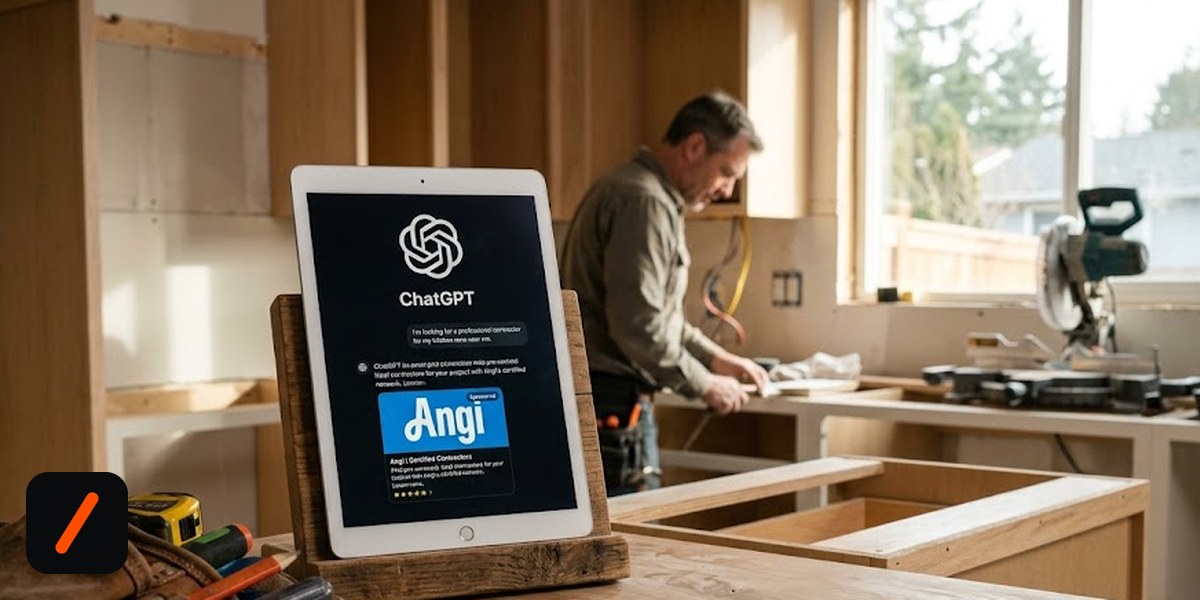
OpenAI is testing a new kind of ChatGPT ad that isn't a banner at all: a labeled "Sponsored" agent that steps into your conversation and offers to keep chatting on a brand's behalf. Home-services marketplace Angi is the first advertiser in the pilot, meaning a ChatGPT user asking about a kitchen remodel could now be handed off, mid-conversation, to an Angi-run AI that walks them toward booking a contractor.
- OpenAI's Sponsored Agent pilot lets an AI agent trained and run by an advertiser appear inside a relevant ChatGPT conversation, clearly labeled "Sponsored," rather than the static ad boxes OpenAI launched in February.
- Angi is the first confirmed partner: its agent can appear when a user discusses a home project, and users can opt to keep talking with it before it hands them into Angi's own service-request flow to find a local pro.
- The pilot follows OpenAI CFO Sarah Friar's September 8 remark that ChatGPT's ad business should look "like Google and Meta had a baby," and lands after the company said its ad revenue hit a $1 billion annualized run rate roughly seven months after ads first went live.
- More than 30 Omnicom Media clients are already part of OpenAI's broader ad pilot program, so Angi is likely the first of several brands to get an agent, not the last.
What did OpenAI actually announce?
OpenAI and Angi confirmed, in an announcement dated today, that Angi is piloting "Sponsored Agents" inside ChatGPT: a new ad unit where a brand's own AI agent, not just a link or a product card, becomes part of the conversation. When a ChatGPT user is discussing a home-improvement topic that Angi is relevant to, an Angi-branded agent can surface as a clearly labeled sponsored experience. The user can choose to engage with it, describe their project in more detail, and get routed into Angi's existing service-request system to be matched with a local professional.
RelatedClaude Cowork vs ChatGPT Work: the agent app war goes mobile
This is distinct from the Angi "app" that already exists inside ChatGPT under OpenAI's apps framework. That app is something a user has to add themselves, the way you'd install a skill. The sponsored agent is different: it can appear unprompted, inside an organic conversation the user was already having, because an advertiser paid to put it there. Angi co-founder Angie Hicks framed it as a natural extension of that existing integration: "With OpenAI's Sponsored Agent pilot, homeowners can go directly from discussing a home project in ChatGPT to connecting with a skilled local pro who can help."
Why is this different from the ads OpenAI already launched?
OpenAI turned on its first ChatGPT ads on February 9, 2026: small, clearly separated sponsored boxes that appeared beneath an answer for logged-in Free and Go-tier users in the US. Paying subscribers on Plus, Pro, Business, Enterprise and Education never saw them. That format is a straightforward evolution of search advertising: OpenAI answers your question, then shows you a labeled sponsored link related to it. You click through to the advertiser's site, the same way you would from a Google search result.
Sponsored agents are a step further into the model itself. Instead of a link out, the ad is a conversational partner that lives inside ChatGPT and keeps the user there. Angi's agent doesn't just tell you Angi exists; it can ask follow-up questions about your kitchen leak, gather the details a contractor would need, and push you into a booking flow, all without the user leaving the chat. That is a fundamentally different ad unit from anything Google or Meta currently sells, because neither of their core products is built around a multi-turn conversation an advertiser can plug an agent into.
What's the mechanism that makes this work?
ChatGPT already supports third-party "apps" that plug into a conversation through OpenAI's apps framework, tools that a developer builds and a user can choose to add, like Angi's existing home-services app. A sponsored agent reuses that same plumbing, but flips who initiates it. Instead of a user deliberately invoking a brand's app, OpenAI's ad-matching system decides, based on the topic of an ongoing conversation, that a paying advertiser's agent is relevant enough to surface on its own, with a visible "Sponsored" label attached so it isn't mistaken for OpenAI's own answer.
OpenAI has been explicit that the underlying model's answers aren't for sale: the company says ads don't influence what ChatGPT tells you, and that advertisers don't get access to the conversation itself, only the fact that a relevant sponsored agent was shown. Whether that separation holds up once dozens of brands are bidding for agent placement inside people's actual conversations is the open question critics keep raising, and it is largely untestable from the outside right now, since OpenAI hasn't published how the relevance-matching or bidding system actually ranks candidates.
Who's affected, and who goes first?
Angi is the confirmed first pilot partner, and the fit is obvious: home-services searches are exactly the kind of high-intent, "I need to hire someone soon" query that converts well, which is also why Angi already built a standalone ChatGPT app earlier this year before signing up for the sponsored-agent pilot. But Angi is very unlikely to be the only brand OpenAI has been testing this with. Omnicom Media, one of the largest ad-buying holding companies, said more than 30 of its clients are already part of OpenAI's wider ad pilot program, which strongly suggests sponsored agents will expand into more verticals (travel, local services, retail) once OpenAI is comfortable with how the Angi pilot performs.
RelatedSalesforce's 7 Named Agentforce Agents Can Work for Weeks
For everyday ChatGPT users on the Free and Go tiers, the practical change is that a "helpful" answer to a home-project question might now come with an AI agent from a company that paid to be there, continuing the conversation. For competitors like Thumbtack or Angi's own rivals in home services, it raises the stakes on getting into OpenAI's ad pilot early, since a sponsored agent placement inside ChatGPT is a genuinely new kind of distribution channel that didn't exist a year ago.
What it means for the market
Angi trades on Nasdaq as ANGI (its parent is IAC-controlled Angi Inc.), and pairing a public company with a first-mover ad placement inside the world's most-used consumer AI product is the kind of signal investors watch even before revenue shows up in a quarterly filing. The bigger read is on OpenAI itself: Sarah Friar's framing of the ad business as "Google and Meta having a baby" at Goldman Sachs' Communacopia+Technology conference on September 8 was already a statement of ambition, and a $1 billion annualized run rate roughly seven months after the February launch shows the basic ad box format scales fast. Sponsored agents are a bet that a conversational ad unit converts at a meaningfully higher rate than a static link, which would justify charging advertisers more per placement, exactly the kind of monetization OpenAI needs as it burns cash on compute and model training. For anyone tracking OpenAI's path toward the kind of revenue that could support its reported valuation, sponsored agents are worth watching as evidence of pricing power, not just a product experiment.
| Ad format | ChatGPT Sponsored Agent | ChatGPT ad box (Feb 2026) | Google Search ads | Meta feed ads |
|---|---|---|---|---|
| What the user sees | A labeled agent that can converse | A labeled link below an answer | A labeled link above/beside results | A labeled post in the feed |
| Does it keep the user in-app? | Yes, the agent chats in ChatGPT | No, click-through to advertiser site | No, click-through | Sometimes (in-app browser) |
| Personalization signal | Live conversation context | Single-turn query context | Search query + profile | Behavioral/profile data |
| First confirmed advertiser | Angi | Undisclosed pilot partners | N/A, mature market | N/A, mature market |
- Feb 9, 2026OpenAI launches its first ChatGPT ads labeled boxes below answers, US, Free/Go tiers only
- Sept 8, 2026CFO Sarah Friar previews a bigger ad ambition "like Google and Meta had a baby," per remarks at Goldman Sachs' Communacopia+Technology conference
- Sept 8, 2026OpenAI's ad business reaches a $1B annualized run rate about seven months after the February launch
- Sept 16, 2026Sponsored Agents pilot goes live with Angi as first partner today's announcement
- NextExpansion to more of Omnicom's 30+ pilot clients expected if the Angi pilot performs
- Disclosure scrutiny. Regulators and consumer advocates will want to know exactly how clearly "Sponsored" is labeled once an agent is actively conversing, not just displayed as a card.
- More categories. Watch for travel, real estate, or retail brands landing their own sponsored agents next, which would confirm this isn't an Angi-specific experiment.
- Conversion data. If OpenAI or Angi publishes any numbers on how sponsored-agent leads compare to Angi's normal channels, that's the real test of whether this format is worth the ad spend.
- Competitive response. Google's Gemini and Perplexity both have their own monetization pressure; a working conversational ad unit at OpenAI raises the chance they test something similar.
Our take
The interesting thing about sponsored agents isn't the ad format itself, it's what OpenAI is signaling about where ChatGPT's business model is headed. A static ad box under an answer is a bolt-on. An agent that can hold its own conversation, gather details, and complete a handoff is a redesign of what "showing an ad" even means inside a chatbot, and it only works because ChatGPT already has hundreds of millions of people treating it as a place to ask real questions about real problems. That's valuable precisely because it's high-trust, which is also why getting the disclosure right matters more here than in a banner ad: if users can't easily tell where OpenAI's answer stops and Angi's pitch starts, the trust that makes ChatGPT useful for this kind of query erodes fast. OpenAI clearly knows this is the tightrope, hence the loud "clearly labeled" language in every statement about the pilot. Whether that labeling holds up as more brands and more agents get added is the thing worth checking back on, not whether the ad revenue grows, because it almost certainly will.
- OfficialOpenAI: Reimagining advertising with AI OpenAI's own announcement of the Sponsored Agent pilot
- OfficialAngi: Among First Brands to Pilot Sponsored Agents in ChatGPT Angi's press release confirming the pilot, with Angie Hicks quote
- ReferenceAngi: ChatGPT marketplace announcement Background on Angi's earlier ChatGPT app integration
Original analysis by GenZTech Team. Source: OpenAI.