
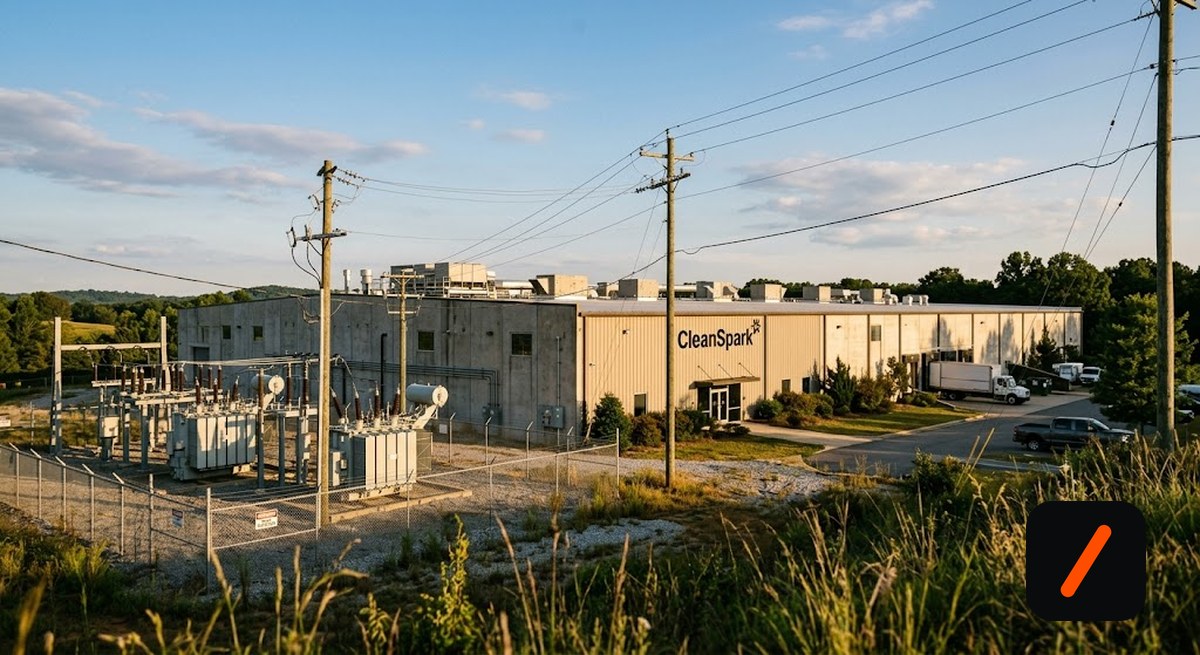
CleanSpark has signed a twenty-year triple-net lease worth roughly $6.6 billion in contracted revenue, rising to as much as $11.6 billion if both five-year extension options are exercised, to hand 175 MW of critical IT load at its Sandersville, Georgia campus to an unnamed investment-grade technology company. The company built that site to mine bitcoin. The real story is not the headline number, it is the conversion: a business whose revenue swung with hashprice just replaced it with a contracted, escalating rent stream, and in doing so stopped being a miner in any meaningful sense.
- Twenty-year triple-net lease with annual escalators, $6.6 billion contracted, up to $11.6 billion with two five-year extensions, for 175 MW of critical IT load.
- Deliveries are expected to begin in Q4 2027, so no revenue arrives for more than a year.
- Management projects nearly 100% cumulative net operating income contribution margin, averaging about $330 million a year once deliveries start.
- A letter of intent grants the same tenant exclusivity over CleanSpark's entire Texas portfolio: 718 acres and up to 885 MW across the Sealy and Brazoria campuses.
What are the actual terms?
CleanSpark announced on July 14, 2026 that it entered a twenty-year infrastructure lease at its Sandersville campus with what it described as a high-investment-grade global technology company. The tenant is not named. The structure is a triple-net lease with annual escalators, covering 175 MW of critical IT load, and the company put contracted revenue at approximately $6.6 billion over the initial term, or up to $11.6 billion including two five-year extension options.
RelatedOracle's Wisconsin AI Campus Now Needs $7B in Collateral
Deliveries are expected to begin in the fourth quarter of 2027. Management projects a cumulative net operating income contribution margin near 100% and average annual NOI of roughly $330 million once deliveries start. Chief executive Matt Schultz called the lease "a transformational moment for CleanSpark as we complete our evolution into a diversified digital infrastructure platform." Shares rose about 10% on the announcement.
The second half of the announcement may matter more than the first. The same tenant executed a letter of intent with exclusivity covering CleanSpark's entire Texas portfolio: 718 acres with up to 885 MW of secured and planned capacity, split across the Sealy campus at 271 acres and nearly 300 MW, and the Brazoria campus at 447 acres with an initial 300 MW demand load expandable to 600 MW. That is a pipeline more than four times the size of the signed deal, controlled by one counterparty.
Why does a triple-net lease change the company this much?
Because it inverts every characteristic of the mining business. A bitcoin miner sells a commodity at spot into a market where its own output is throttled by rising network difficulty and periodically halved by protocol. It carries the power cost, it carries hardware that depreciates on a brutal schedule, and its margin can invert entirely in a drawdown. Forecasting more than a couple of quarters out is guesswork.
A triple-net lease means the tenant, not the landlord, pays operating expenses including power, taxes and maintenance. That is why the near-100% NOI contribution margin figure is plausible rather than promotional: the revenue is rent, and the costs that would normally eat it have been contractually pushed to the tenant. Combine that with a twenty-year term, annual escalators and an investment-grade counterparty, and the cash flow starts to look like an infrastructure asset rather than a commodity producer. Those get valued on multiples of contracted cash flow, not on bitcoin beta.
What is the part being underplayed?
Two things. First, the delivery date. Nothing arrives until Q4 2027, which is more than a year of capital expenditure before the first rent cheque. Converting mining halls to AI data center specification is not a paperwork exercise: it means different power density, different cooling, redundancy the mining business never needed, and network connectivity mining never required. CleanSpark has to fund that build in the interim, and until deliveries start the company still earns like a miner while spending like a developer.
Second, the concentration. One unnamed tenant now accounts for the entire contracted revenue stream and holds exclusivity over the whole Texas pipeline. Investment-grade credit substantially mitigates the risk of non-payment, but it does not mitigate negotiating leverage. A single counterparty controlling both the signed lease and the option on 885 MW more sits in a strong position when the Texas terms are actually negotiated. The market treated the LOI as upside; it is equally a constraint, because those campuses cannot be marketed to anyone else while exclusivity runs.
| Attribute | CleanSpark after the lease | Traditional bitcoin miner |
|---|---|---|
| Revenue basis | Contracted rent, escalating | Spot bitcoin output |
| Who pays power | Tenant | Operator |
| Forecast horizon | 20 years | One to two quarters |
| Halving exposure | None on leased capacity | Direct and recurring |
| Main risk | Execution and tenant concentration | Bitcoin price and difficulty |
| Cash flow starts | Q4 2027 | Immediately |
What it means for the market
CleanSpark trades as CLSK, and the roughly 10% move on announcement understates what happened to the equity's character. A miner is a leveraged bitcoin proxy; investors buy it for beta to the coin. A landlord with twenty-year investment-grade contracted revenue is a different instrument, closer to a data center REIT, and it should attract a different shareholder base while alienating some of the existing one. The signal for investors is to watch whether the multiple re-rates toward infrastructure comparables or stays anchored to mining peers, because that gap is where the value sits.
RelatedGoogle Launches Four TPUs Into Orbit With Project Suncatcher
The broader read applies to the whole listed mining sector. Miners hold something scarce that has nothing to do with bitcoin: energized land with interconnect agreements, in a market where AI power capacity is the binding constraint. This deal prices that optionality. Expect every miner with a decent power pipeline to be revalued on megawatts rather than exahash, and expect more conversion announcements. The risk in that trade is crowding: interconnect queues and construction capacity are finite, and a rush of miners pitching the same hyperscalers will compress terms for whoever signs last.
- Jul 14, 2026Twenty-year Sandersville lease announced $6.6B contracted, shares up ~10%
- Jul 14, 2026Texas LOI and exclusivity signed 718 acres, up to 885 MW
- 2026-2027Conversion build at Sandersville Capex with no lease revenue yet
- Q4 2027First deliveries, rent begins ~$330M average annual NOI
- TBDTexas leases converted from LOI The real test of the thesis
Who is affected?
CleanSpark shareholders most directly, and not all of them favourably: anyone holding CLSK as a bitcoin proxy now owns a construction and leasing business with a 2027 revenue start. Rival miners are affected competitively, since the deal establishes a public benchmark for what energized capacity is worth per megawatt and invites their own boards to ask why they are still mining. Hyperscalers and large AI operators gain a supply channel that sidesteps multi-year interconnect queues, which is the actual scarcity in AI infrastructure right now. And the bitcoin network itself loses committed hashrate capacity over time as more operators convert, though 175 MW alone is not a security concern.
- Tenant identity. The name will eventually surface in filings or permits. It determines how much the market trusts the pipeline.
- Texas conversion. An LOI is not a lease. Converting 885 MW of exclusivity into signed contracts is the whole thesis.
- Conversion capex. Watch the funding plan for the Sandersville build. Cost overruns before Q4 2027 are the most likely way this disappoints.
- Sector copycats. If three or more listed miners announce similar leases within a year, terms for later entrants get worse.
Our take
This is the correct trade for CleanSpark and it should be judged on execution rather than on the headline. Swapping spot commodity exposure for twenty years of escalating investment-grade rent is an unambiguous improvement in cash flow quality, and the near-100% NOI margin is a real consequence of the triple-net structure rather than a projection to be discounted.
What we would not do is treat $11.6 billion as the number that matters. That figure assumes both extension options are exercised more than two decades out. The number that matters is $330 million a year starting in Q4 2027, and even that is contingent on a conversion build the company has not yet completed, funded during a period when it is still exposed to mining economics. The tenant concentration deserves more attention than it received: one counterparty holding both the lease and exclusivity over four times as much capacity has leverage, and the Texas terms will show it. Our read is that the strategic direction is right, the risk has simply moved from bitcoin's price to CleanSpark's project management.
- OfficialCleanSpark investor relations announcement , primary source for all lease terms
- OfficialPR Newswire release, full text , includes the Texas LOI and capacity detail
- ReportingBlockspace: CleanSpark Sandersville lease analysis , independent read on the share move and terms
- ReferenceGenZTech funding tracker , running record of AI infrastructure capital
Original analysis by GenZTech. Lease terms per CleanSpark's official announcement.