
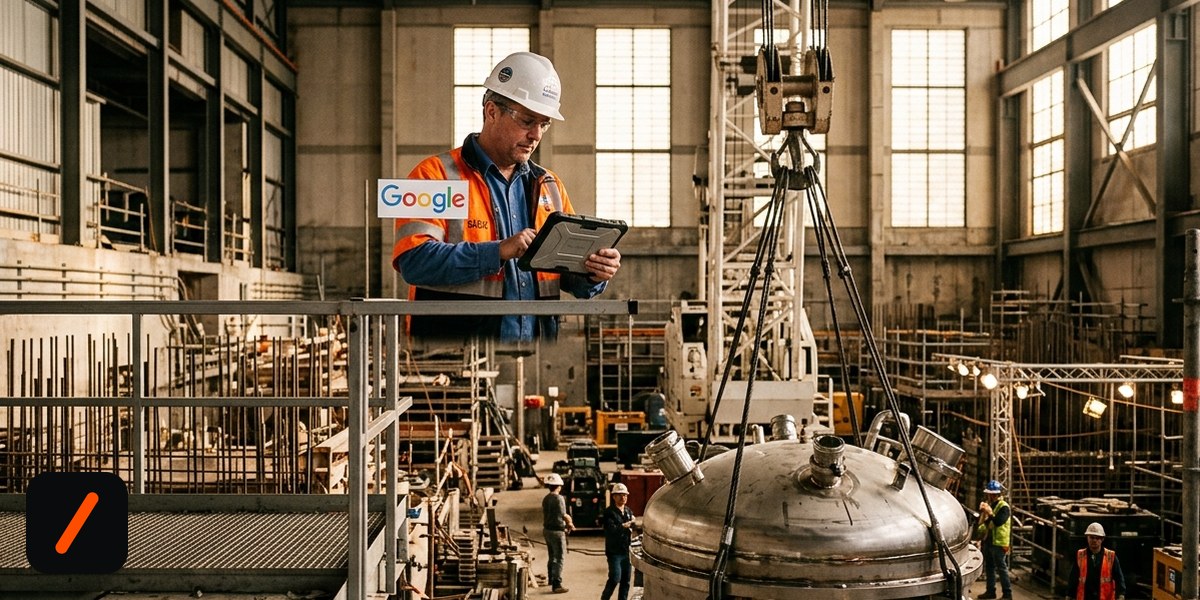
Samsung C&T is putting up to $100 million into Kairos Power, split between $70 million in equity and $30 million in in-kind engineering work, to help build the reactor that is supposed to start feeding Google's data centers by the end of the decade. The money and the labor both point at the same bottleneck: Kairos has a signed customer and a licensed design, but building an actual nuclear plant on a five-year clock is a construction problem as much as a technology one, and construction is exactly what Samsung C&T knows how to do.
- Deal size: up to $100 million, $70M equity plus $30M of engineering services rather than a straight check.
- Target: Hermes 2, a 50-megawatt demonstration reactor at Oak Ridge, Tennessee, aimed at 2030.
- Bigger picture: Google's 2024 agreement with Kairos covers up to 500 megawatts across six or seven reactors by 2035.
- Samsung C&T's pitch is experience, not cash: the firm has built or helped build roughly a dozen reactors worldwide.
Why is a construction conglomerate buying into a nuclear startup?
Kairos Power is a 2016 spinout from work at UC Berkeley, and until recently it was best known for winning an NRC construction permit for Hermes, a low-power, non-electricity test unit that broke ground in 2024. Getting a reactor permitted is one kind of hard. Actually pouring the concrete, welding the piping, and commissioning the salt loops on schedule is a different kind, and it's where a lot of advanced-reactor projects worldwide have quietly slipped by years. Samsung C&T's engineering and construction arm has delivered nuclear projects across multiple countries, and folding that expertise into Hermes 2 as part-payment is a bet that Kairos's design risk is manageable but its execution risk needs outside muscle. The equity slice gives Samsung a stake in whatever comes after Hermes 2, since Kairos still needs to build five or six more reactors to hit the 500-megawatt Google commitment.
RelatedProxima Fusion raises 411M euro for stellarator power
What is actually different about a Kairos reactor?
Most of the coverage of this deal skips the part that makes Kairos worth a $100 million bet in the first place: the reactor design itself. Kairos builds what's called a fluoride salt-cooled high-temperature reactor, KP-FHR for short. Instead of water under enormous pressure, which is how essentially every reactor operating in the United States today cools its core, Kairos circulates a molten fluoride salt at normal atmospheric pressure. That matters because pressure is where a lot of nuclear engineering complexity and cost lives. Remove the need to contain a pressurized water loop and you remove entire categories of pipe-rupture accident scenarios, along with the thick steel and concrete built to survive them.
The fuel is TRISO, tiny uranium kernels wrapped in layers of ceramic and carbon that are individually more heat-resistant than the reactor could plausibly get in an accident. Pack enough of those into pebbles, drop the pebbles into flowing salt, and you get a design its backers describe as walk-away safe: pull the operators out and the reactor cools itself down without melting. None of that is unique to Kairos. X-energy and others are working similar territory. What is specific to Kairos is that it already has an NRC construction permit in hand for a non-power test version, Hermes, which broke ground at Oak Ridge in 2024 and is now under construction. Hermes 2, the version this Samsung money is funding, is the step up to actually generating electricity.
Why does Google need a nuclear reactor at all?
Data centers, specifically the ones full of GPUs, are the reason. Google's electricity demand has climbed fast enough that the company has spent the past two years signing power deals that would have looked exotic five years ago: fusion offtake with Commonwealth Fusion Systems, geothermal with Fervo, and in October 2024 the Kairos agreement itself, Google's first corporate deal for small modular reactor power and one of the first anywhere. The appeal of nuclear specifically is that it runs around the clock regardless of weather, which matches how a data center actually consumes power, unlike solar or wind, which need storage or backup to do the same job. Utilities everywhere are warning that new data center demand is outrunning grid capacity, and hyperscalers have responded by trying to build or buy their own generation rather than wait in a multi-year interconnection queue.
| Company | Google + Kairos | Microsoft | Amazon | Meta |
|---|---|---|---|---|
| Reactor partner | Kairos Power (SMR, new-build) | Constellation (Three Mile Island restart) | Talen / X-energy (SMR) | Constellation (existing fleet) |
| Committed capacity | Up to 500MW | 835MW | Up to 960MW | 1.1GW annually |
| Reactor type | Molten salt, TRISO fuel | Existing pressurized water | Existing + planned SMR | Existing pressurized water |
| Target online | First unit 2030 | 2027 | Existing now, SMR 2030s | Already operating |
What does Samsung actually get out of this?
Samsung C&T is the construction and trading arm of the Samsung Group, not the phone-and-chip Samsung Electronics most readers know, and it trades on the Korea Exchange as a small piece of a much larger conglomerate. Its own reactor-building resume runs through South Korea's domestic APR-1400 program and export projects in the UAE, which is where the "helped build about a dozen reactors" claim comes from. Buying equity in Kairos gets Samsung C&T a foothold in the American advanced-reactor market at a moment when the Trump administration has pushed to speed up NRC licensing and when nearly every hyperscaler is chasing the same scarce pool of experienced nuclear contractors. The in-kind engineering services are arguably the more interesting half of the deal for Kairos: cash is available from plenty of investors, but companies that have actually poured concrete for a working reactor are not, and Kairos needs several of those built in the next nine years to hit its Google commitment.
RelatedPixxel Raises $100M in India's Largest Spacetech Round
What it means for the market
Kairos itself is private, so there's no ticker to trade on this news directly. Samsung C&T sits on the KRX under 028260, and a $100 million commitment is small enough relative to the wider Samsung Group that it will barely register in that stock's own numbers. The more useful read for investors is the pattern this deal confirms: the buildout of AI data center power is turning into its own investable sector, separate from the AI labs themselves. Names like Constellation Energy, NuScale Power, and Oklo have all moved on hyperscaler nuclear headlines this year, and the signal worth watching isn't Google or Samsung, it's whether specialist nuclear construction and fuel-supply firms keep landing contracts as the six other reactors in this specific deal get built. A slip on Hermes 2's 2030 target, which advanced reactors have a well-documented habit of doing, would be the more market-relevant story than the funding announcement itself.
- 2024Google signs its first SMR power agreement with Kairos Power up to 500MW across six to seven reactors by 2035
- 2024Kairos breaks ground on Hermes, a non-power test reactor Oak Ridge, Tennessee
- Nov 2024NRC issues a construction permit tied to the Hermes program clears a path for follow-on units
- May 2025Nuclear construction work begins in earnest at the site per Kairos's own site updates
- Sep 2026Samsung C&T commits up to $100M, equity plus engineering, to Hermes 2 this deal
- 2030Hermes 2 targeted to reach 50MW of electricity output first commercial-scale unit
- 2035Full Google agreement targeted at up to 500MW requires five or six more reactors after Hermes 2
- Hermes construction milestones. Watch for Kairos's own site updates on whether the original Hermes test unit hits criticality on schedule, since any slip there pushes Hermes 2 too.
- More contractor deals. If Samsung C&T's equity-plus-labor structure works, expect Kairos to strike similar deals with other construction firms for the remaining five or six reactors it needs.
- NRC throughput. A wave of SMR applications is now moving through the NRC at once; how fast the agency licenses Hermes 2's follow-on units is a real bottleneck, not a formality.
- Rival hyperscaler responses. Microsoft, Amazon and Meta are all placing different nuclear bets; watch whether any of them follow Google into a pre-commercial SMR design rather than an existing reactor restart.
Our take
The headline number here is small by AI-infrastructure standards, $100 million is a rounding error next to the billion-dollar GPU deals that show up in this space weekly, but the structure of the deal is the actual news. Paying a contractor partly in equity instead of cash is what a capital-constrained but credibility-rich startup does when it needs execution more than money, and it is a reasonable bet for both sides. Samsung C&T gets early exposure to whichever advanced-reactor design ends up winning the American SMR race, and Kairos gets a partner who has actually built the thing before instead of another investor who has only modeled it in a spreadsheet. The risk sits entirely on the 2030 date. Advanced reactor projects, across basically every company that has tried one, have a track record of slipping years past their original targets, and Google's data center power needs are not going to wait politely if Hermes 2 does.
- OfficialKairos Power: Google and Kairos Power Partner to Deploy 500 MW the original 2024 agreement
- OfficialGoogle: Advanced nuclear clean energy agreement with Kairos Power Google's own announcement
- ReportingTechCrunch: Kairos Power gets up to $100M from Samsung group first report of the Samsung C&T investment
- ReferenceGenZTech Funding Tracker every funding round we've covered, ranked
Original analysis by GenZTech, based on public filings, company statements and reporting linked above.