
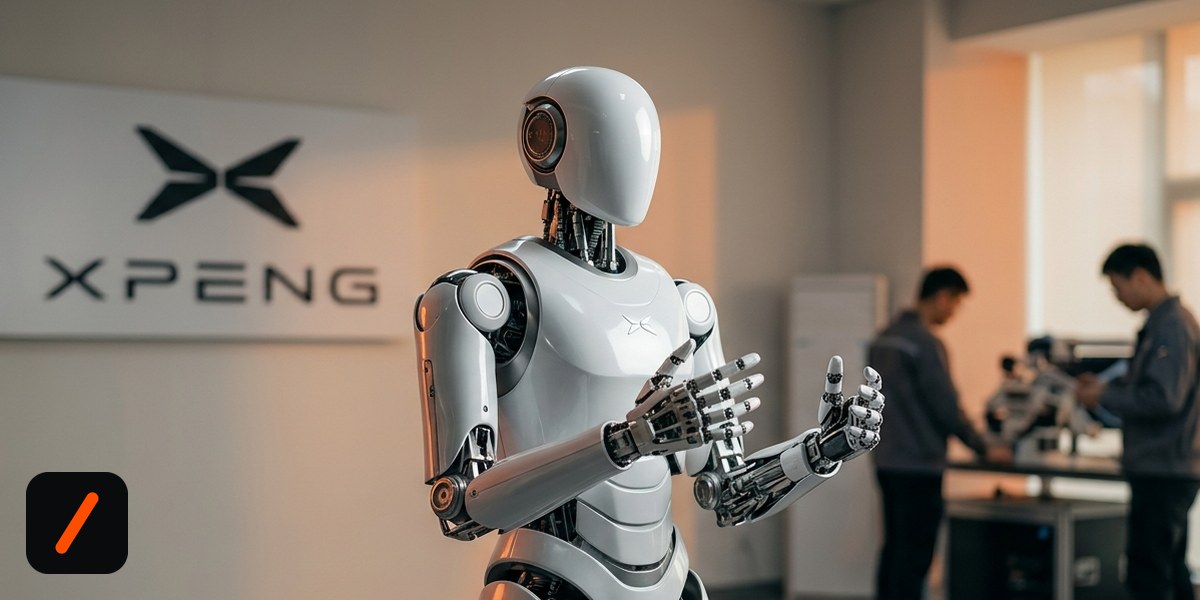
XPeng's robotics unit, Dogotix, has closed a funding round worth more than $900 million at a valuation topping $6.3 billion. XPeng calls it the largest single private funding round any embodied-intelligence company has landed in China so far, and the money is earmarked for one job: getting the company's IRON humanoid robot from prototype to assembly line before the end of 2026.
- Dogotix raised $600 million from outside investors led by IDG Capital, with Gaorong Ventures co-investing and Tencent and Alibaba coming in as strategic backers.
- XPeng itself put in $200 million, and its top executives personally contributed another $100 million, a combined $300 million from insiders alongside the outside capital.
- IRON runs on three of XPeng's own Turing chips for up to 2,250 TOPS of on-device compute, and moves through 76 degrees of freedom in its body plus 21 in each hand.
- Mass production is targeted for the end of 2026, with commercial deliveries in China and overseas markets planned for 2027.
What did XPeng actually raise, and who's writing the checks?
The structure is unusual for a Chinese automaker's robotics arm: $600 million came from outside investors, $200 million came from XPeng's own balance sheet, and $100 million came directly from the pockets of XPeng's top executives, including founder and CEO He Xiaopeng. IDG Capital led the external round, Gaorong Ventures co-invested, and Tencent and Alibaba both joined as strategic investors. Two of China's biggest tech platforms backing the same humanoid robotics spinout, in the same round, is itself a signal about how seriously Beijing's tech establishment is treating the embodied-AI category right now.
RelatedHelion Raised $465M for Fusion, and the Bet Just Got Bigger
XPeng frames the total, over $900 million at a post-money valuation above $6.3 billion, as the largest single private-equity round completed anywhere in China's embodied intelligence sector to date. That's a specific claim worth sitting with: this isn't the biggest robotics raise globally, but XPeng is asserting a domestic record, and the investor list backs up the scale of the claim.
What makes IRON different from a research-lab humanoid?
Most humanoid demos you've seen this year are built around a rigid metal skeleton with exposed joints. IRON uses a proprietary fully enclosed flexible lattice structure instead, a design choice XPeng is betting will matter more once these robots leave the stage and start working around people in stores, warehouses, or homes. Rigid frames are easier to engineer. Enclosed, flexible ones are harder to build and much friendlier to be near.
The compute side is where XPeng is leaning on its car business. IRON carries three of the company's Turing chips, the same silicon lineage XPeng designed for its vehicles, delivering up to 2,250 TOPS of effective on-device computing power. That's the detail that matters most technically: the robot runs its "Physical AI" foundation model locally, not as a cloud-dependent puppet. A humanoid that needs a stable connection to do basic reasoning is a demo. One that can think through its own chips is a product. Add 76 degrees of freedom across the body and 21 in each hand, more than enough to handle fine manipulation tasks, and you get a spec sheet built for real dexterity rather than a scripted stage walk.
He Xiaopeng has described IRON as combining highly human-like design with advanced engineering, though the full context of that remark wasn't available in the materials we reviewed, so we're not quoting it directly here.
Why spin Dogotix out instead of funding it from XPeng's own balance sheet?
XPeng makes electric cars, and electric cars already eat capital for years before they turn a profit. Loading a second capital-intensive bet, humanoid robotics, directly onto the same balance sheet would have forced EV shareholders to underwrite a completely different business with a completely different risk profile and a much longer payoff horizon.
A separate raise solves that cleanly. Dogotix gets its own capital structure, its own valuation, and its own investor base that specifically wants exposure to embodied AI rather than EVs. It also lets XPeng bring in backers who wouldn't otherwise touch a car company. Tencent and Alibaba aren't natural XPeng shareholders. Robotics gave them a door in.
What it means for the stock
Here's the part that complicates the good-news framing: XPeng's US-listed shares, ticker XPEV, fell roughly 6.8% following the announcement, according to Blockonomi. A $900 million validation round at a multibillion-dollar valuation is, on its face, a strong signal. The market didn't read it that way, at least not immediately.
RelatedMistral Raises €3B, Europe's Biggest-Ever Tech Funding Round
A few explanations can coexist without any single one being the full story. Some investors may be pricing in the reality that funding a robotics subsidiary, even one structured to insulate the parent, still represents capital and management attention pulled away from the core EV business at a time when that business needs both. Others may simply be taking profits after a run-up in XPeng shares heading into the announcement. There's also a dilution-optics question: carving out a subsidiary and inviting external ownership into it changes how investors model the parent company's future claim on that unit's upside. The signal for investors here isn't a verdict on whether the robotics bet is sound. It's a reminder that spinning out a capital-hungry new venture, even a well-funded one, doesn't automatically read as good news to a market focused on near-term EV execution.
What happens between now and 2027?
XPeng's own timeline gives this story a clear set of checkpoints. Mass production of IRON is targeted for the end of 2026, with the earliest units deployed inside XPeng's own stores and campuses, essentially a controlled environment where the company can catch failures before customers do. Commercial deliveries, both inside China and in overseas markets, are planned for 2027. That's an aggressive schedule for a robot with this level of on-device compute and mechanical complexity, and it puts XPeng on a collision course with the rest of the 2026 humanoid funding wave, including Figure AI, Unitree, and Tesla's Optimus program, all racing toward commercial deployment on roughly similar timelines.
This round will be tracked on our own Funding Tracker alongside the rest of 2026's embodied-AI raises, and it's a strong candidate for our biggest AI funding rounds list once the dust settles.
Our take
The interesting thing about this raise isn't the dollar figure, it's who signed up for it. IDG Capital leading, Tencent and Alibaba both strategic investors, and XPeng's own leadership putting personal money in alongside the company: that's a lot of independent parties agreeing that on-device Physical AI running on automotive-grade chips is the right architecture bet for humanoid robots, not just a nice-to-have. The flexible lattice structure and the insistence on local compute over cloud dependency suggest XPeng is building for deployment in messy real environments, not for another round of viral demo videos. The stock dip is worth watching, but it says more about how public markets price capital-intensive diversification than it does about whether IRON itself is a good bet. The real test isn't the raise. It's whether XPeng actually ships working units to its own stores on schedule by the end of 2026.
- End-of-2026 mass production milestone. Whether XPeng actually hits its own manufacturing timeline, or slips it the way most hardware roadmaps do.
- In-store deployment results. Early performance data from IRON units working XPeng's own retail floors and campuses will be the first real-world signal, ahead of any customer shipments.
- 2027 overseas delivery plans. Which international markets XPeng targets first, and whether export or regulatory friction slows that rollout.
- Further Dogotix fundraising or spinoff signals. A round this size, with this investor list, often precedes talk of an independent listing further down the line.
- Official XPeng Robotics Business Raises Over US$900 Million : official XPeng press release via PR Newswire
- Reporting XPeng Robot Unit to Raise $900 Million From Likes of Alibaba : Bloomberg
- Reporting XPeng Robotics raises $900M for IRON humanoid at record valuation : Electrek
- Reference GenZTech Funding Tracker : live tracker, this round will be added
Original analysis by GenZTech. Source: XPeng press release.