
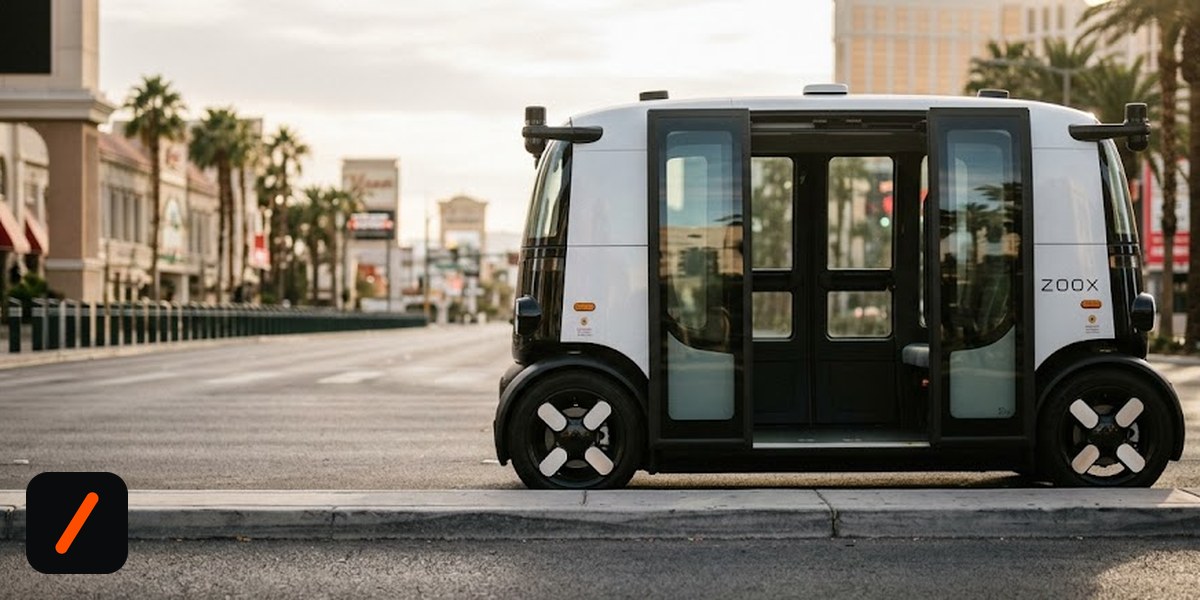
Federal regulators cleared Zoox on Thursday to start charging money for rides in a vehicle with no steering wheel, no pedals and no side mirrors. The National Highway Traffic Safety Administration granted the Amazon-owned company the first commercial Part 555 exemption ever issued for a purpose-built robotaxi, waiving portions of eight federal motor vehicle safety standards. Paid fares begin in Las Vegas next month. The number buried in the grant matters more than the milestone: Zoox may put 2,500 vehicles a year on the road for two years, and its own factory was built for four times that.
Part 555 is the narrow old door in US vehicle law. It lets a manufacturer put a limited run of non-compliant vehicles into service, usually so new technology can be proven on public roads. Nobody had ever walked a driverless passenger pod through it for commercial use. GM asked for one for the Cruise Origin and never got it.
RelatedNevada Clears 7,000 Robotaxis for Tesla, Waymo and Uber
What exactly did NHTSA grant?
The grant is narrower and more conditional than the headlines suggest. Zoox did not get a blanket clearance; it got relief from specific rules, attached to specific promises.
- Relief from portions of eight FMVSS, among them windshield defrosting and defogging, windshield wipers, rear visibility, lighting and light-vehicle braking. Those are the rules written on the assumption that a human sits behind glass and looks out of it.
- A ceiling of 2,500 vehicles per year across a two-year term, so 5,000 units of total headroom.
- Extra reporting duties covering crashes and vehicles that stop inappropriately in the roadway, which has been the single most visible failure mode of driverless fleets in cities.
- Every remote operator supporting the fleet must be physically located in the United States.
- Zoox has to publish maps of the areas where its vehicles actually operate.
NHTSA described the arrangement as an enhanced, adaptable oversight structure that can evolve as the technology does, and said conditions will be adjusted based on how the vehicles behave. Read plainly, that is a regulator keeping a hand on the dial rather than issuing a one-time approval. The remote-operator and published-map conditions are new in kind, and both are aimed at things the agency cannot inspect on a vehicle: who is watching, and where.
Zoox chief executive Aicha Evans said the company was honored to receive the first-ever commercial exemption for a purpose-built robotaxi, calling it another step toward bringing autonomous ride-hailing to more communities. The same day, NHTSA said it is updating the Part 555 process itself to create a more flexible oversight structure for future exemptions.
Why is a 2,500-vehicle cap the real story?
Zoox opened a 220,000 square foot assembly plant in Hayward, California in June 2025, designed to build up to 10,000 robotaxis a year at a peak rate near 100 a week. The exemption authorises a quarter of that annual figure. Across its full two-year run it authorises about six months of a fully ramped line.
That gap is the constraint that will shape the next two years. Robotaxi economics are a utilisation game: fixed cost per vehicle, revenue per vehicle-hour, and you need dense coverage in a city before wait times drop enough for riders to switch from Uber. Waymo crossed roughly 500,000 paid rides a week by late in the first quarter of 2026 and has said it wants a million a week by year end, running a fleet of modified Jaguar I-PACE crossovers across six US cities. Those Jaguars keep their steering wheels, which is precisely why Waymo never needed an exemption and never faced a cap.
Zoox is not chasing Waymo's numbers with 2,500 units a year. It is proving a manufacturing and service model at small scale while the rules underneath it get rewritten.
How did Tesla dodge the same cap?
By refusing to use the door. Tesla vice president of vehicle engineering Lars Moravy has said the Cybercab will not be subject to the 2,500-vehicle annual cap, because Tesla intends to self-certify the vehicle against the standards rather than seek an exemption from them. Cybercab production started at Giga Texas earlier this year.
Self-certification carries no numeric ceiling, which is the whole attraction. It also carries a harder engineering problem, since a vehicle without a brake pedal has to satisfy standards drafted around one. That is why the more consequential regulatory event of the past month was not the Zoox grant at all: NHTSA has a proposed braking rule out that would let compliant vehicles ship without a brake pedal, with the comment window closing in late July. If that rule lands, the exemption route stops being the only path, and the production cap that defines Zoox's next two years stops mattering to anyone who comes after.
RelatedNvidia's $96.2B Quarter Meets Its First Real Challenger
| Zoox | Waymo | Tesla Cybercab | |
|---|---|---|---|
| Vehicle | Purpose-built pod, bidirectional | Modified Jaguar I-PACE | Purpose-built two-seater |
| Steering wheel | None | Yes | None |
| Federal route | Part 555 exemption | Self-certified | Self-certification, per Tesla |
| Annual vehicle cap | 2,500 | None | None claimed |
| Paid rides | Las Vegas, from August 2026 | Yes, roughly 500k per week | Not yet |
| Live cities | Las Vegas, San Francisco | Six US cities | None |
Who can actually book one?
Las Vegas riders first, next month, at a fare. Zoox has been running free rides there and in San Francisco, and the California side stays free for now: paid service in the state needs separate permits from the Public Utilities Commission and the Department of Motor Vehicles, and a federal exemption does nothing to speed those up. Zoox lists Austin, Miami, Atlanta and Los Angeles among its announced next markets.
- Jun 2025Hayward factory opens 220,000 sq ft, designed for 10,000 robotaxis a year
- 2025NHTSA opens an AV exemption pathway framed as accelerating automated vehicle deployment
- 30 Jul 2026First commercial Part 555 exemption granted eight standards waived, 2,500 vehicles a year, two years
- Aug 2026Paid fares begin in Las Vegas first money ever charged for a ride with no steering wheel
- TBDCalifornia paid service blocked until CPUC and DMV permits clear
What it means for the market
Nothing in this grant moves Amazon's numbers. Two thousand five hundred vehicles a year, ramping from a base of dozens, cannot register against a company of Amazon's size, and Zoox has never been a revenue story. What it changes is the option value: Amazon now owns the only company in the US permitted to sell rides in a vehicle built from scratch without human controls, and it owns the factory to build them.
The signal for investors is not the exemption. It is the FMVSS rewrite. An exemption is a permission slip with a number on it; a rewritten standard is a market. Alphabet's Waymo is exposed to the same shift from the opposite direction, since its advantage today partly rests on having chosen a vehicle that never needed permission. Watch the braking rulemaking docket, the pace of Zoox's Las Vegas fare launch, and whether the California permits arrive before the exemption's two-year clock starts looking short.
- The braking rule, not the exemption. If NHTSA finalises a standard that drops the brake-pedal requirement, the 2,500 cap becomes a footnote and self-certification becomes the default path for everyone.
- Fare data from Las Vegas. First paid rides in August give the first real read on price and utilisation for a purpose-built pod, which is the number the whole thesis rests on.
- California permits. San Francisco is Zoox's home market and stays free until the CPUC and DMV act. A long delay there says more about the state of AV regulation than the federal grant does.
- Whether the cap ever binds. Zoox has to actually build past 2,500 a year for the ceiling to hurt. If Hayward stays well under it, the cap was never the constraint and execution was.
Our take
This is a genuine first and it is also a smaller thing than it reads. Zoox now has federal permission to charge for something no company has ever charged for in the US, and it earned that by building a vehicle that could not exist under the rules as written. But the grant is temporary, capped, conditioned on reporting, and quietly outflanked by a competitor that decided to comply with the old rules instead of asking to skip them. The durable win is not the exemption Zoox holds. It is the rulebook rewrite the exemption is a placeholder for, and that fight is happening in a comment docket, not on a road in Las Vegas.
- OfficialNHTSA: exemption grant and Part 555 process update — terms, conditions and oversight structure
- OfficialZoox: NHTSA Part 555 commercial exemption — company statement and launch plan
- ReferenceTechCrunch: Zoox clears final federal hurdle — California permit status
- ReferenceTechCrunch: inside the Hayward robotaxi plant — 10,000-a-year design capacity
Original analysis by GenZTech. Reported first by Engadget.