
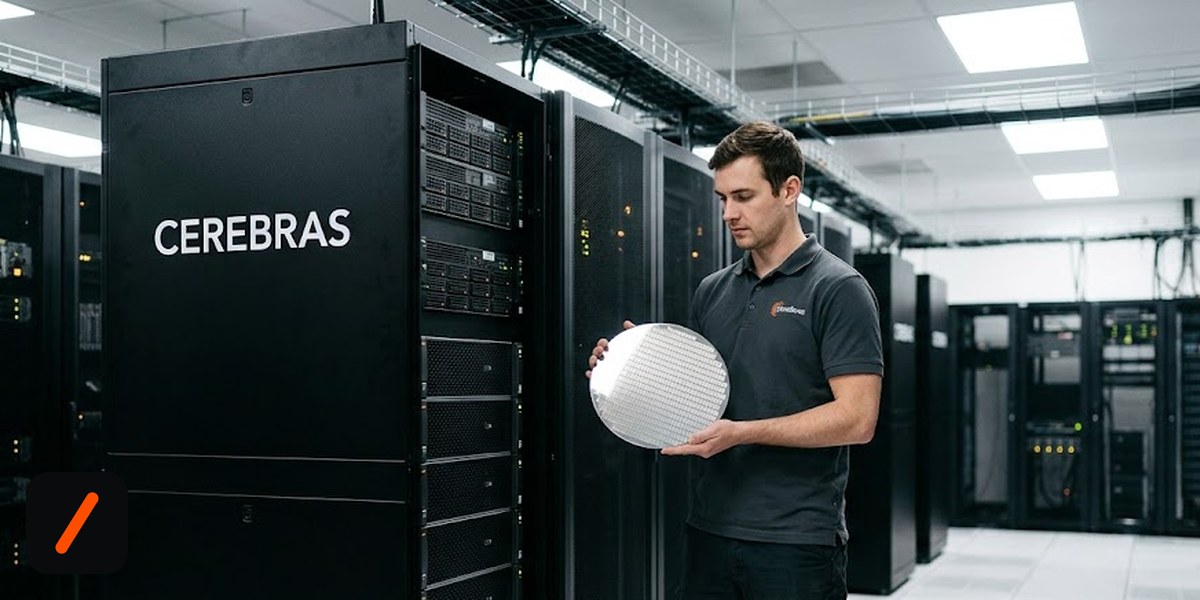
Cerebras Systems announced the CS-4 on August 19, 2026, and the headline number everyone repeats is 750 petaflops of AI compute. The number buried a few paragraphs into most coverage matters more: the silicon inside is identical to what shipped in the CS-3. Same 900,000 cores per wafer, same 4 trillion transistors, same TSMC 5nm process. Cerebras didn't shrink the die. It bolted three of them together.
- The CS-4 is Cerebras' first multi-wafer system, combining three Wafer Scale Engine 3 Turbo processors in a single rack rather than shipping a new chip generation.
- Each wafer still carries 4 trillion transistors, 900,000 cores and 44 GB of on-wafer SRAM on TSMC's 5nm node, unchanged from the CS-3.
- A new interconnect layer called Nexus links the three wafers with latency as low as 2 microseconds, which is the actual engineering achievement here.
- Cerebras claims up to 30x the tokens per second per user of GPU-based inference systems and up to 10x the performance per watt of the CS-3. Both are vendor figures, not independently measured.
That distinction matters because it tells you where the real bottleneck in AI inference sits right now, and what to expect from the next CS-5.
RelatedAMD Names Zen 7 and Zen 8, Locking Its Server Plan to 2030
What actually changed between CS-3 and CS-4?
Nothing at the transistor level. The WSE-3 Turbo wafer anchoring the CS-4 is the same part Cerebras already ships. What's new is Nexus, the interconnect and platform layer that lets three wafers act as one coherent system instead of three machines bolted to a switch. Cerebras frames the 2 microsecond wafer-to-wafer hop as the number that unlocks the rest: 750 PFLOPS aggregate compute, 7.2 Tb/s of I/O, 129.6 PB/s of combined memory bandwidth. None of that required a new chip. It required three existing chips talking fast enough that the seams stop mattering, a packaging story rather than a Moore's Law one.
Why does memory bandwidth matter more than raw compute here?
For a single user waiting on tokens, the bottleneck usually isn't floating point throughput, it's how fast weights move from memory to the cores doing the math. GPUs pair compute dies with HBM stacks reached over a package interconnect, and that hop is where inference latency piles up. Cerebras keeps 44 GB of SRAM directly on each wafer, next to the cores using it, which is why the company can claim large per-user throughput gains on models that fit. The catch is capacity: 44 GB per wafer is tiny next to frontier model weights, which is exactly why a single WSE-3 Turbo was never going to be the whole story. Three wafers roughly triples the on-chip SRAM, and the 2 microsecond hop is what lets Cerebras treat that as one memory pool instead of three, supporting models it says can run past 50 trillion parameters.
How does this compare to Nvidia's rack-scale approach?
Nvidia keeps GPUs as the compute unit and scales their count per rack, linking them with NVLink inside a node and InfiniBand or Ethernet across nodes. It works, and it's why Nvidia dominates training and inference infrastructure today. But every GPU-to-GPU hop and every hop out to HBM adds latency a wafer-scale chip skips. Cerebras is betting fewer, larger surfaces on a purpose-built fabric beat many small ones on general-purpose networking, at least for serving tokens fast to one user.
| Axis | CS-4 | CS-3 | Typical GPU rack |
|---|---|---|---|
| Compute unit | 3x WSE-3 Turbo wafers, one rack | 1x WSE-3 wafer | Dozens of separate GPU dies |
| Process node | TSMC 5nm, unchanged | TSMC 5nm | Varies by vendor and generation |
| On-chip memory | 44 GB SRAM per wafer, on-wafer | 44 GB SRAM, on-wafer | HBM stacked off-die, package-level |
| Aggregate memory bandwidth | 129.6 PB/s claimed | Single-wafer bandwidth only | Bounded by per-GPU HBM plus interconnect |
| Chip-to-chip latency | As low as 2 microseconds via Nexus | Not applicable, single die | NVLink and InfiniBand hops add up |
| Vendor throughput claim | Up to 30x tokens/sec/user vs GPU systems | Baseline for CS-4's 10x claim | Reference point in Cerebras' marketing |
| Availability | First shipments this quarter | Shipping | Shipping |
Should the 30x and 10x numbers be trusted as is?
Not without independent verification, and Cerebras hasn't published third-party benchmarks with the announcement. The 30x tokens-per-second-per-user figure and the 10x perf-per-watt figure are numbers Cerebras chose itself, tied to workloads and comparisons the company selected. "Up to" is doing real work: it describes a ceiling under favorable conditions, not an average. The 2 microsecond latency and the 750 PFLOPS, 7.2 Tb/s, and 129.6 PB/s specs are architectural numbers that follow from the hardware design, a different category of claim than a multiplier measured against a rival's system under undisclosed conditions.
What it means for the market
Nvidia still owns inference incumbency. Most production LLM serving runs on Nvidia GPUs, and the installed base, the CUDA ecosystem, and Nvidia's own rack-scale systems make switching costly for large buyers. Cerebras is private, so there's no public stock to point at, but the CS-4 targets exactly the part of the market Nvidia dominates: inference serving, not training. Training tolerates latency in ways real-time chat and agent workloads don't, and that gap is what Cerebras is pushing on with a wafer-scale architecture instead of a GPU cluster.
RelatedApple's Mac Mini Gets the First M6 Chip, Built for On-Device AI
The signal for investors is that inference-serving economics, cost per token and latency per user, is becoming a competitive front of its own, not an afterthought to training capacity. A credible non-GPU challenger there, even a private one with no shares to trade, changes how durable Nvidia's inference lead looks. This is analysis of where pressure is building, not investment advice.
Our take
Read the CS-4 launch as proof Cerebras ran out of easy wins at the single-wafer level and opened a second front, system-level scale-out, to keep its curve moving. That's not a knock. Getting three huge chips to behave as one memory and compute pool at 2 microsecond latency is a hard systems problem, and if it holds up, the architecture matters more long-term than any one generation's PFLOPS figure. But the marketing blurs two achievements together, letting "2x the performance of CS-3" sit next to "30x the tokens per second of GPU systems" as if measured the same way. They weren't. One follows from tripling wafer count. The other is Cerebras' own comparison against unspecified rivals. Wait for independent numbers before calling either settled.
- Independent benchmarks. No third party has verified the 30x or 10x claims yet.
- First shipment customers. Cerebras says shipments begin this quarter. Who deploys first, and for what workload, matters more than the spec sheet.
- Whether Nexus scales past three wafers. The 2 microsecond hop works at three. Whether it holds at larger clusters decides if this keeps pace with 50 trillion parameter models.
- Nvidia's answer on latency. If Cerebras' throughput claims hold up, expect Nvidia's next rack-scale platform to attack GPU-to-GPU and GPU-to-HBM latency harder.
- OfficialCerebras introduces CS-4 with 750 PFLOPS of AI compute press wire, full specs
- AnalysisCerebras CS-4 wafer-scale AI inference system flags the chip isn't new
- ReferenceCerebras launches CS-4 for faster AI inference specs and timing
- OfficialCerebras Systems company site
- BenchmarkGenZTech AI coding leaderboard our live tracker
Original analysis by GenZTech. External links open in a new tab and are provided for source verification, not endorsement.