
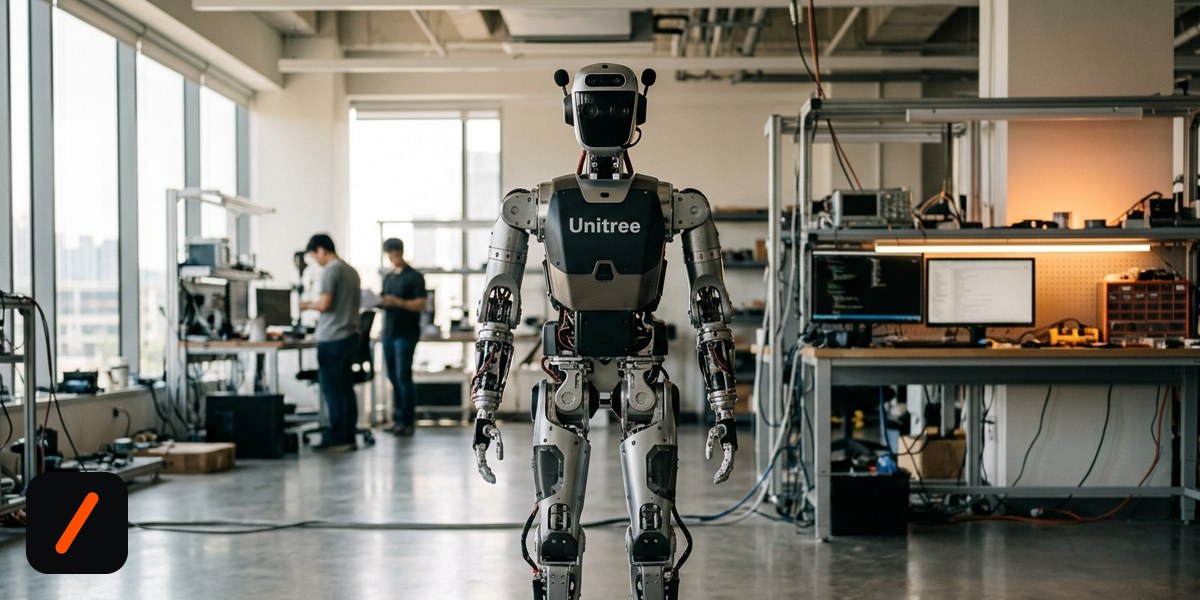
The FCC added foreign-made humanoid robots, quadruped robots and power inverters to its Covered List on July 29, which blocks new equipment authorizations and therefore new imports. China's commerce ministry threatened countermeasures the following day, saying the move "severely damages China-U.S. economic and trade stability" and urging Washington to withdraw it. Chairman Brendan Carr framed the action as securing "America's critical supply chains."
The number that decides whether this policy works is not the 85% market share everyone is quoting. It is 15,000, the approximate total of humanoid robots shipped worldwide in 2025. This is a ban on a market that has barely started, which makes it either unusually well-timed or unusually premature depending on how fast you think the category scales.
RelatedChinese DRAM Quietly Ships Inside HP and Asus Laptops
What the FCC actually did
The Covered List is not a tariff and not an export control. It is the FCC's roster of equipment deemed an unacceptable national-security risk, and landing on it means the Commission will not issue new equipment authorizations. Without an authorization, a radio-emitting device cannot legally be imported or marketed in the United States. Nearly every humanoid and quadruped robot has Wi-Fi, so nearly every one falls under that gate.
Three things follow from the mechanism, and coverage has mostly skipped them:
- Existing devices keep working. The listing blocks new authorizations, so robots already deployed in American warehouses and labs are unaffected.
- Previously approved models can still be sold. The restriction attaches to new versions, which means a Chinese maker's current catalog has a grace period that its next product does not.
- Power inverters were added in the same action. That is a far larger existing market than robots, covering solar installations, data centers and household appliances, and it will produce the near-term economic friction.
The determination came from a White House-convened interagency body, which warned that internet-connected robots carry data-privacy and cybersecurity exposure. That framing matters: the stated risk is the sensors and the network stack, not the actuators.
The shipment math nobody is citing
Unitree and AGIBOT each moved more than 5,000 humanoids in 2025. Tesla and Figure AI, the two American programs with the most attention and the most capital, each shipped a few hundred units or fewer. The 85% share figure is real, but it describes a market where the absolute volumes are still closer to a pilot program than an industry.
| Maker | 2025 units | Origin | Import status |
|---|---|---|---|
| Unitree | 5,000+ | China | New models blocked |
| AGIBOT | 5,000+ | China | New models blocked |
| Tesla | A few hundred or fewer | US | Unaffected |
| Figure AI | A few hundred or fewer | US | Unaffected |
Read that table as an industrial-policy bet rather than a market intervention. Blocking imports at 15,000 units a year costs American buyers very little today, because almost nobody has bought one. The wager is that domestic manufacturers can reach volume before the protected market matures, and that the protection is what buys them the runway.
The complication sitting in the middle of that bet is Nvidia, which published a humanoid reference design built on a Unitree chassis. American robotics work has been prototyping on Chinese hardware because Chinese hardware is what exists at a workable price. A ban on new imports raises the cost of the research that the policy is meant to accelerate.
What it means for the market
The investor read here is narrower than the headlines suggest. Tesla and Figure AI gain a protected domestic market, but neither is currently supply-constrained by competition, so the near-term revenue effect is close to zero. The category is pre-revenue for both. What changes is the terminal-value story, and that is why the announcement moves sentiment more than fundamentals.
RelatedHuawei, Cambricon Hike AI Chip Prices as HBM Squeeze Bites
The concrete exposure is in power inverters, which shipped in the same order and into a market with real installed volume. Solar developers and data-center builders source inverters from Chinese suppliers at scale, and an authorization freeze on new models there is a supply-chain event with actual near-term cost. Anyone modelling the impact of this FCC action should weight the inverter line far more heavily than the robot line.
The signal for investors is that the humanoid trade is now partly a policy trade. Morgan Stanley projects China's humanoid market alone could reach $15 billion by 2030, and the American companies competing for the equivalent domestic figure now do so behind a regulatory wall. That improves the odds on their long-term share and does nothing for their next four quarters.
- July 29, 2026FCC adds humanoid robots, quadruped robots and power inverters to the Covered List Carr: securing "America's critical supply chains"
- July 30, 2026China's commerce ministry threatens countermeasures Calls the restrictions damaging to trade stability, demands withdrawal
- NextScope of Chinese retaliation Rare earths and robotics components are the obvious levers
Our take
Restricting a category before it has a domestic supply chain is a bet on a timeline, and the timeline is the part nobody has justified publicly. If humanoids stay a 15,000-unit-a-year curiosity through 2028, this costs almost nothing and protects almost nothing. If the category inflects in the next 18 months, American buyers face a hardware gap with no near-term domestic substitute at volume, and American researchers lose the cheap platforms they have been building on.
Beijing's response is worth reading carefully too. The commerce ministry pointed out that it has been restrained on product bans of its own, which is less a complaint than a description of the leverage it has not used yet. China controls a great deal of the upstream input to robotics, from rare earth magnets to actuators, and a retaliation aimed there would hit the American humanoid programs this policy is designed to protect.
- The retaliation target. Whether Beijing goes after components rather than finished goods determines if this helps or hurts Tesla and Figure AI.
- Inverter prices. The real economic bite of this order lands in solar and data-center supply chains, not robotics.
- Research platforms. Watch whether American labs standardizing on Unitree chassis find a substitute, or simply keep running the units they already own.
- OfficialFCC Covered List the equipment-authorization mechanism behind the ban
- ReferencePBS NewsHour: US bans foreign-made humanoid robots shipment figures, named makers, Carr statement
- ReferenceCNBC: China threatens retaliation commerce ministry response, July 30
Original analysis by GenZTech. Shipment and market-share figures via CNN Business.