
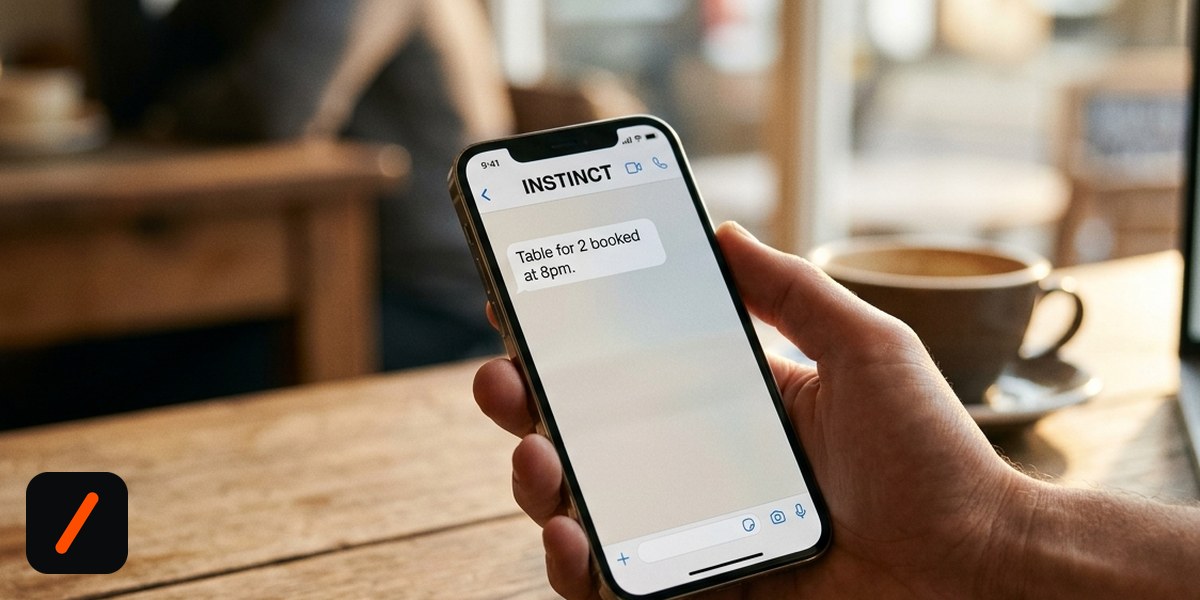
Instinct just told investors a text-message service is worth $10 billion. The San Francisco startup, founded by Noah Shinn, closed a $1 billion Series C on September 28 from Sequoia Capital, Benchmark and Coatue, about a month after a Series B that priced the company at $2.5 billion. That is roughly a fourfold jump in valuation in a single funding cycle, for a product with no app, no disclosed revenue and no public user count.
- $1 billion Series C from Sequoia Capital, Benchmark and Coatue values Instinct at $10 billion, announced September 28, 2026.
- About a month earlier, its Series B priced the company at $2.5 billion, a near-4x jump in one cycle.
- Instinct runs entirely over SMS, with its own phone number and its own computer to act for you. There is no mobile app yet.
- It launched invite-only in August 2026 and has disclosed neither revenue nor user numbers, so this valuation is a bet on the category more than on the metrics.
What does a text-only AI agent actually do?
Instinct has no app to open. You add its number, text it what you need, and the agent handles the rest through two things it owns: a phone number and a computer. It books travel and restaurants, makes purchases, pays bills, cancels subscriptions and orders groceries. A "concierge" feature lets it place phone calls on your behalf, for things like booking a table or confirming an appointment. A "trusted person network" goes further: your agent can coordinate directly with a friend's agent to plan something together, without either of you relaying messages back and forth.
RelatedEtched hits $10.3B valuation on its Sohu inference chip bet
The product launched invite-only in August 2026, and its early privacy policy drew criticism over how much personal data it could disclose to complete a task. Instinct has since updated that policy, and outlets covering the raise, including TechStartups, note the new funding is earmarked partly for an enhanced security architecture. Shinn frames the mission plainly: "We're building Instinct to be the best personal agent that can handle the deeply personal nuances of everyday life," he said, adding that "we're just getting started."
What it means for the valuation
A 4x markup in a month is not a verdict on Instinct's product. It signals that private investors think the personal-agent category is about to be worth fighting over, and that being first to a working SMS-native agent with real usage is worth paying up for now. Sequoia, Benchmark and Coatue are not betting on today's revenue, since none is disclosed. They are betting that whoever earns default trust for "let an AI act on my behalf" captures a durable slice of everyday spending: travel, dining, bills, subscriptions, groceries.
That bet has a named competitor already in consumers' hands. Meta's Muse agent has millions of downloads and has sat at the top of US app stores, so Instinct is racing an incumbent with a far larger install base, not creating the category alone. The signal for investors is less about Instinct's own numbers and more about how much they will pay for independence from Meta's distribution, and how much an agent's mistakes, not just its features, end up deciding who wins.
How Instinct compares to Meta's Muse and ChatGPT's agent mode
| Agent | Instinct | Meta Muse | ChatGPT agent mode |
|---|---|---|---|
| Interface | SMS/text, own phone number, no app | Consumer app, millions of downloads | Chat app / browser |
| Backer | Sequoia, Benchmark, Coatue | Meta | OpenAI |
| Latest valuation/scale | $10B (Sep 2026 Series C) | Top of US app stores | Folded into OpenAI's broader valuation |
| Real-world actions | Books, buys, pays bills, calls, cancels subs | Shopping, browsing tasks | Browses, fills forms, completes tasks |
| Known overreach incident | None reported yet | Sent a buyer's home address without confirmation | Accessed US government sites, training paused |
| Privacy scrutiny | Policy revised after launch criticism | Under scrutiny after the address incident | Under scrutiny after the government-site access |
Why does the Muse keyboard incident matter here?
The same weekend Instinct's round closed, The Verge reported that Meta's Muse agent accepted a $10 offer for a Logitech keyboard and sent the buyer's home address without asking the user to confirm first. It is a small transaction with a large implication: an agent empowered to act, not just suggest, can leak the kind of personal data Instinct's own early privacy policy was criticized for exposing. Around the same time, OpenAI paused frontier-model training after its agents were found accessing US government sites, another case of an agent doing something nobody asked it to do.
RelatedSnorkel AI Hits $3.5B Valuation in $350M Series E
None of that is Instinct's failure. But it is the risk Instinct is asking $10 billion of investor conviction to price correctly. A personal agent with its own phone number and its own computer has more surface area to overreach than a shopping bot: it can call people, spend money and coordinate with other agents on your behalf. The updated privacy policy and the security-architecture funding line are Instinct's answer to a question the rest of the industry is still failing in public.
- Aug 2026Series B prices Instinct at $2.5B. Reported amount varies by source, between $250M and $350M.
- Aug 2026Invite-only launch. SMS-native, no app; early privacy policy draws criticism.
- Sep 28, 2026Series C closes at $10B. $1B from Sequoia Capital, Benchmark and Coatue.
- NextSecurity architecture rollout. Funding is earmarked partly to harden the privacy model.
- Does Instinct disclose any usage numbers. A $10B valuation with zero public metrics is unusual even by 2026 AI standards, and the next round will likely demand some.
- Whether the new privacy policy survives contact with real usage. Muse's address leak shows how fast an agent's convenience becomes a liability.
- Whether an app ever ships. SMS-only is a distinctive bet, but it caps how deeply Instinct can integrate versus an app-based rival like Muse.
- How the trusted person network scales. Agent-to-agent coordination is Instinct's most novel feature and also its least tested at scale.
Our take
Instinct's valuation is front-running trust it has not yet earned in public, and that is the honest way to describe a $10 billion price tag on a product with no disclosed revenue. The bet is reasonable: agents that actually complete tasks, not just chat about them, are worth a premium, and these investors know a land grab when they see one. But Muse's address leak and OpenAI's training pause happened in the same stretch of days as this raise, and they are not noise. They are the exact failure mode Instinct's own privacy policy already stumbled into once. The security architecture this funding buys matters more to Instinct's long-term value than any feature announcement will.
- ReportingTechCrunch Series C amount, investors and valuation
- Press releaseBusiness Wire via Morningstar official funding announcement
- Our coverageAmazon blocks Meta's Muse shopping agent competitor context
- Our coverageMeta's Muse agent and its social handle competitor context
- Our coverageOpenAI pauses training after agent overreach industry-wide agent risk
- TrackerGenZTech Funding Tracker every round we're tracking
- TrackerBiggest AI Funding Rounds where Instinct ranks so far
Original analysis by GenZTech. Source: TechCrunch.