
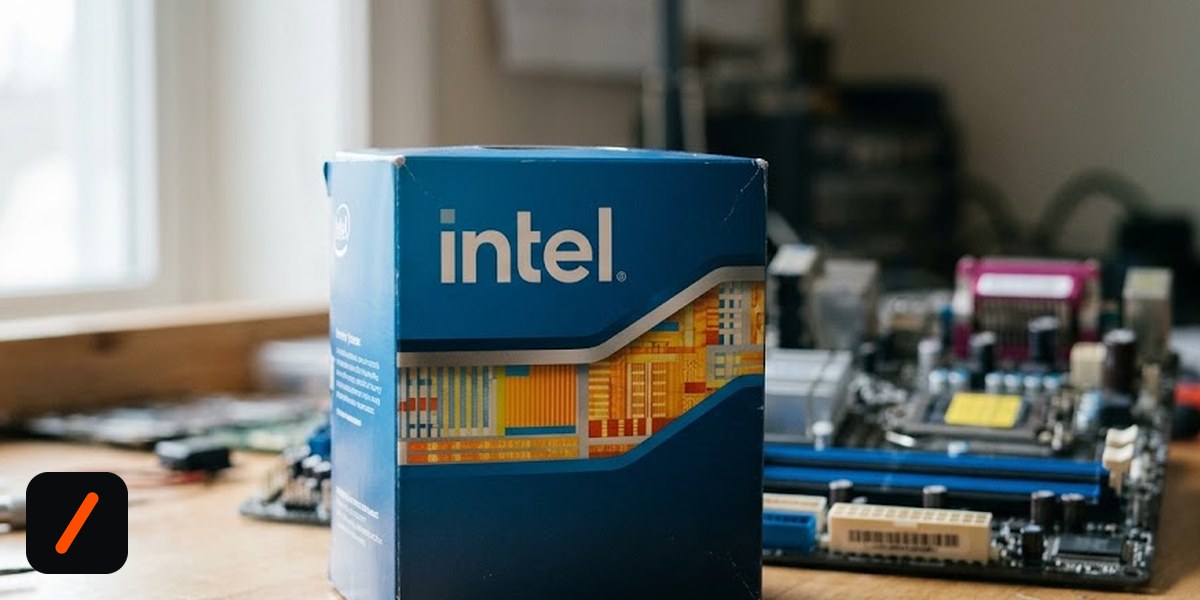
Intel will put its next new CPU core in desktop machines before any data center product ships with it, VP Robert Hallock said in an interview published Saturday, and he aimed the point squarely at AMD. Hallock, who runs Intel's enthusiast business, said the company has a new core "coming to desktop first" and that he hopes enthusiasts do the math on what that means. The core is Coyote Cove, the P-core inside Nova Lake, and the ordering inverts what has quietly become the industry default.
That default is worth spelling out. Server silicon carries the fattest margins, so new architectures increasingly debut there and reach desktops later, already hardened by long qualification cycles. AMD is running that exact play with Zen 6: EPYC Venice took the core to servers in July, with Ryzen parts queued behind it. Intel is reversing the order. The reason is a little less generous than the pitch.
RelatedApple's A20 Pro Is the First 2nm Smartphone Chip
- The claim: Intel's next new core reaches desktop before it reaches the data center, straight from the VP who owns that segment.
- The core: Coyote Cove P-cores paired with Arctic Wolf E-cores, both names Intel confirmed in its own instruction-set reference documentation.
- The server counterpart: Coral Rapids, the data center design built on the newer core generation, is not expected until roughly 2028 to 2029.
- The catch: whoever gets a core first also absorbs first-silicon risk, which is exactly what went wrong for desktop buyers with Arrow Lake.
What did Hallock actually say?
The comment came in a long one-on-one with Tom's Hardware, published alongside the outlet's full transcript. Hallock is Intel's VP and general manager for the enthusiast segment, so this is the executive with direct ownership of desktop, not a spokesperson reading a roadmap slide. He described a new core arriving on desktop ahead of the data center and invited enthusiasts to draw their own conclusion, a barely disguised reference to AMD putting Zen 6 into EPYC Venice before Ryzen.
The same interview covered a lot of ground beyond that line. Hallock addressed the Arrow Lake damage directly, describing the cheap Arrow Lake Refresh pricing as a first step toward rebuilding credibility ahead of Nova Lake. He characterized the PC market as split, with the mainstream segment taking a beating while enthusiast demand holds up, and floated a future where mainstream and enthusiast sockets diverge across the whole industry. He also teased a Raptor Lake Next part aimed at DDR4 platforms, which reads as a budget play for builders who never moved to DDR5.
Why does core debut order matter at all?
Because first silicon is where the errata live. A brand new core arrives with a list of hardware bugs that get papered over in microcode, BIOS updates, and OS scheduler patches over the following months. Server customers rarely feel that. They buy into qualification programs that run for quarters before deployment, on platforms validated by the OEM, with firmware curated by the vendor. Desktop buyers get a retail box and a forum thread.
Intel lived through the ugly version of this in public. Arrow Lake shipped in October 2024 and lost to its own predecessor in a pile of games at launch, then needed months of firmware and Windows scheduling fixes to claw back the deficit. That was a new core and a new memory topology meeting real workloads for the first time, and enthusiasts were the test population. Going desktop-first is a genuine gift in terms of access. It is also a transfer of risk, and the last transfer did not go well.
Is this a strategy or a roadmap artifact?
Here is the part most of the coverage skips. Intel's near-term server chip is Diamond Rapids, and it uses Panther Cove P-cores, not Coyote Cove. The data center design built on the newer core generation is Coral Rapids, and that one sits out around 2028 to 2029, when Intel also plans to bring simultaneous multithreading back to its P-cores after stripping it out of recent client designs.
So the desktop is "first" partly because the server slot for that core generation is simply years away. Both things are true at once: Hallock's statement is accurate, and it describes a schedule as much as a decision. A reader deciding what to buy should weigh the access, not the framing.
| Intel Nova Lake | Intel Diamond Rapids | AMD Zen 6 | |
|---|---|---|---|
| Debut segment | Desktop | Server | Server (EPYC Venice) |
| P-core | Coyote Cove | Panther Cove | Zen 6 |
| Answer to 3D V-Cache | 144MB bLLC, reported K-only | n/a | 3D V-Cache incumbent |
| Socket | LGA1954, reported | server socket | AM5 continues |
| Timing | Late 2026 into 2027 | Ahead of Coral Rapids | Servers 2026, desktop later |
| Confirmation level | Cores confirmed, SKUs leaked | Core confirmed | Shipping in servers |
What is actually confirmed about Nova Lake?
Separate the two piles, because the gap between them is wide. Intel has confirmed the architecture names, Coyote Cove and Arctic Wolf, through its own instruction-set reference documentation, and it has confirmed Nova Lake as the next desktop platform under Core Ultra 400 branding.
Everything else circulating is leak-grade. Reports point to a flagship with up to 52 cores, split as 16 P-cores, 32 E-cores and 4 low-power E-cores, an LGA1954 socket with Z990 boards, Xe3 integrated graphics, and a 144MB big last-level cache restricted to unlocked K parts as Intel's response to AMD's 3D V-Cache. The cache detail is the one worth watching, because reserving it for the expensive tier means the mainstream Nova Lake parts would not carry Intel's gaming trump card at all. None of that is official. Treat it as direction, not specification, until Intel publishes SKUs.
- Oct 2024Arrow Lake launches and regresses in games months of microcode and scheduler fixes follow
- Jul 2026AMD ships EPYC Venice on Zen 6 new core goes to servers first
- Aug 16 2026Hallock says Intel's next core lands on desktop first interview published this weekend
- Late 2026Nova Lake first wave expected Core Ultra 400, LGA1954 reported
- 2027Wider rollout, 52-core flagship reported last Z990 boards at retail
- 2028–2029Coral Rapids brings the newer core to servers SMT returns to P-cores
Who should care right now?
Anyone sitting on LGA1851 should read this as confirmation that the socket is a dead end. Nova Lake is reported to move to LGA1954, which means an Arrow Lake board buys no upgrade path into the new core. That is not a reason to panic, but it is a reason to stop paying a premium for platform longevity on the current socket.
RelatedSnapdragon C specs land, minus the plugged-in benchmarks
Builders shopping this quarter get a cleaner decision than usual. Arrow Lake Refresh is cheap on purpose, by Intel's own admission, and a DDR4-friendly Raptor Lake Next would push that further down the stack. If a machine is needed now, the value is in the outgoing platform. If the goal is the newest core, the wait is measured in quarters, not years, and that is a genuine change from the era when desktops got architectures secondhand.
What it means for the market
Intel's data center and foundry narratives have carried the story for most of this year, while the consumer segment is where it lost mindshare and pricing power. A desktop-first core debut is a cheap way to buy back enthusiast attention relative to what a server tapeout slot costs. The signal to watch for anyone tracking INTC is execution, not cadence: whether Nova Lake actually ships in volume inside the late-2026 window or slides into 2027, and whether the launch reviews read like Arrow Lake's did. A roadmap-order claim is marketing. A clean launch is the thing that would move the segment.
AMD's position is the mirror image and is deliberate. Selling Zen 6 into servers first captures the highest average selling prices while the desktop install base sits on AM5, a socket it has kept alive far longer than Intel has kept any of its own. Letting Intel claim the desktop-first headline costs AMD very little in the near term.
- Ship date discipline. Late 2026 versus a Q1 2027 slip is the single clearest read on whether this is a plan or a slide.
- Where the cache lands. If the 144MB bLLC really is K-only, mainstream Nova Lake parts face AMD's X3D chips without an answer.
- Launch-week stability. The core debuts on desktop, so the first errata reports come from buyers, not from OEM qualification labs.
- The DDR4 tease. A Raptor Lake Next part would signal Intel is defending the budget tier rather than conceding it.
Our take
The claim is true, the jab at AMD lands, and it still should not decide anyone's build. Being first to a new core is a privilege that comes with a bill attached, and Intel's own recent history is the best evidence of what that bill looks like. The credibility problem here was never roadmap order. It was what happened the last time a new desktop core met real workloads.
If Nova Lake arrives on time and stable, desktop-first becomes a real structural advantage for Intel, and the enthusiast segment gets something it has not had in years: the newest silicon before the hyperscalers. If it arrives needing two quarters of microcode, the math Hallock invited enthusiasts to do works out the other way, and the next executive doing this interview will be answering for it.
- InterviewTom's Hardware, full 1:1 transcript with Robert Hallock · the primary record of the quotes
- ReportIntel to launch its new core on desktop before the data center · the story as first published
- ReferenceIntel ISA reference doc confirms Nova Lake and Diamond Rapids cores · Coyote Cove, Arctic Wolf, Panther Cove
- Report144MB big last-level cache reported for unlocked Nova Lake parts · the 3D V-Cache answer
- ContextKitGuru on the confirmed core names · independent read of the same doc
- GenZTechAMD put Zen 6 in servers first with EPYC Venice · the cadence Hallock is contrasting against
- GenZTechIntel 18A yields and the Panther Lake ramp · why execution matters more than roadmap order
Original analysis by GenZTech. Reporting and quotes via Tom's Hardware.