
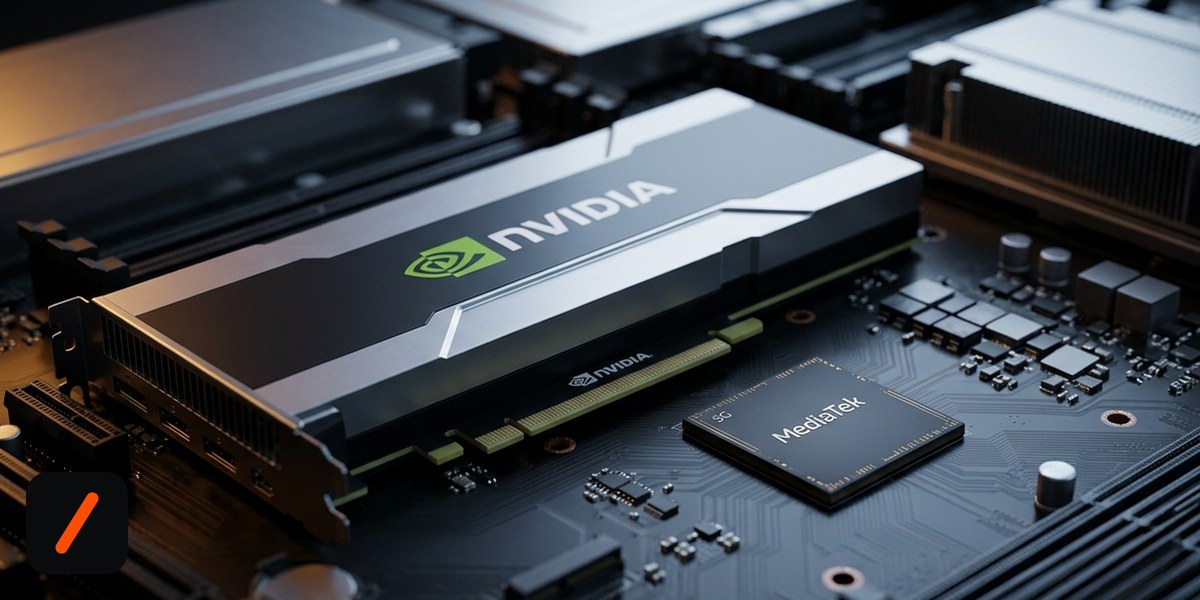
Nvidia is buying $3.5 billion worth of MediaTek convertible bonds, and in exchange MediaTek is adopting Nvidia's NVLink Fusion platform as the foundation for its custom AI accelerator chips. The deal was announced Monday and confirmed in Tuesday trading, when MediaTek shares jumped 10% on the Taiwan Stock Exchange.
- Nvidia is investing $3.5 billion in MediaTek through a convertible bond, and MediaTek will build its custom AI accelerators on NVLink Fusion, the interconnect-plus-memory-plus-packaging stack that lets outside chips plug into Nvidia's data centers.
- MediaTek shares rose 10% on the announcement. The company already expects its custom ASIC design business to generate $2 billion in revenue in 2026, a target it laid out back in June.
- The partnership reaches beyond data centers into PC chips, building on the existing Nvidia RTX Spark and DGX Spark collaboration, and into automotive platforms built around MediaTek's Dimensity line.
- Strategically, the deal is Nvidia's answer to hyperscalers like Google, Amazon, Meta, and Microsoft designing their own AI chips to cut Nvidia dependency. It puts Nvidia inside the custom-silicon trend instead of being sidelined by it.
What Nvidia and MediaTek actually agreed to
The core of the deal is a $3.5 billion convertible bond investment from Nvidia into MediaTek. In return, MediaTek commits its custom silicon roadmap to NVLink Fusion, Nvidia's framework for letting outside companies build chips that connect directly into Nvidia's rack-scale infrastructure rather than competing against it from outside. That's the headline. But the two companies also said they'll keep working together on PC chips, extending a collaboration that already produced the RTX Spark and DGX Spark line, and on automotive platforms built around MediaTek's Dimensity chips, which already power AI features in several car makers' infotainment and driver-assist systems.
RelatedGoogle Can Buy $12.2B of Marvell Stock in New Chip Deal
None of this is MediaTek's first Nvidia collaboration. What's new is the depth of the commitment and the size of the check. A convertible bond isn't a simple stock purchase, it gives Nvidia the option to convert its debt holding into MediaTek equity later, which tells you Nvidia wants a durable stake in how MediaTek's silicon roadmap evolves, not just a one-time partnership announcement.
Why NVLink Fusion is the part that actually matters
NVLink Fusion is not a single product. It's a bundle: Nvidia's high-speed NVLink interconnect, high-bandwidth memory, advanced chip packaging, and the rack-scale integration Nvidia already sells to hyperscalers. Package all of that together and you get a foundation that other companies can build custom silicon on top of, instead of building their own competing stack from the ground up.
That's the pitch to MediaTek and, implicitly, to whoever else Nvidia eventually signs. Design your own ASIC, tune it for whatever workload you care about, and it slots into Nvidia's existing data-center hardware without needing your own interconnect, your own packaging partnerships, or your own rack engineering. For a company like MediaTek that already knows how to design chips but doesn't run its own hyperscale infrastructure, that's a meaningfully lower bar to clear.
The custom-silicon problem this defuses for Nvidia
Google has TPUs. Amazon has Trainium. Microsoft and Meta both have their own AI chip programs in various stages. Every one of those is, in part, an attempt to reduce how much a hyperscaler has to pay Nvidia for GPUs. That trend has been building for years, and it's the single biggest long-term risk to Nvidia's dominance in AI infrastructure: not a competitor beating Nvidia's chips outright, but Nvidia's own biggest customers deciding they'd rather build than buy.
Getting MediaTek onto NVLink Fusion is Nvidia's move to blunt that risk without fighting it head-on. MediaTek brings real ASIC design expertise, the kind hyperscalers want when they commission custom silicon. If MediaTek becomes a go-to partner for building that silicon on top of Nvidia's platform instead of a fully independent one, Nvidia stays central to the AI buildout even as the industry shifts toward custom chips. It's less about stopping the custom-silicon wave and more about riding it.
Who actually benefits: MediaTek's ASIC unit, PCs, and cars
MediaTek has spent the past couple of years building out a custom data-center ASIC design business, separate from its longtime smartphone chip work where it competes directly with Qualcomm. In June, the company said it expects that ASIC unit to bring in $2 billion in revenue in 2026. A $3.5 billion Nvidia investment and a formal NVLink Fusion commitment is about as strong a signal as that business could ask for, both in terms of capital and in terms of credibility with potential hyperscaler customers evaluating who to trust with custom chip design.
RelatedQualcomm bets $4B on Modular to own the AI software stack
The PC and automotive pieces matter too, even if they got less attention than the data-center headline. RTX Spark and DGX Spark already put Nvidia and MediaTek silicon in the same consumer and enterprise PC products. Extending that into automotive, where MediaTek's Dimensity chips are already showing up in AI-powered car platforms, gives Nvidia a foothold in a market it's chased for years without becoming the dominant supplier.
What it means for the market
MediaTek (2454.TW) jumped 10% on the announcement, a big single-day move for a company of its size. Nvidia (NASDAQ: NVDA) barely moved, which makes sense given the deal is a rounding error relative to Nvidia's balance sheet but a meaningful capital infusion and strategic validation for MediaTek. The signal for investors watching this space isn't about either stock's short-term price action. It's about what the deal says regarding Nvidia's platform position: a company with real ASIC design chops and its own stated $2 billion 2026 revenue target for custom silicon just chose to build inside Nvidia's ecosystem rather than around it. That's a data point in favor of Nvidia staying relevant as the custom-chip era matures, not proof that the threat has gone away. None of this is investment advice, just a read on what changed and why the market reacted the way it did.
| Approach | Who | Relationship to Nvidia |
|---|---|---|
| NVLink Fusion partner | MediaTek (data-center ASICs, plus PC and automotive chips) | Builds on Nvidia's interconnect, HBM, and packaging stack; plugs directly into Nvidia racks |
| Independent custom silicon | Google TPU (built with Broadcom) | Fully separate stack, no NVLink dependency |
| Independent custom silicon | Amazon Trainium (built with Marvell/Annapurna Labs) | Fully separate stack, no NVLink dependency |
| Independent custom silicon | AMD Instinct (Infinity Fabric) | Its own interconnect and GPU roadmap, entirely outside Nvidia's platform |
Our take
The interesting part of this deal isn't the dollar figure, it's the mechanism. Nvidia isn't trying to out-engineer every hyperscaler's internal chip team, and it isn't trying to litigate its way out of the custom-silicon trend either. It's buying its way into being the substrate that custom silicon gets built on, one design partner at a time, using convertible debt as the tool to make sure the relationship sticks around longer than a press release. That's a smart hedge if it works. The risk is that MediaTek's hyperscaler customers, the ones actually deciding whether to build TPU-style chips or NVLink Fusion chips, don't care much who MediaTek's silicon partner is as long as the price and performance are right. Nvidia bought itself a seat at that table. It didn't buy the outcome.
- Whether other chip designers follow MediaTek onto NVLink Fusion in the next year. One partner is a bet, several partners is a platform.
- Whether MediaTek's ASIC unit actually clears its own $2 billion 2026 revenue target, since that's the company's own forecast and the clearest scoreboard for whether this bet pays off.
- Whether Google, Amazon, Meta, and Microsoft keep expanding fully independent chip programs regardless, since none of them are the ones who signed up for NVLink Fusion here.
- ReportingTechCrunch: Nvidia's $3.5B MediaTek bet reveals its plan for tackling Big Tech's AI chip buildout
- ReportingCNBC: Nvidia deal sends MediaTek shares higher
- ReportingTom's Hardware: Nvidia pours $3.5 billion into MediaTek, company will adopt NVLink Fusion
- ReportingYahoo Finance: Nvidia invests $3.5 billion in MediaTek
- ReportingTaipei Times: Nvidia, MediaTek deal coverage
Original analysis by GenZTech on what the Nvidia-MediaTek deal actually changes, built on reporting from TechCrunch, CNBC, Tom's Hardware, Yahoo Finance, and Taipei Times.