
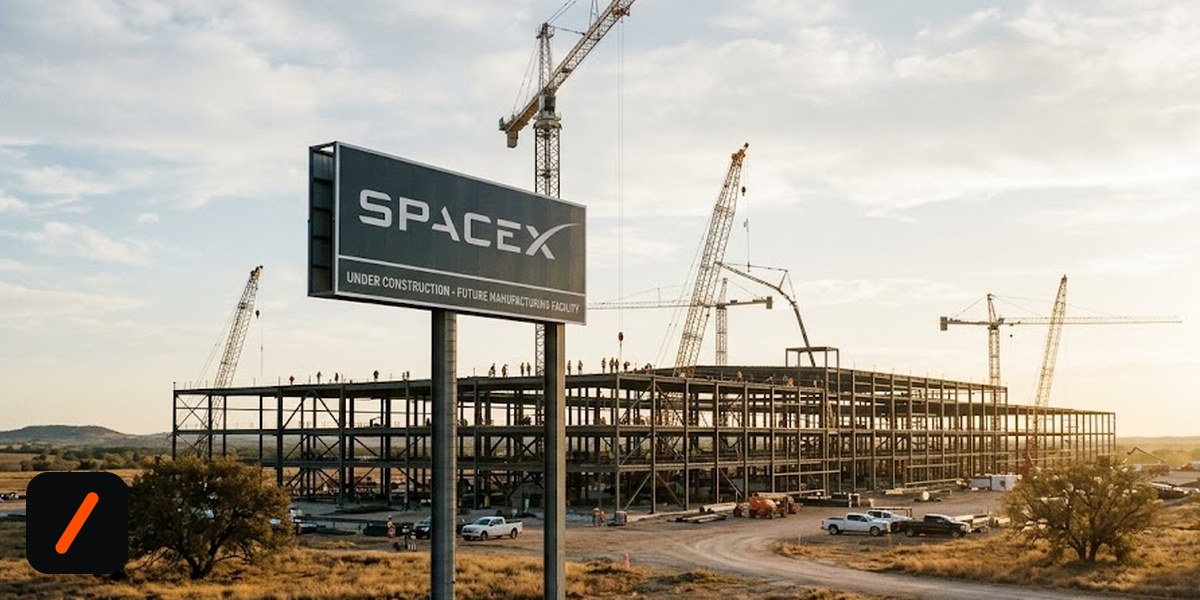
SpaceX and Tesla said this morning they will put $16.8 billion into Terafab, a semiconductor plant in Grimes County, Texas that the two companies will build and operate together. The confirmation came shortly after 8:20 a.m. Pacific, and the figure is the opening tranche rather than the price tag: a SpaceX filing from May put the full multi-phase build at up to $119 billion.
What separates this from the last four years of American fab announcements is who the customer is. TSMC in Arizona and Samsung in Taylor are adding capacity to sell to whoever books it. Terafab is being built to feed two companies that already know precisely what they want out of it and cannot buy enough of it anywhere else. Elon Musk, who runs both, called the result "the largest and most valuable building on Earth by far."
RelatedNVIDIA and SK Group Unveil $500B Korea AI Buildout
What did SpaceX and Tesla actually commit to?
The announced scope is unusually specific for a project this early:
- $16.8 billion as the initial investment, in Grimes County, roughly an hour northwest of Houston.
- More than 100 million square feet of manufacturing space across the finished campus.
- At least 3,000 workers, drawn from Grimes and neighbouring Brazos County.
- Logic, memory, packaging and test in one building, instead of shuttling wafers between a foundry, a memory supplier and an assembly house on three continents.
That last point is the technically interesting one, and most of today's coverage skated past it. Vertical integration at a fab is not a marketing line. Advanced packaging is currently the tightest bottleneck in the industry, and it sits in a different building, owned by a different company, from where the logic die is made.
Why build a fab instead of just buying capacity?
Because the capacity is not for sale on the terms Musk needs. Tesla wants inference silicon for Optimus and the Cybercab in volumes that do not exist yet. SpaceX wants high-power parts for orbital data centers, a workload with thermal and radiation constraints no merchant part is designed around. Musk has said the long-run target is one million wafer starts per month, producing 100 to 200 billion custom AI and memory chips a year at full scale.
Set that against what buying looks like right now. We covered TSMC raising wafer prices because it can, and Intel fighting to get 18A yields to a point where Foundry is credible. A customer at Tesla's projected volume is a price taker in that market, waiting in a queue behind Apple and Nvidia. Owning the line converts an unpredictable input cost into a capital expense you control.
| Terafab | Merchant foundry | Classic IDM | |
|---|---|---|---|
| Who it serves | Two owners, by design | Any paying customer | Mostly itself, some external |
| Scope on one site | Logic, memory, packaging, test | Wafers only, packaging elsewhere | Logic and packaging, rarely memory |
| Process | Intel 14A, per Musk | In-house node | In-house node |
| Capacity risk | Owner absorbs it | Spread across a customer book | Owner absorbs it |
| Why it exists | Supply it cannot buy | Sell wafers at margin | Control its own roadmap |
What does Intel get out of this?
Intel has joined the project, and Musk has said the fab will run Intel's 14A process, though the exact structure of Intel's role has not been spelled out. For Intel Foundry the logic is easy to read: it has spent three years looking for an anchor customer large enough to justify a leading-edge node, and a captive buyer planning a million wafer starts a month is a considerably better answer than another evaluation agreement. Whether Intel is contributing process licensing, equipment, staff, or equity is the detail worth chasing over the next few weeks.
- May 6, 2026SpaceX filing surfaces Multi-phase build costed at up to $119B
- Jun 4, 2026Grimes County approves Commissioners vote 4 to 1 for the incentive package
- Jun 22, 2026Agreement signed SpaceX CFO Bret Johnsen binds $5B by 2030, 1,800 jobs by 2035
- Aug 5, 2026County meeting Residents press on tax breaks and transparency
- Aug 6, 2026$16.8B confirmed Tesla joins as co-investor; construction starts
- 2030First binding checkpoint $5B invested, or the abatement is in question
What does the Grimes County deal actually cost?
This is the part of the story that gets flattened into "Texas lands a fab," and it deserves better. Commissioners granted a 100 percent property tax abatement over 35 years. In place of property tax, SpaceX pays the county $20 million a year under a payment-in-lieu-of-taxes arrangement, about $700 million over the term.
The binding commitments are much smaller than the headline. The signed June agreement obliges SpaceX to invest at least $5 billion by 2030 and create at least 1,800 full-time jobs by 2035. The $119 billion and the 3,000 jobs are intent. The $5 billion and the 1,800 jobs are the floor a county can actually enforce. Residents raised exactly this at Wednesday's meeting, alongside questions about transparency. SpaceX has committed to draw water from the Gibbons Creek Reservoir rather than local groundwater, which addresses the other standard objection to a fab this size.
RelatedAMD Names Zen 7 and Zen 8, Locking Its Server Plan to 2030
What it means for the market
Intel (INTC) is the most direct listed exposure. A named anchor tenant for 14A is the single strongest signal Intel Foundry has produced since it was carved out, and the market has been pricing Foundry as an open question. Watch for Intel to quantify its role on the next earnings call, because "has agreed to contribute" is not yet a revenue line.
For Tesla (TSLA), the read is capex discipline. Tesla is now co-funding a fab while also funding Optimus production and the robotaxi fleet, and it did not walk through this commitment on a recent earnings call. Shareholders should expect the question. For SpaceX, still private, a $119 billion multi-phase obligation is the kind of item that shapes the next valuation round more than another launch cadence record. This is analysis, not investment advice: the signal to track is whether Intel's role is disclosed in dollars.
- Intel's actual stake. Process licensing and an equity position are very different stories. The next 10-Q should settle it.
- Equipment orders. Litho and deposition bookings are the only honest early tell that construction is real, not announced.
- The 2030 checkpoint. $5 billion is the number that matters legally. Miss it and the 35-year abatement becomes a live political fight.
- Memory on site. If Terafab really co-locates DRAM with logic, it sidesteps the packaging bottleneck that is currently constraining everyone else.
Our take
The scale claims deserve heavy discounting. One million wafer starts a month would make Terafab among the largest fabs on the planet, and Musk's timelines are famously aspirational. But the strategic logic is sound in a way that a lot of vanity megaprojects are not. Tesla and SpaceX have a demand problem no merchant foundry is structured to solve, and the packaging bottleneck is real, expensive and worsening.
The number to hold onto is not $119 billion. It is $5 billion by 2030. That is the only figure anyone has signed, and it is the one that will tell you in four years whether this was a fab or a press release with cranes in front of it.
- OfficialSpaceX updates / company announcement of the Terafab site and investment
- FilingMay filing, up to $119B multi-phase / the cost ceiling behind today's tranche
- GovernmentGrimes County commissioners vote / the 4 to 1 approval and abatement terms
- ReferenceGenZTech AI cost calculator / what captive silicon has to beat on inference cost
Original analysis by GenZTech. Reporting: TechCrunch.